VFW 614
VFW-Fokker
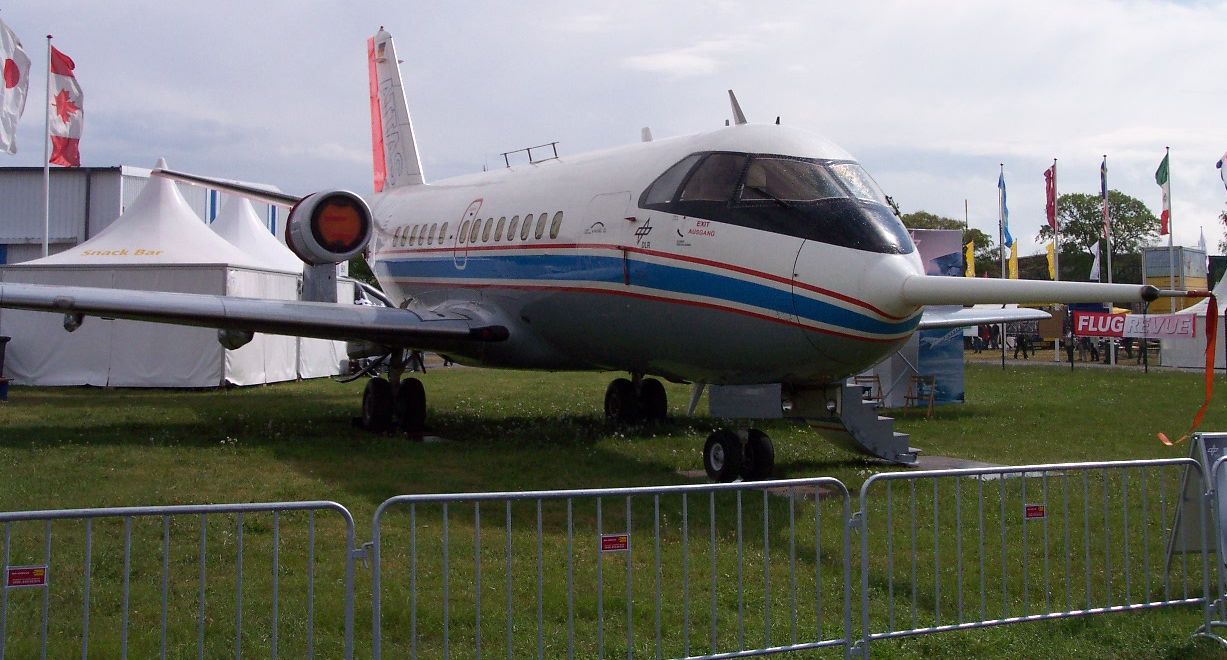
Historical Context & Origins
The VFW-Fokker VFW 614, whose first flight took place on 14 July 1971, was born from an ambitious European need of the 1960s: to develop a modern regional jet, capable of replacing outdated turboprop aircraft such as the DC-3 and the Fokker F27. The goal was to create an efficient aircraft for short-haul routes, operating even from less prepared and shorter runways, a market then dominated by US manufacturers.
The project came to light thanks to a consortium, initially German with VFW (Vereinigte Flugtechnische Werke), which was later joined by the Dutch Fokker. This transnational collaboration was an innovation for its time, aiming to unite European industrial and technological forces to compete in the global civil aviation sector. The idea was to combine the load capacity of a turboprop with the speed and comfort of a jet.
VFW 614 was designed to meet the growing demand for regional air connections, offering a capacity of approximately 40-44 passengers. The choice of a specific powertrain was crucial: the engines had to be quiet, efficient and suitable for the regional operating environment. The solution found was bold and represented a turning point in aeronautical design.
Architecture & Technological Design
The most distinctive and revolutionary feature of VFW 614 lay in its propulsion architecture: the two Rolls-Royce/Snecma M45H turbofan engines were mounted in distinctive nacelles above the wing. This unconventional configuration offered multiple advantages, including increased foreign object protection (FOD) on semi-prepared runways and a significant reduction in noise perceived on the ground, key aspects for a regional aircraft.
The high-wing design also helped improve STOL (Short Take-off and Landing) performance, allowing the aircraft to operate from airports with shorter, less equipped runways. The entire aerodynamics of the aircraft, including its T-shaped empennage, were optimized to ensure stability and control at low speeds, essential for operations on regional routes. The approach was extremely innovative for its time.
The fuselage of the VFW 614 was designed for maximum passenger comfort in a 2+2 layout, offering large spaces for a regional category jet. Although the avionics were cutting edge for the early 1970s, the real technological heart lay in the integration of the engines and wing, a prime example of bold engineering that sought to solve specific operational problems with original solutions.
Onboard Specifications
- ◆Rolls-Royce/Snecma M45H Overwing Engines: The first civil medium bypass ratio turbofans, specifically designed for this aircraft, significantly reducing noise and offering FOD protection.
- ◆High Wing and T-Tail Configuration: Design optimized for high STOL performance and greater stability at low speeds, essential for operations from short and semi-prepared runways.
- ◆Efficient and Comfortable Passenger Cabin: 2+2 layout for 40-44 passengers, designed to offer a superior travel experience compared to turboprops of the time.
Operational Career & Operators
Despite the technical innovation, the operational career of VFW 614 was troubled. The first prototype flew on July 14, 1971, but the program suffered delays and rising costs, culminating in certification in 1974. The oil crisis of the 1970s hit the market hard, making an aircraft with engines that, although innovative, were not the cheapest at the time less attractive.
The main commercial operator was the Danish company Cimber Air, which received the first examples and used them regularly on its regional routes. Other carriers included France's Touraine Air Transport (TAT). The Luftwaffe, the German Air Force, used some VFW 614s for VIP transport and training, confirming the solidity of the basic design, but commercial sales unfortunately remained small.
In total, only 19 examples were produced (including prototypes and pre-series ones) before production ceased in 1977. The VFW 614 found itself competing with more consolidated and more economically advantageous aircraft, such as the Fokker F27 and, later, the British Aerospace BAe 146, which led to its commercial failure despite its engineering qualities.
Legacy & Cultural Impact
The VFW 614 is a classic example of commercial failure but engineering triumph. Despite its market difficulties, the aircraft demonstrated the feasibility and advantages of the overwing engine configuration, an idea that was then taken up, in different forms, by subsequent projects such as the innovative HondaJet. It remains an icon of bold engineering and out-of-the-box thinking.
It was one of the first dedicated regional jets, anticipating a category of aircraft that would become fundamental in modern air transport. Its story highlights the inherent challenges in developing new aircraft, especially when trying to innovate in a competitive and cost-sensitive market. His legacy is that of an unfortunate but visionary pioneer.
Today, several examples of the VFW 614 are preserved in aeronautical museums, such as the Deutsches Museum Flugwerft Schleissheim and the Technik Museum Speyer, testifying to its importance in the history of aviation. Its unmistakable silhouette and history of innovation and resilience continue to fascinate enthusiasts, making it a memorable, albeit brief, chapter in European aeronautical engineering.
Telemetria Specs (HUD)
Hangar Trivia & Curiosità
- 💡Il posizionamento unico dei motori sopra le ali era chiamato design 'Pod-Over-Wing' (POW), che permetteva anche un carrello d'atterraggio più corto e leggero, rendendolo adatto per aeroporti con piste meno preparate.
- 💡Il suo insuccesso commerciale è spesso attribuito alla crisi petrolifera del 1973, che aumentò i costi operativi, alla forte concorrenza e ai presunti elevati requisiti di manutenzione dei suoi motori Rolls-Royce/SNECMA M45H.
- 💡Nonostante una breve carriera commerciale (furono prodotti solo 19 esemplari), diversi VFW 614 furono utilizzati per molti anni dalla Luftwaffe (Aeronautica Tedesca) per trasporto VIP e ruoli di ricerca, dimostrando la robustezza del suo design per compiti specifici.
Archivio Avvistamenti Spotter
Immagini scattate dalla community in tutto il mondo