Vimy Commercial
Vickers
Historical Context & Origins
At the end of World War I, the aviation industry faced a challenging new challenge: converting vast manufacturing capacity and war experience into civilian opportunities. Against this backdrop of profound transformation, Vickers Limited recognized the potential of its famous heavy bomber, the Vimy, to usher in the era of commercial air transport.
The Vickers Vimy, already known for its heroic deeds and pioneering flights such as the first non-stop Atlantic crossing, possessed an inherent robustness and reliability that made it an ideal candidate for civilian reuse. The commercial adaptation, christened Vimy Commercial, made its first flight in 1919, symbolizing an epochal transition from military to passenger use.
This conversion was not a mere readjustment, but a far-sighted vision that aimed to satisfy the emerging demand for fast and efficient connections. The Vimy Commercial represented one of the first real attempts to build an aircraft specifically intended for the transport of passengers and cargo, laying the foundations for future airlines and the entire air transport industry.
Architecture & Technological Design
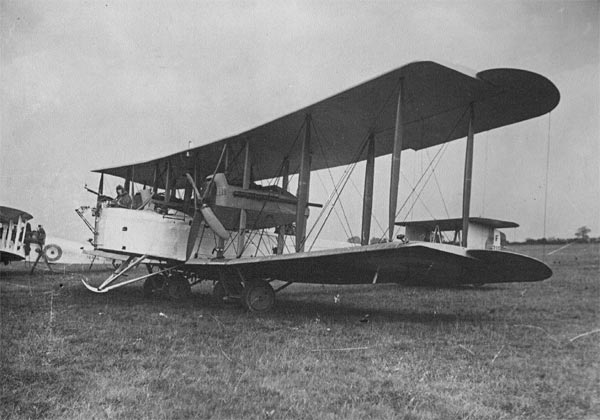
The Vimy Commercial inherited the solid and proven biplane architecture of its military predecessor, characterized by a fabric-covered wooden structure and robust fixed landing gear. However, its internal configuration was radically modified to accommodate civilian needs, introducing significant innovations for passenger comfort.
The front fuselage, where the gunner's position was located in the bomber, was transformed into a closed and partially heated cabin capable of accommodating up to ten passengers. This solution represented an extraordinary luxury in an era when early passenger flights were often exposed to the elements, ensuring a much more comfortable and protected travel experience.
The aircraft was powered by a pair of reliable Rolls-Royce Eagle VIII engines of 360 horsepower each, mounted in nacelles between the wings. This powerful twin-turbine configuration guaranteed not only the thrust needed to transport heavy loads, but also a high level of reliability, crucial for the long and adventurous air routes that were beginning to be explored.
Onboard Specifications
- ◆Enclosed and heated passenger cabin: A fundamental innovation for comfort in an era of often open flights.
- ◆Rolls-Royce Eagle VIII Engines: Two engines with proven reliability and power, essential for heavy transport.
- ◆Extended autonomy and load capacity: It allowed intermediate routes and the efficient transport of goods and passengers.
Operational Career & Operators
The Vickers Vimy Commercial was a true pioneer on the first European air routes, although its operational career was relatively short due to the very rapid evolution of the sector. Fledgling airlines such as Instone Air Line and Handley Page Transport employed it for crucial connections between cities such as London, Paris and Brussels.
These aircraft were instrumental in demonstrating the commercial feasibility of air transport, despite facing all the technical and logistical difficulties of the time. The challenges of primitive navigation, field maintenance, and engine reliability made each flight a feat, but the Vimy Commercial met these obstacles with its inherent ruggedness.
Despite the limited number of examples produced and their withdrawal from service within a few years, the Vimy Commercial played an irreplaceable role in shaping the infrastructure and operational practices of nascent air transport. Each of his flights was a fundamental step towards the normalization and acceptance of air travel as a means of transport.
Legacy & Cultural Impact
The legacy of Vickers Vimy Commercial transcends its brief operational career. It represents a tangible symbol of the transition from military to civil aeronautics, demonstrating that planes could be much more than instruments of war. It was a catalyst for the development of dedicated and more specialized passenger aircraft.
Vimy Commercial has helped establish the credibility and economic potential of air transport, encouraging future investment and innovation. Its enclosed, heated cabin, while rudimentary by today's standards, laid the foundation for the comfort and safety we take for granted when we fly today.
Ultimately, the Vickers Vimy Commercial was not just an aircraft, but a visionary experiment that helped shape the future of civil aviation. Its story reminds us of the audacity and ingenuity of those who, at the dawn of the aeronautical age, dared to dream of a world connected by the sky, laying the foundations for the global aviation industry.
Telemetria Specs (HUD)
Hangar Trivia & Curiosità
- 💡It was a direct commercial conversion of the Vickers Vimy bomber, famous for the first non-stop transatlantic flight in 1919.
- 💡The aircraft featured a large, enclosed cabin, a significant comfort innovation for passengers compared to open cockpits common at the time.
- 💡Primarily used for early airmail services and experimental passenger routes by pioneering airlines in the UK and Europe.
Archivio Avvistamenti Spotter
Immagini scattate dalla community in tutto il mondo