Trident 1C
Hawker Siddeley
Historical Context & Origins
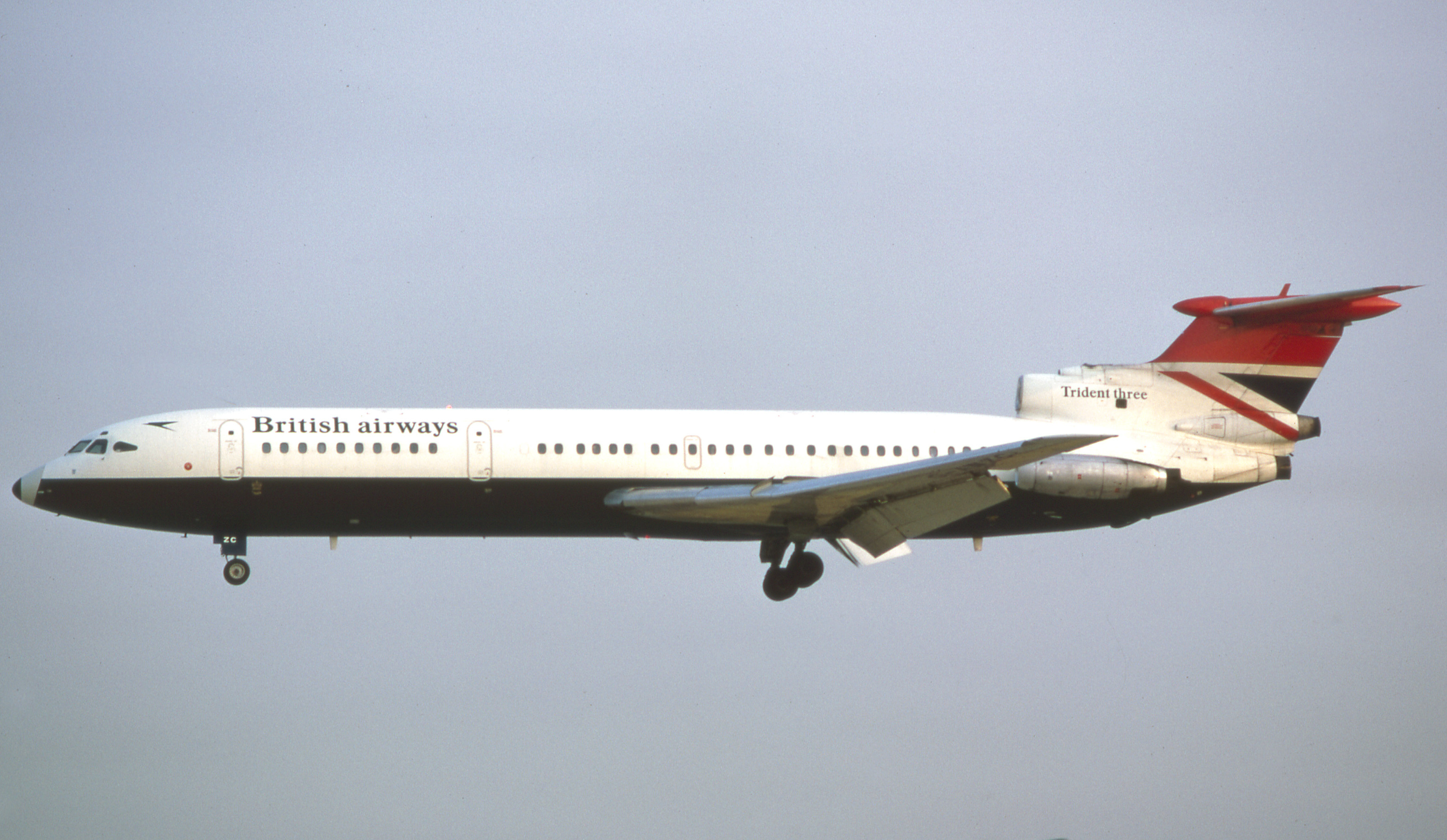
At the dawn of the 1960s, the British aviation industry was in turmoil, driven by the need to produce a jet for medium-short range routes that could compete with the American giants. It was in this ambitious scenario that the project that would later give life to the Hawker Siddeley Trident, originally conceived by de Havilland as DH.121, was born.
<br>
The main need was dictated by British European Airways (BEA), which required an airliner with around 100 seats, capable of operating efficiently on busy European routes. BEA's specification was particularly stringent: it required high speed and the ability to operate in adverse weather conditions, also influenced by the nascent era of supersonic aircraft.
<br>
The result was the Trident 1C, the first of its series to take flight on 9 January 1962. It represented a bastion of British engineering, designed to set new standards of speed and automation in short- to medium-range commercial air transport.
Architecture & Technological Design
The Trident 1C was distinguished by its avant-garde architecture, characterized by a tail-mounted triple-engine configuration and an imposing T-tail. This arrangement, powered by three Rolls-Royce Spey turbofan engines, allowed for a pylon-cleaned wing, improving aerodynamic efficiency and significantly reducing cabin noise for passengers.
<br>
The Trident's design was not just aesthetic, but functional. The accentuated swept wing and robust structure gave it excellent flight performance, in particular a remarkable cruising speed for the time. Every aspect was calibrated to maximize efficiency on European routes and speed in ground operations.
<br>
But the real innovation lay in its avionics sector. The Trident was one of the first aircraft in the world to incorporate an advanced automatic autoland system, designed to allow precise and safe landings even in extremely low visibility conditions, anticipating modern standards by decades.
Onboard Specifications
- ◆Integrated Autoland System: Pioneer for operations in low visibility (CAT IIIB), allowing fully automatic landings and revolutionizing the safety and regularity of flights.
- ◆Rear Tri-Engine Configuration: Three Rolls-Royce Spey turbofan engines offered redundancy, fuel efficiency and reduced noise, contributing to a more comfortable flying experience.
- ◆Advanced Aerodynamic Design: Striking swept wing and T-tail for high speed performance and excellent stability, pushing airliner capabilities on short routes.
Operational Career & Operators
The Hawker Siddeley Trident 1C entered service with BEA in 1964, quickly becoming the mainstay of its fleet for European routes. Its introduction marked a radical modernization in air travel, offering passengers a faster and more comfortable experience.
<br>
Despite its complex technology, the Trident proved to be a reliable and capable aircraft, with remarkable climb capability and sustained speeds. Its peculiarity of operating in low visibility made it a valuable asset for BEA, reducing delays and cancellations due to bad weather, a common problem in European airports.
<br>
Although its commercial success outside Britain was limited by stiff competition from the Boeing 727 and Douglas DC-9, the Trident served BEA and British Airways faithfully for decades, cementing its reputation as a British workhorse.
Legacy & Cultural Impact
The Hawker Siddeley Trident 1C is remembered as a true pioneer in the field of avionics and automation. Its Category IIIB Autoland system was not just a technical feature, but a promise of a future where bad weather would no longer impede air travel, laying the foundation for modern systems.
<br>
Its influence extends far beyond its operational period. It demonstrated the feasibility and reliability of complex automatic flight systems, influencing the design and development of subsequent generations of airliners. The Trident was a flying laboratory for concepts that are standard today.
<br>
Despite not achieving the global fame of other jets of the era, the Trident remains a symbol of British aeronautical ingenuity of the 1960s. An aircraft that, with its bold technical solutions, pushed the limits of what was possible, leaving a lasting legacy in the history of commercial aviation.
Telemetria Specs (HUD)
Hangar Trivia & Curiosità
- 💡Il Trident è stato il primo aereo al mondo ad essere certificato per atterraggi completamente automatici in condizioni meteorologiche di Categoria IIIA (visibilità quasi zero).
- 💡Originariamente progettato per British European Airways (BEA), era uno degli aerei di linea subsonici più veloci in servizio, spesso con una velocità di crociera prossima a Mach 0.9.
- 💡La sua configurazione insolita a 'tri-reattore', con due motori montati sulla fusoliera posteriore e uno all'interno della coda, era una caratteristica distintiva che condivideva la discendenza progettuale con il De Havilland Comet.
Archivio Avvistamenti Spotter
Immagini scattate dalla community in tutto il mondo