DC-10-30
McDonnell Douglas
Historical Context & Origins
In the late 1960s, the aviation industry was in turmoil. While the Boeing 747 dominated the "jumbo jet" segment for the busiest routes, there was a clear need for a wide-body aircraft with intermediate capacity, suitable for medium-to-long-haul routes that did not require the gigantic capacity of the 747. Airlines were looking for an "airbus" – a concept later embodied by Airbus itself – that offered spacious comfort without the excess of seats.
It was in this scenario that the concept of the McDonnell Douglas DC-10 was born. Initially designed as a twin-engine to meet an American Airlines specification, the needs for greater range and safety on transoceanic flights, before the advent of the ETOPs standards, pushed towards a three-engine configuration. The DC-10-30, the flagship variant for long-range operations, made its first flight in 1972, a defining moment for global aviation.
This version differed significantly from the smaller domestic DC-10-10. Designed to meet the challenges of international and intercontinental flights, the DC-10-30 represented McDonnell Douglas' response to the growing demand for a robust and versatile aircraft, capable of covering longer distances with a higher payload, competing directly with the Lockheed L-1011 TriStar.
Architecture & Technological Design
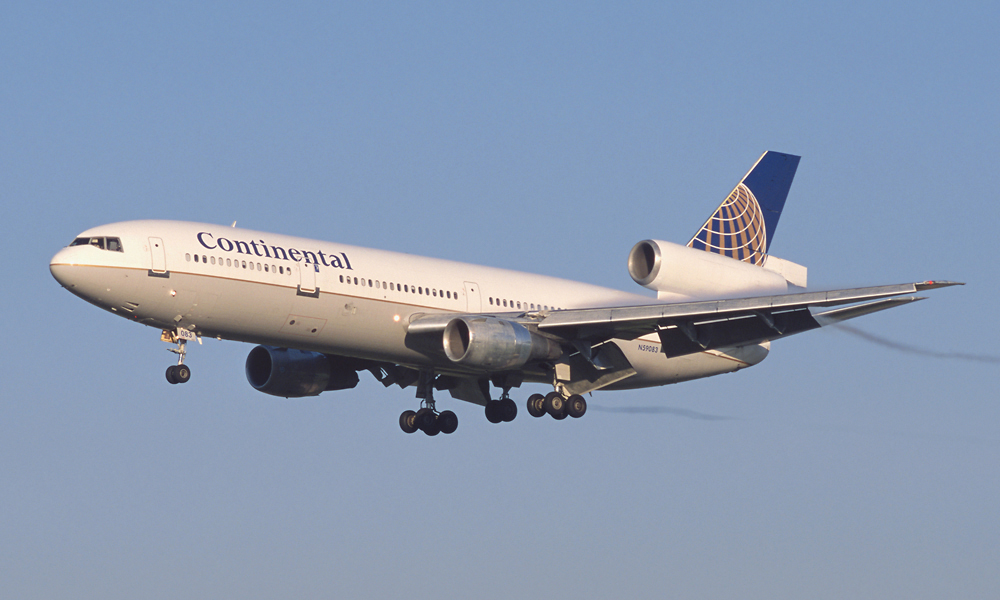
The McDonnell Douglas DC-10-30 boasted a distinctive architecture, typical of trijets of the time. Its configuration included two engines under the wings and a third engine integrated into the base of the vertical fin, powered by a particular "S-duct" air intake which improved aerodynamics and reduced noise. This design solution was a trademark, giving it an instantly recognizable silhouette.
Compared to the -10 variant, the DC-10-30 featured a reinforced wing structure and a larger wingspan, designed to accommodate additional fuel tanks, crucial to its extended range. The landing gear had also been upgraded, with an additional two-wheeled center landing gear under the fuselage, required to support the higher Maximum Take-Off Weight (MTOW) of 263,000 kg.
Power was provided by three General Electric CF6-50 engines, known for their reliability and high thrust, approximately 227 kN (51,000 lbf) each. These engines, combined with an advanced avionics suite for the time, which included a sophisticated Inertial Navigation System (INS), allowed the DC-10-30 to fly transoceanic routes with great precision and efficiency, setting new standards for long-range flights.
Onboard Specifications
- ◆General Electric CF6-50 Engines: Three powerful and reliable turbofans, critical for long-range performance.
- ◆Wide-body cab: Dual aisle configuration, typically 2-5-2 or 2-4-2 in economy, for superior comfort.
- ◆Inertial Navigation System (INS): Cutting-edge technology for its time, essential for precise navigation on transcontinental routes.
Operational Career & Operators
The McDonnell Douglas DC-10-30 quickly entered service with some of the world's most prestigious airlines, including Lufthansa, Swissair, KLM, Air France and British Caledonian. Its combination of capacity, range and comfort made it an ideal choice for high-density international routes, becoming a mainstay of global long-haul fleets for decades.
Despite some tragic accidents early in its career, primarily related to cargo door design issues and maintenance practices, the DC-10-30 demonstrated its inherent ruggedness. McDonnell Douglas implemented significant changes and improvements, making it, in its subsequent versions, an extremely safe and reliable aircraft. Many examples then served as cargo, testifying to the solidity of the design.
Its presence in the skies was a symbol of modern, accessible air travel. It has connected continents and cultures, carrying millions of passengers and significantly contributing to globalization. Its versatility and operational reliability, especially after the difficult first years, have ensured it a prominent place in the history of commercial aviation.
Legacy & Cultural Impact
The McDonnell Douglas DC-10-30 left a complex but undeniably significant legacy. It represented the pinnacle of the trijet philosophy for long-haul flight, proving that an aircraft with fewer than four engines could meet the challenges of ocean crossings, paving the way for modern wide-body twin-engine aircraft and the next ETOPs era.
Despite the initial difficulties that tarnished its reputation, the DC-10-30 remained a symbol of American aeronautical engineering of its time. It influenced the design of its successor, the McDonnell Douglas MD-11, which took many of its structural and aerodynamic features, while incorporating more modern technologies.
Today, few original DC-10-30s remain in passenger service, but a sizable number continue to fly as cargo aircraft, converted to meet the needs of global cargo transportation. Its unmistakable silhouette and its role in defining an era of air transport make it a legendary aircraft, a true giant of the skies that overcame adversity to leave an indelible mark on the collective imagination.
Telemetria Specs (HUD)
Hangar Trivia & Curiosità
- 💡The DC-10-30's distinctive third engine, mounted high on the vertical stabilizer, became its most recognizable feature.
- 💡Despite initial safety concerns related to earlier DC-10 variants, the -30 model achieved a strong safety record over its long operational life.
- 💡Many DC-10-30s have been converted into dedicated cargo aircraft, particularly through the MD-10 freighter conversion program, extending their service well into the 21st century.
Archivio Avvistamenti Spotter
Immagini scattate dalla community in tutto il mondo