Caravelle VI-N
Sud Aviation
Historical Context & Origins
The Sud Aviation Caravelle, and in particular the VI-N version with its first flight in 1960, represents a fundamental chapter in the evolution of commercial aviation. Born from the "South-East SE 210" program launched by France after the war, the objective was clear: to create a medium-range jetliner that could compete internationally.
The project was notable for its bold vision of an all-jet airliner, designed to effectively serve the emerging European air transport market. The success of the first versions, such as the Caravelle I, paved the way for more high-performance models, culminating in the Caravelle VI-N, a refined and powerful machine.
This variant incorporated significant improvements, projecting the Caravelle into a leading position in the global aeronautical landscape. It demonstrated French ingenuity in surpassing British and American pioneers in the short-medium range jet segment, setting new standards of speed and comfort.
Architecture & Technological Design
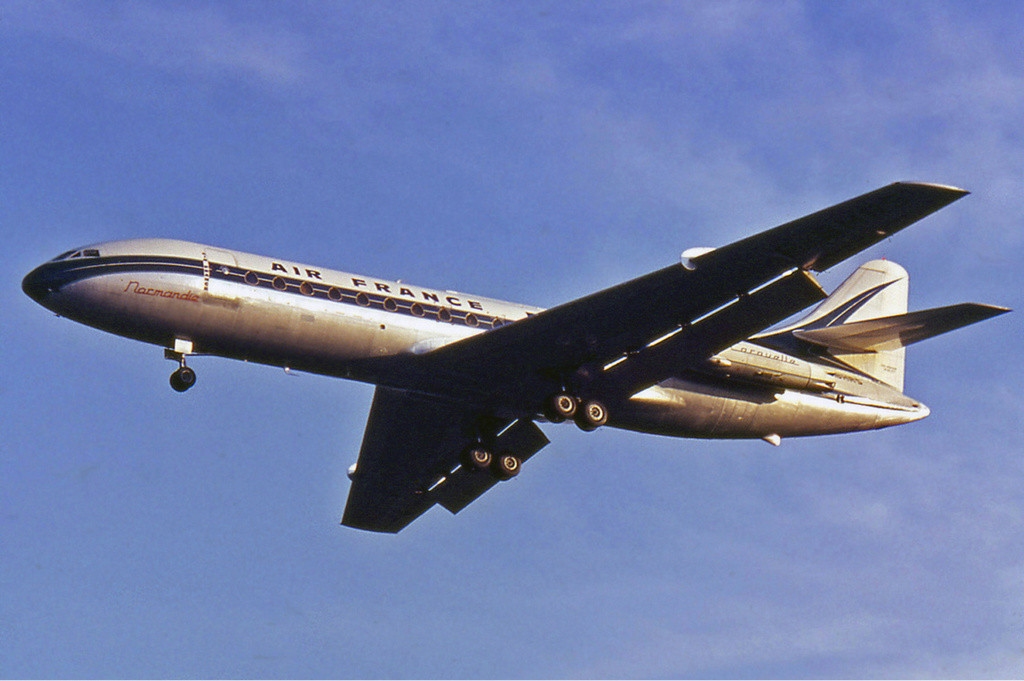
The Caravelle VI-N immediately stood out for its avant-garde and unmistakable architecture: the two engines mounted in the tail section of the fuselage. This solution, revolutionary at the time for a jetliner, offered crucial advantages such as a drastic reduction in cabin noise and greater aerodynamic cleanliness of the wings.
The "clean wing" configuration allowed the wings to generate greater lift and less drag, contributing to the aircraft's excellent aerodynamic efficiency. The innovation was not limited to the engines: the fuselage featured rounded triangle passenger windows, a bold stylistic choice that also guaranteed greater structural resistance to the stresses of pressurization.
These design choices not only defined the Caravelle's unique aesthetic, but also influenced future generations of commercial aircraft, demonstrating the effectiveness of bold solutions to improve performance and comfort. The Caravelle VI-N was a true concentration of advanced engineering for its time.
Onboard Specifications
- ◆Rolls-Royce Avon Mk 532R engines: Guarantee of improved power, reliability and performance for the VI-N version.
- ◆Built-in thrust reversers: Essential for reducing landing spaces, increasing safety and operational versatility on shorter runways.
- ◆Rounded Triangle Windows: A distinctive design that minimized stress concentrations, increasing the structural safety of the pressurized cabin.
Operational Career & Operators
The Sud Aviation Caravelle VI-N, from its first flight in 1960, quickly became a symbol of the jet age, adopted by prestigious airlines around the world. Its reliability and excellent performance made it a mainstay for medium-haul flights, democratizing air travel in Europe and beyond.
Airlines such as Air France, SAS, Swissair, Alitalia and even United Airlines (which used the Caravelle in its operations) relied on the VI-N for their busiest routes. This aircraft was instrumental in the expansion of mass tourism and in connecting major European cities with unprecedented speed and comfort.
Its presence in the skies was a guarantee of efficiency and an icon of modernity, carrying millions of passengers and helping to shape the first experiences of jet flight for many. The Caravelle VI-N was a true "workhorse" of commercial aviation.
Legacy & Cultural Impact
The Sud Aviation Caravelle VI-N was not just a successful aircraft; he was a pioneer and a cultural icon who left an indelible mark on the collective imagination. Its elegant and futuristic silhouette made it instantly recognisable, symbolizing the optimism and technological progress of the 1960s.
Its innovative rear-engine configuration paved the way for numerous future designs, directly influencing the development of other airliners and regional jets. The Caravelle demonstrated that design could combine aesthetics and functionality in a sublime way, offering an exceptional flying experience.
Although no longer in active service today, the legacy of the Caravelle VI-N endures as a testament to French aeronautical ingenuity and its crucial role in shaping the era of jet aviation, remaining a cornerstone of aviation history.
Telemetria Specs (HUD)
Hangar Trivia & Curiosità
- 💡The Caravelle was one of the first jet airliners designed for short-to-medium haul routes, a niche previously dominated by propeller aircraft.
- 💡Its distinctive nose cone and cockpit section were famously derived from the de Havilland Comet, a result of early French-British cooperation.
- 💡The Caravelle VI-N incorporated more powerful Rolls-Royce Avon Mk. 532R engines, offering improved performance over earlier variants and making it popular with European and some American carriers.
Archivio Avvistamenti Spotter
Immagini scattate dalla community in tutto il mondo