Yak-42D
Yakovlev
Historical Context & Origins
The Yakovlev Yak-42, the original prototype of which first flew in 1975, was conceived as a modern successor to the popular but now dated Tupolev Tu-134 and Antonov An-24 in Soviet civil aviation. The goal was to create an efficient medium-range jet, capable of operating from less well-equipped airports, with higher passenger capacity and lower operating costs than its predecessors.
<br>
Despite the initial innovation, the standard version of the Yak-42 encountered some operational challenges. To overcome these and to respond to the growing demand for an aircraft with greater autonomy and reliability, the Yakovlev design bureau introduced the Yak-42D version. This model, which made its first flight in 1988, represented a crucial update, bringing significant improvements in terms of autonomy and performance.
<br>
The Yak-42D was specifically designed for regional and medium-range routes, aiming to bridge the gap between small turboprops and large, long-range jets. Its introduction in 1988 was a key moment, marking the Soviet commitment to modernizing its air fleet with a more competitive and versatile aircraft, suited to the country's vast expanses and its particular infrastructure needs.
Architecture & Technological Design
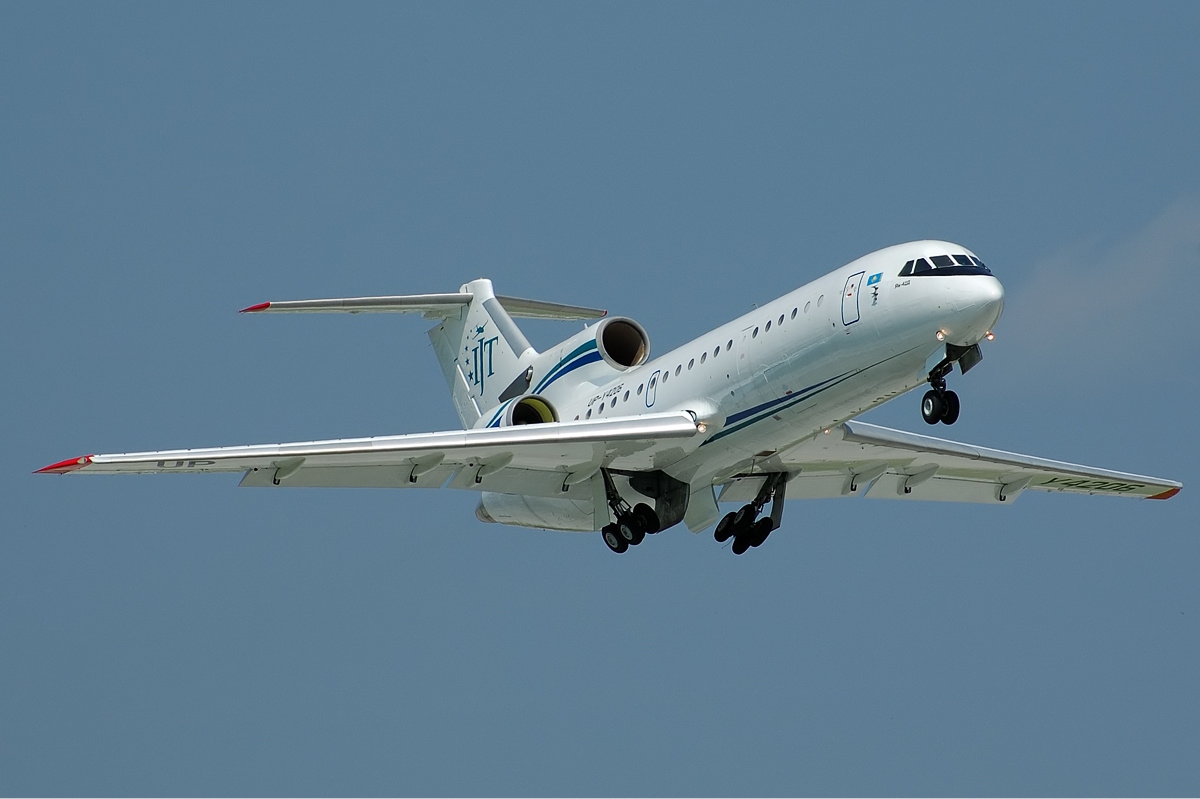
The heart of the Yak-42D's architecture lies in its distinctive three Lotarev D-36 turbofan engine configuration, mounted in the rear of the fuselage. This design choice ensured not only considerable redundancy and operational safety, but also reduced cabin noise and excellent ability to operate on shorter, less prepared runways, a key aspect for many Soviet regions.
<br>
The design featured a distinctive T-tail and swept wings, which contributed to the aircraft's aerodynamic efficiency and stability at various speeds. The fuselage, wider than that of many direct competitors, allowed a cabin configuration with five seats per row, offering greater comfort to passengers and a higher transport capacity for its weight category.
<br>
The 'D' version incorporated structural reinforcements and a revised fuel system, which significantly increased its operational range. The upgrade also included a modernization of the avionics, with the introduction of more advanced instrumentation for navigation and flight control, making it more competitive and reliable in the international aeronautical environment.
Onboard Specifications
- ◆Increased fuel capacity: extended flight range up to 2,900 km with standard payload, almost double compared to the basic version.
- ◆High efficiency Lotarev D-36 engines: three turbofans providing a combined thrust of approximately 63.7 kN (14,300 lbf) each, offering an excellent power-to-weight ratio.
- ◆Upgraded Avionics: Inclusion of Inertial Navigation Systems (INS) and Flight Management Systems (FMS) for greater precision and automation.
Operational Career & Operators
The Yak-42D quickly became a mainstay for civil aviation in Russia and other Commonwealth of Independent States (CIS) countries. Its main operator was Aeroflot, which used it extensively on its domestic routes and on some medium-range international connections. Its robustness and ability to operate in adverse weather conditions made it ideal for Russia's vast and diverse geographies.
<br>
In addition to Aeroflot, several Russian regional airlines and operators in countries such as Cuba, China and Pakistan acquired the Yak-42D, appreciating its versatility and relatively low operating costs. This aircraft proved its reliability as a true workhorse, maintaining air connectivity in many areas where airport infrastructure was limited.
<br>
Despite some isolated incidents that led to temporary suspensions of its operation, the Yak-42D has undergone continuous upgrades and safety improvements, which have extended its operational life. Many examples have exceeded 30,000 flight hours, testifying to the robustness of its design and its ability to serve for decades in demanding conditions.
Legacy & Cultural Impact
The Yakovlev Yak-42D represents a significant chapter in the history of Soviet and Russian aviation. It was one of the first Russian airliners to achieve ICAO certification, paving the way for the integration of the Russian aviation industry into the global market after the fall of the Soviet Union. Its longevity and widespread presence have cemented its image as a symbol of resilience and adaptability.
<br>
Its cultural impact also lies in its role as a connector of remote regions and in the transport of millions of passengers, significantly contributing to economic and social development. The Yak-42D served as a bridge between the past and future of Russian aviation, demonstrating Yakovlev's ability to produce a modern and reliable airliner in an era of profound transformation.
<br>
Today, although many Yak-42Ds have been retired or replaced by more modern aircraft, some continue to fly, especially in regional contexts or for special cargo flights. Its legacy is that of an aircraft that, although not the most famous in the world, played an irreplaceable role in its context, demonstrating the ability of Russian aeronautical engineering to innovate and adapt to the needs of the time.
Telemetria Specs (HUD)
Hangar Trivia & Curiosità
- 💡The 'D' in Yak-42D stands for 'Dal'niy,' meaning 'long-range,' reflecting its improved fuel capacity and extended operational capabilities over the standard Yak-42.
- 💡Its distinctive three rear-mounted Lotarev D-36 turbofan engines and T-tail configuration make it easily recognizable, a design choice aiming for reduced cabin noise and increased aerodynamic efficiency.
- 💡Despite its origins in the late Soviet era, the Yak-42D has proven remarkably durable, with some aircraft still flying commercial and special missions, particularly within Russia and former Soviet states.
Archivio Avvistamenti Spotter
Immagini scattate dalla community in tutto il mondo