Yak-42
Yakovlev
Historical Context & Origins
The Yakovlev Yak-42 emerged in the mid-1970s Soviet aviation landscape as a response to a pressing need: modernizing Aeroflot's short- and medium-range fleet. The goal was to replace the aging An-24 turboprops and complement smaller jets like the Tu-134 on less busy routes, offering greater efficiency and comfort to passengers.
OKB Yakovlev, traditionally known for its agile fighters, tried its hand at civilian transport, proposing a design that was distinct from the Tupolev or Ilyushin schools. The project aimed for a modern, economical and extremely reliable aircraft, capable of operating from less equipped runways, a crucial feature for the extensive Soviet domestic route network.
The first flight occurred on March 21, 1975, marking the beginning of an ambitious chapter for Soviet civil aviation. The Yak-42 was destined to become a mainstay of regional routes, embodying an attempt to bring Soviet technology into line with international standards in efficiency and performance.
Architecture & Technological Design
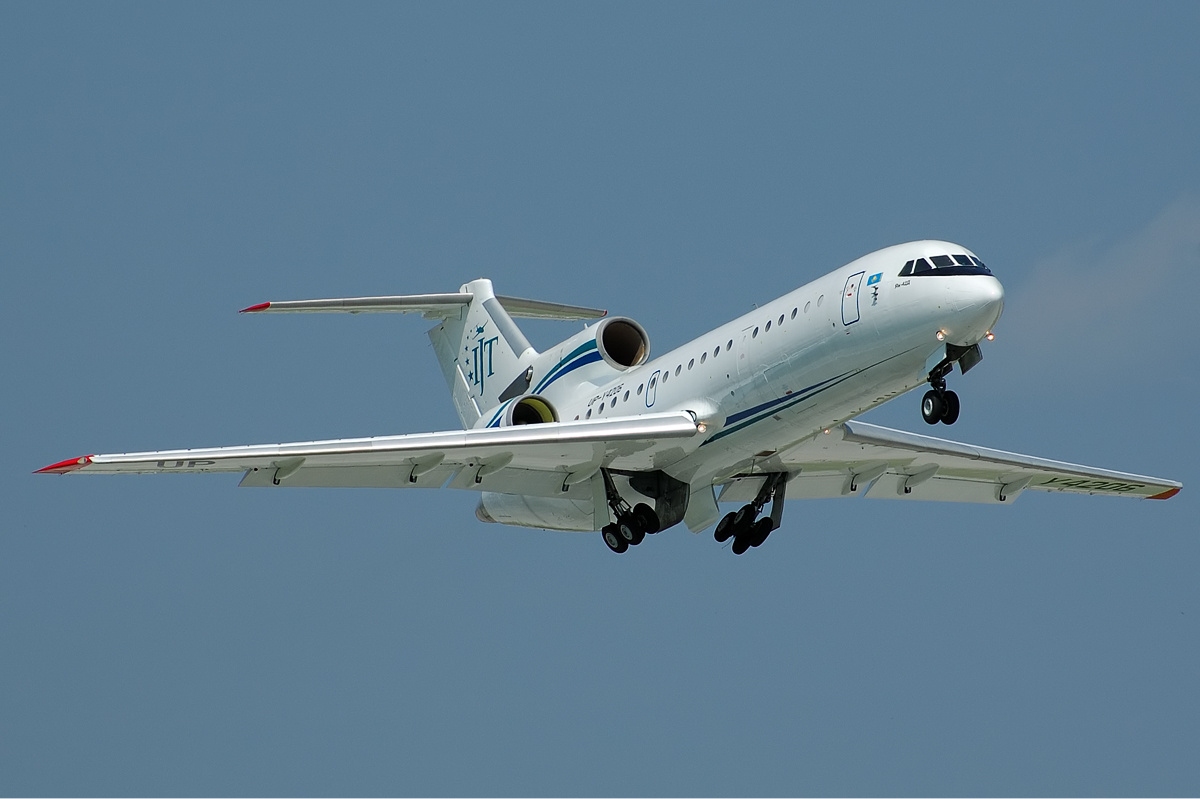
The Yak-42 had a distinctive configuration with three engines (trijet) mounted in the tail, with a T-shaped empennage, a technical choice that recalled the Boeing 727 or the Hawker Siddeley Trident, but with a clear Soviet identity. This architecture was designed to guarantee high take-off power and greater safety in the event of engine failure.
The aerodynamic design aimed for excellent subsonic efficiency, with a clean wing and advanced airfoils, optimized for cruising speeds and low-speed performance. Attention to detail, including sophisticated slats, was aimed at allowing the aircraft to operate even from shorter and less prepared runways.
The structure was predominantly made of aluminum alloys, robust and designed to withstand the severe operational and climatic conditions of the Soviet Union. Despite the initial challenges, its construction proved solid and capable of long operational careers, thanks also to subsequent revisions and structural reinforcements.
Onboard Specifications
- ◆Lotarev D-36 high-bypass turbofan engines: the first of their type on a Soviet airliner, providing significant improvement in fuel efficiency and noise reduction compared to their predecessors.
- ◆Analog fly-by-wire control system: One of the first implementations of this technology in Soviet commercial aircraft, offering greater control precision and reducing pilot workload.
- ◆Two-member cockpit: a radical solution for the Soviet era, eliminating the flight engineer and reducing operational costs and crew complexity.
Operational Career & Operators
The Yak-42 entered service with Aeroflot in 1980, starting to fly on crucial domestic routes. While promising, its introduction was marred by some initial challenges, including a tragic accident in 1982 that led to a temporary halt in production and a major design overhaul, focused on structural and control system improvements.
Once these obstacles were overcome, the Yak-42 demonstrated its reliability and versatility. It became a workhorse for Aeroflot and successor airlines in Russia and the former Soviet bloc, operating effectively on a wide range of routes, even in extreme weather conditions and from airports with limited infrastructure.
Despite domestic success, exports were limited, primarily to Cuba and some African nations, due to international competition and the political dynamics of the time. However, its ruggedness has allowed it to remain in service with several companies today, a testament to its durability and adaptability.
Legacy & Cultural Impact
The Yakovlev Yak-42 represents a significant turning point in Soviet civil aviation, serving as a bridge between older generations of aircraft and a more modern, internationalized approach. It was the first Soviet aircraft to incorporate high-bypass turbofan engines and a two-member cockpit, standards that would become the norm.
Its introduction pushed the Russian aviation industry to improve its safety and reliability standards, particularly after the initial crashes. The experience gained with the Yak-42 contributed to the development of future designs and demonstrated the ability of Soviet engineering to adapt to new aviation needs.
Beyond its technical impact, the Yak-42 is a symbol of a transitional era, an aircraft that struggled to establish itself but ultimately proved its worth, carrying millions of passengers across vast expanses. It remains an important piece of aeronautical history, still appreciated today for its resistance and operational capacity.
Telemetria Specs (HUD)
Hangar Trivia & Curiosità
- 💡The Yak-42 was the first Soviet passenger aircraft to be equipped with modern, high-bypass turbofan engines (Lotarev D-30K series).
- 💡It shares its trijet configuration and T-tail design with Western counterparts like the Boeing 727, though it is an entirely distinct Soviet design.
- 💡Following an accident in 1982 attributed to a design flaw in its horizontal stabilizer, the entire Yak-42 fleet was temporarily grounded for two years while the issue was redesigned and corrected.
Archivio Avvistamenti Spotter
Immagini scattate dalla community in tutto il mondo