Yak-40
Yakovlev
Historical Context & Origins
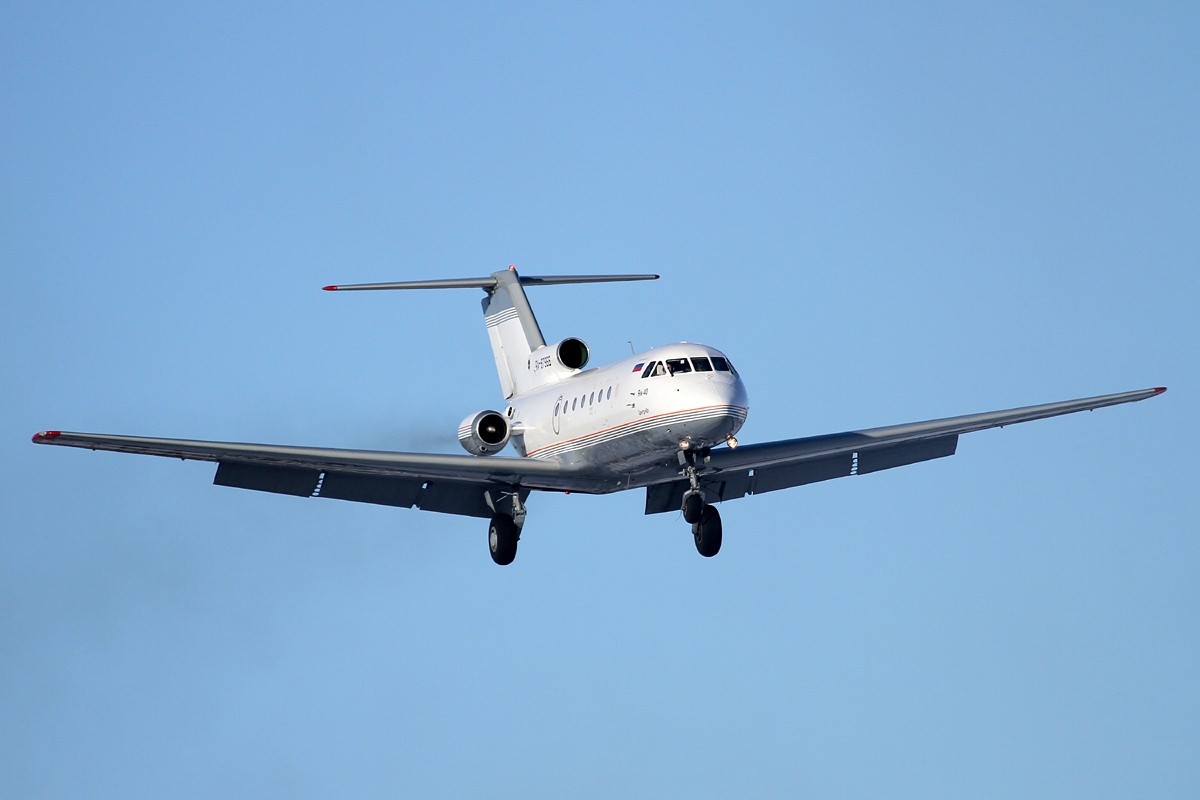
The Yakovlev Yak-40, which made its first flight in 1966, emerged as a bold and innovative response to growing Soviet demand for a reliable jet aircraft for regional routes. The primary objective was to replace the aging fleet of piston aircraft, such as the Li-2 and Il-14, by connecting smaller airfields and unprepared runways in vast and remote areas of the Soviet Union.
The Yakovlev design bureau set itself the ambitious task of creating an aircraft that combined the speed of jets with the robustness and operational simplicity required for use in extreme conditions. It was intended to be a jet "air taxi", capable of operating from short, semi-prepared runways, opening up new air transport opportunities.
Architecture & Technological Design
The Yak-40 immediately stood out for a bold and, for the time, almost unique technical configuration for an aircraft of this size: the rear tri-reactor arrangement. This choice, with three Ivchenko AI-25 turbofan engines mounted in the rear part of the fuselage, guaranteed not only considerable thrust but also exceptional redundancy and operational safety, crucial for flights over isolated territories.
The design featured a high aspect ratio straight wing, optimized for excellent low speed performance and an amazing STOL (Short Take-Off and Landing) capability. The landing gear was particularly robust and equipped with low-pressure tires, specifically designed to absorb the impacts of landings on unpaved surfaces, cementing its reputation as an "off-road jet".
Onboard Specifications
- ◆Rear tri-jet configuration: Unique for a regional jet, it offered exceptional redundancy and reliability, ensuring safety even in the event of an engine failure.
- ◆Reinforced landing gear: Designed to operate on unprepared and semi-prepared runways, including grassy or gravel airfields, providing great operational versatility.
- ◆Straight wing with advanced slats: Optimized for excellent low-speed performance and amazing STOL (Short Take-Off and Landing) capability, allowing access to a large number of smaller stopovers.
Operational Career & Operators
The Yak-40 quickly became the workhorse of the Soviet state airline Aeroflot, connecting hundreds of remote cities and villages throughout the USSR. With a typical capacity of 24-32 passengers, it proved to be an extremely versatile aircraft, also used for VIP transport, military missions and aerophotogrammetry.
Its reliability and ease of maintenance made it popular even outside the Soviet bloc. It was exported to numerous countries, including Italy, where it operated for a regional company, and Germany, used for special missions. over 1000 examples were built, testifying to its success and strategic importance.
Legacy & Cultural Impact
The Yakovlev Yak-40 left a lasting legacy as a pioneer of regional jets, demonstrating the feasibility of jet airlift on short-haul routes and from airports with limited infrastructure. Its robustness earned it affectionate nicknames such as "Iron Baby" or "Flying Mercedes" in some cultures, underlining its durability and reliability.
Even today, although the number of examples in service has drastically decreased, the Yak-40 is remembered as a brilliant example of Soviet aeronautical engineering, capable of practical innovation and adaptation to difficult operating conditions. It paved the way for future generations of regional aircraft, consolidating the concept of widespread air connectivity.
Telemetria Specs (HUD)
Hangar Trivia & Curiosità
- 💡Lo Yak-40 è uno dei pochi jet regionali di piccole dimensioni ad adottare una configurazione a tre motori, una caratteristica più comune su aerei di linea più grandi come il Boeing 727.
- 💡Era famoso per le sue eccellenti capacità STOL (Short Take-Off and Landing), che gli permettevano di operare da piste in erba o sterrate, rendendolo ideale per collegamenti aerei in regioni remote.
- 💡Il suo design robusto e la semplicità di manutenzione gli valsero il soprannome di 'Aero-Taxi' o 'Auto Volante' in alcune parti del mondo, sottolineando la sua versatilità e affidabilità.
Archivio Avvistamenti Spotter
Immagini scattate dalla community in tutto il mondo
Vettori Rilevati (Flotta Attiva)

AeroBratsk
In Flotta: x11 u.
Motor Sich Airlines
In Flotta: x4 u.
Russia Special Flight Detachment
In Flotta: x13 u.
Vologda Air
In Flotta: x9 u.
Aeroflot
In Flotta: x6 u.
KrasAvia
In Flotta: x16 u.
Petropavlovsk-Kamchatsky Air Enterprise
In Flotta: x4 u.