Y-7
Xian
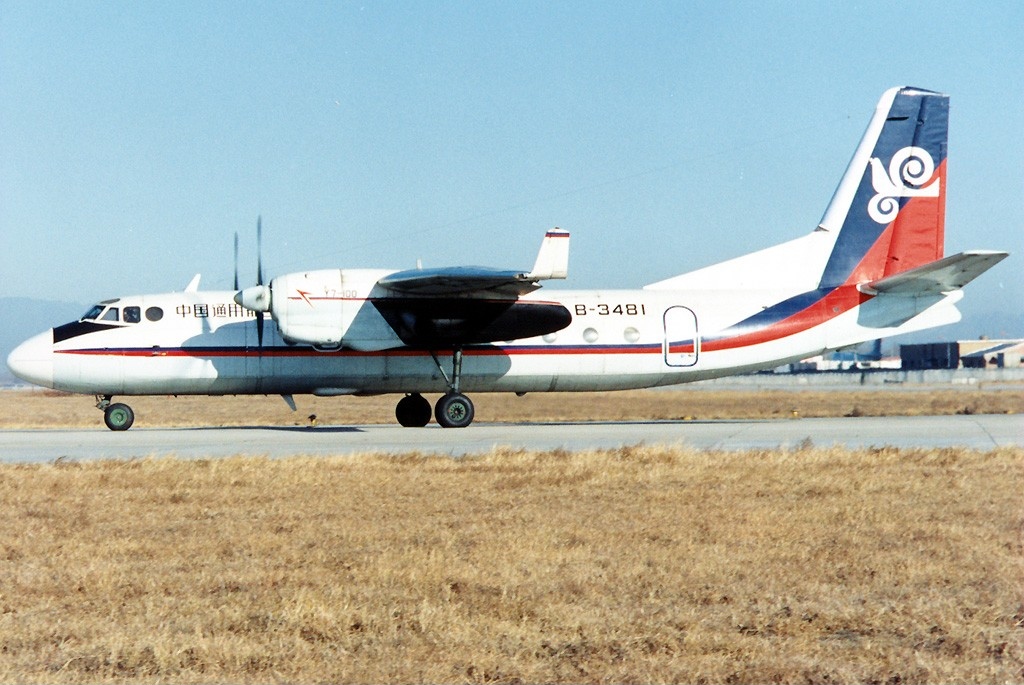
Historical Context & Origins
The Xian Y-7 represents a milestone in Chinese aviation, emerging from a period of intense need for air transportation infrastructure. In the 1960s, the People's Republic of China sought to modernize its air capabilities, both military and civilian, with a focus on robustness and reliability to operate across a vast and often challenging territory.
The genesis of the Y-7 is intrinsically linked to the acquisition of the production license of the proven Soviet Antonov An-24, a twin-turbine regional transport already extensively tested. This strategic decision allowed Xian Aircraft Factory (XAC) to quickly start production, leveraging a proven design rather than undertaking expensive and time-consuming development from scratch.
The first flight of the Y-7 occurred in December 1970, marking the beginning of a long and prolific career. It was not just a copying operation, but a crucial step towards technological independence and mastery of advanced aircraft manufacturing techniques for the Chinese industry.
Architecture & Technological Design
The architecture of the Xian Y-7 faithfully follows that of its Soviet predecessor, featuring a high-wing twin-turbine configuration that provides exceptional stability and versatility. The design was conceived to maximize load capacity and reliability in different operating conditions, from prepared runways to improvised and less equipped airports.
Structural strength is a hallmark of the Y-7, with a semi-monocoque fuselage constructed predominantly of aluminum alloys. This made it extremely resistant to wear and operational stress, crucial for an aircraft intended to serve both military and civil needs in a challenging geographical context.
Initially equipped with turboprop WJ-5A-1 engines, derived from the An-24's Ivchenko AI-24 engines, the Y-7 provided adequate power for short takeoffs and solid performance. The choice of engines reflected the need for reliability and ease of maintenance, which are critical for remote and long-term operations.
Onboard Specifications
- ◆Multi-role capability: Designed to carry a variety of loads, from bulky cargo to 48-52 passengers or troops.
- ◆Operation on unprepared runways: Robust undercarriage and high wing for use from airports with limited infrastructure.
- ◆Reliability and simplified maintenance: Robust and accessible on-board systems for operations in remote contexts.
Operational Career & Operators
The Xian Y-7 has been the backbone of Chinese aviation for decades. The People's Liberation Army Air Force (PLAAF) has employed it in a wide range of roles, from troop and cargo transport to maritime patrol (in its modified variants) and crew training. Its versatility has made it irreplaceable.
Even in the civilian sector, the Y-7 played a fundamental role. Airlines such as CAAC and subsequent regional entities have used it to connect China's most remote cities, transporting cargo and passengers, significantly contributing to the country's economic and social development.
Its long operational career and reliable performance have led to the development of numerous variants and upgrades. Its ability to adapt to different tasks solidified its reputation as a true "workhorse" of the Chinese air force, although it saw limited export.
Legacy & Cultural Impact
The legacy of the Xian Y-7 is deep and lasting. It not only provided an essential service for decades, but also laid the foundation for the subsequent evolution of China's aviation industry. The experience gained in its production, maintenance and upgrading has been invaluable for future projects.
The Y-7 was the direct precursor to the more modern MA60 (Modern Ark 60) series, incorporating advanced avionics and next-generation turboprop engines, but maintaining the same robust design philosophy. This demonstrates the intrinsic validity of the original project and China's ability to innovate starting from solid foundations.
A symbol of self-sufficiency and pragmatism, the Xian Y-7 is not just a transport aircraft; it is a tangible testimony of Chinese aeronautical growth in an era of profound transformations. Its longevity and impact on transportation and logistics make it an aircraft of extraordinary historical and technical importance.
Telemetria Specs (HUD)
Hangar Trivia & Curiosità
- 💡It is a licensed copy of the Soviet Antonov An-24, adapted for Chinese manufacturing and operational requirements.
- 💡The Y-7 formed the basis for the more modern Xi'an MA60 series, which features updated avionics and engines, achieving some international sales.
- 💡It has been widely used by various branches of the People's Liberation Army for military transport, maritime surveillance, and other specialized roles.
Archivio Avvistamenti Spotter
Immagini scattate dalla community in tutto il mondo