Vanguard
Vickers
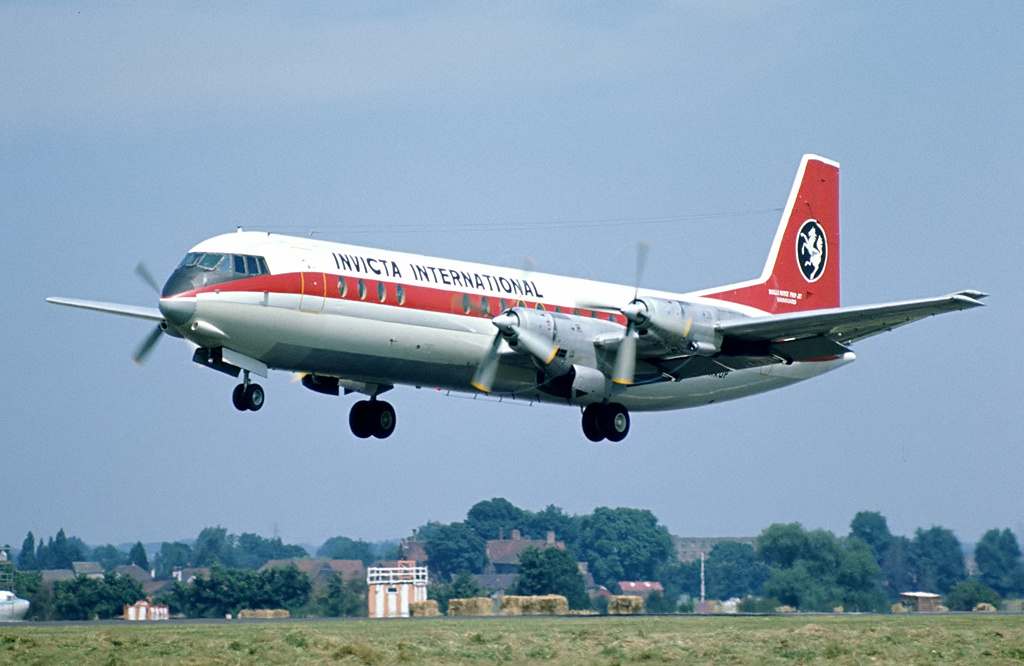
Historical Context & Origins
In the heat of the post-war era, with civil air transport rapidly expanding, Vickers-Armstrongs aimed to consolidate the success of its famous Viscount. From this vision was born the Vickers Vanguard, conceived as a larger, faster and more versatile successor, specifically designed for short-to-medium range routes and increased capacity demand. Its first flight occurred in 1959, placing it in a transition era between piston-powered aircraft and the early pioneers of the jet.
The Vanguard was the British response to the need for more efficient and capable passenger aircraft, with a particular focus on operational versatility. Major British and Canadian airlines, particularly British European Airways (BEA) and Trans-Canada Airlines (TCA), expressed strong interest, becoming its launch customers. The goal was to offer an aircraft capable of handling a high volume of passengers or an optimal mix of passengers and cargo, making it extremely flexible.
This ambitious project, initially called Type 950, aimed to combine the reliability of turboprops with an innovative design that maximized economic efficiency. Its genesis was a symbol of British aeronautical engineering seeking to maintain technological leadership in an increasingly competitive market dominated by the rise of pure jets, offering an intermediate and pragmatically efficient solution.
Architecture & Technological Design
The Vickers Vanguard was distinguished by its futuristic architecture, culminating in the choice of four Rolls-Royce Tyne turboprop engines. These engines were cutting edge for their time, offering an excellent combination of power, fuel efficiency and low noise, crucial aspects for passenger comfort and operational profitability on intermediate duration flights.
A prominent innovation of the Vanguard was its "double-bubble" section fuselage, an ingenious solution that created two distinct areas: a spacious upper cabin for passengers and a huge lower cargo compartment. This design maximized combined passenger and cargo capacity, making the Vanguard exceptionally flexible for airlines needing to operate passenger flights with a significant volume of cargo.
With a cruising speed of approximately 680 km/h (425 mph) and a range adequate for European and North American routes, the Vanguard offered competitive performance. Its structural strength and refined aerodynamics, inherited from the consolidated Vickers experience, guaranteed stable and comfortable flight, representing a pinnacle in turboprop aircraft engineering of the time.
Onboard Specifications
- ◆Rolls-Royce Tyne Engines: Leading turboprops for performance and efficiency.
- ◆Double-Bubble Fuselage: Innovative design for high combined passenger/cargo load capacity.
- ◆Spacious, pressurized cabin: Superior comfort for passengers on medium-haul routes.
Operational Career & Operators
The Vickers Vanguard entered service with BEA (British European Airways) in 1960 and shortly thereafter with TCA (Trans-Canada Airlines), which later became Air Canada. Companies appreciated its extraordinary cargo carrying capacity combined with passenger transport, a characteristic that made it particularly valuable on domestic and intra-community routes where the demand for rapid shipments was increasing.
Despite its excellent qualities, the Vanguard faced stiff competition from first-generation jets such as the Boeing 707 and Douglas DC-8, which promised superior speed and prestige, capturing the collective imagination. This led to a limited number of orders, failing to replicate the immense commercial success of its predecessor, the Viscount.
Nonetheless, the Vanguard earned a reputation as a reliable and rugged aircraft. Many examples were later converted to cargo aircraft, taking on the designation "Merchantman", demonstrating their longevity and the effectiveness of the double-bubble design for transporting cargo. They continued to serve in this role for decades, well beyond their passenger careers.
Legacy & Cultural Impact
Although not a global sales champion, the Vickers Vanguard left a significant footprint in aviation, serving as a technological bridge between the piston engine and pure jet eras. Its design philosophy focused on payload efficiency and versatility anticipated concepts that would be revived decades later in modern cargo and "combi" aircraft.
The Vanguard is a testament to the British engineering of an era that dared to experiment with innovative solutions such as advanced turboprops and unique fuselage configurations. It convincingly demonstrated the economic potential of turboprop aircraft for short to medium range operations, especially when cargo carrying capacity was a key factor.
Its long operational life as a "Merchantman" is the most eloquent proof of its solidity and the validity of its design. Although less famous than some of its contemporaries, the Vickers Vanguard remains a fascinating example of how innovation and the pursuit of efficiency can define an era, indirectly influencing the future development of air transport and cargo logistics.
Telemetria Specs (HUD)
Hangar Trivia & Curiosità
- 💡Its unique 'double-bubble' fuselage cross-section allowed for a spacious passenger cabin above a large, accessible freight hold.
- 💡Powered by four Rolls-Royce Tyne turboprop engines, the Vanguard was notable for its relatively quiet operation and efficiency for its era.
- 💡Many Vanguards were converted into Merchantman freighters, operating well into the 1990s, far outliving their original passenger service plans.
Archivio Avvistamenti Spotter
Immagini scattate dalla community in tutto il mondo