Tu-70
Tupolev
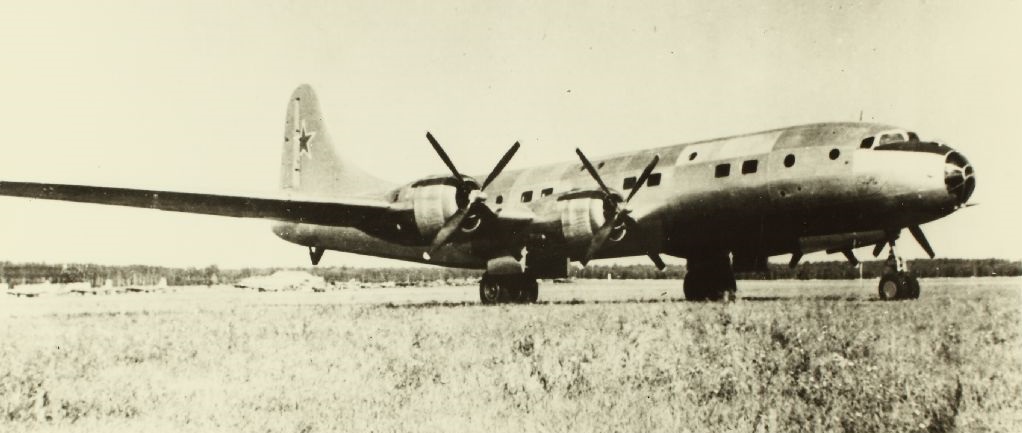
Historical Context & Origins
In the aftermath of World War II, the Soviet Union faced the daunting task of rebuilding and modernizing its infrastructure, including civil aviation. In this post-war scenario, the urgent need emerged for a passenger transport aircraft capable of covering long distances and offering superior comfort compared to previous models. The Tupolev Tu-70, whose first flight took place in 1946, was born from this ambitious vision.
This giant of the skies was a direct derivation of the Tupolev Tu-4 strategic bomber, itself a Soviet copy of the US Boeing B-29 Superfortress. The decision to base an airliner on such a robust military platform was not accidental: it allowed to accelerate development times, taking advantage of a proven design and the availability of components already mass-produced for military purposes, marking a crucial step in the Soviet aeronautical strategy.
Architecture & Technological Design
The Tu-70 inherited from its military predecessor an all-metal structure, extremely resistant and reliable, typical of the constructions of the time. However, Tupolev engineering introduced substantial modifications to adapt it to the civilian role, the most significant of which was the installation of a pressurized cabin. This innovation, then cutting edge for Soviet aviation, promised unprecedented comfort for passengers, allowing flights at higher altitudes and reducing fatigue due to pressure changes.
The aircraft was powered by four powerful Shvetsov ASh-73TK radial engines, the same ones that powered the Tu-4. These engines, equipped with turbochargers, guaranteed the power necessary to lift a considerable payload and maintain high cruising speeds, fundamental aspects for a transport aircraft intended to operate over vast expanses of land. The wing and fuselage design was optimized for aerodynamic efficiency, ensuring remarkable stability and flight performance.
Onboard Specifications
- ◆Pressurized cabin: A crucial innovation for passenger comfort on high-altitude flights, setting it apart from its predecessors.
- ◆High passenger capacity: Designed to carry up to 72 passengers, an impressive figure for the time.
- ◆Considerable autonomy: Capable of traveling long distances, making it ideal for the internal needs of the Soviet Union.
Operational Career & Operators
Despite the promising technical premises and ambitious design, the Tupolev Tu-70 never saw serial production for civil aviation. A single prototype was built, which completed an intensive program of test flights demonstrating its capabilities. However, a series of factors, including the strategic priority given to the production of the Tu-4 bomber and the lack of adequate civil airport infrastructure to support an aircraft of this size in a country still under reconstruction, meant that it was not commercialized.
The project was officially canceled in 1949. Its operational history is therefore limited to that of a technology demonstrator, a flying laboratory that provided valuable data and invaluable experience to Soviet designers. Although it never entered service with any carrier, the Tu-70 served as a key testbed for subsequent generations of Soviet civil transport aircraft.
Legacy & Cultural Impact
Although its operational career was short and limited, the legacy of the Tupolev Tu-70 is far from negligible. This ambitious project demonstrated the Soviet aviation industry's ability to adapt complex military platforms to civilian roles and integrate advanced technologies such as cabin pressurization. It laid the foundation for the development of future large-capacity Soviet airliners.
The Tu-70 represents a symbol of the Soviet Union's titanic efforts in the post-war period to establish itself not only as a military but also a technological power in the field of civil aviation. Although it remained unique, its impact lay in having paved the way for a new era of Soviet aviation, inspiring the subsequent successes of Tupolev and other design bureaus in the field of commercial aviation.
Telemetria Specs (HUD)
Hangar Trivia & Curiosità
- 💡It was a civilian derivative of the Tu-4 bomber, which was a Soviet reverse-engineered copy of the American Boeing B-29 Superfortress.
- 💡The Tu-70 was one of the first Soviet airliners designed with a fully pressurized cabin, significantly improving passenger comfort at high altitudes.
- 💡Despite its advanced features and potential, only one prototype was ever built before the project was cancelled, largely due to the Soviet Union's prioritization of military aircraft development at the time.
Archivio Avvistamenti Spotter
Immagini scattate dalla community in tutto il mondo