Tu-154
Tupolev
Historical Context & Origins
In the heat of the Cold War, the Soviet Union faced the pressing need to modernize its civilian air fleet. An advanced jet airliner was needed, capable of replacing the An-10 and Il-18 turboprops, matching and exceeding the performance of the Tu-104. The objective was ambitious: to offer the country an aircraft that could compete with its Western counterparts in terms of speed, comfort and capacity.
The Tupolev design bureau was tasked with developing a tri-reactor capable of operating effectively on Aeroflot's vast network, from metropolises to the most remote airports. The key requirement was exceptional structural strength and the ability to operate in extreme weather conditions, as well as from less prepared slopes. The Tupolev Tu-154, with its first flight in 1968, emerged as the perfect synthesis of these needs, quickly becoming a pillar of Soviet aviation.
Architecture & Technological Design
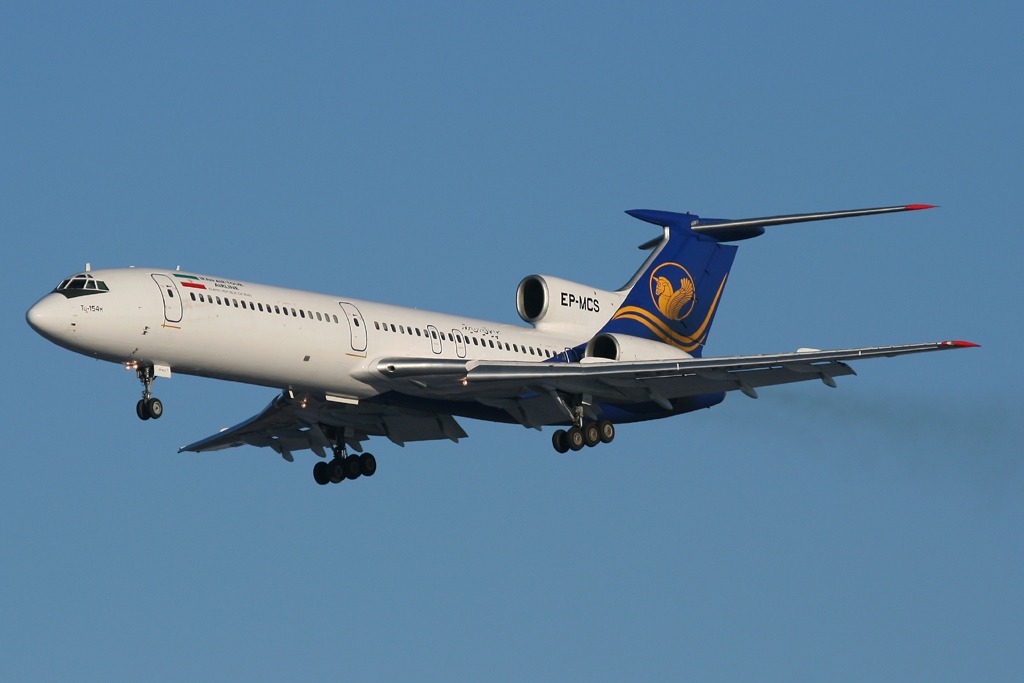
The Tu-154 was distinguished by its iconic tri-jet configuration, with two engines mounted on the sides of the rear fuselage and a third housed inside, powered by a large air intake at the base of the T-shaped fin. This arrangement, borrowed from designs such as the Boeing 727, guaranteed not only redundant power but also considerable thrust, essential for take-off from short runways and at high altitude.
The wings, characterized by a pronounced 35° sweep, were optimized for high cruising speeds, allowing the Tu-154 to reach almost the speed of sound. For the critical take-off and landing phases, the aircraft was equipped with a sophisticated system of triple-slot Fowler slats, which ensured excellent lift performance even on short runways. The initial Kuznetsov NK-8-2 engines were then upgraded to the more efficient and less noisy Soloviev D-30KU in subsequent versions, significantly increasing range and efficiency.
Onboard Specifications
- ◆Structural strength and reinforced landing gear: Designed to withstand the wear and tear of runways with varying standards, even in less developed airport environments.
- ◆Advanced Inertial Navigation System (INS): A cutting-edge technology for its time, which gave the aircraft considerable operational autonomy and route precision, reducing dependence on ground infrastructure.
- ◆Integrated APU (Auxiliary Power Unit): Essential for the self-sufficiency of the aircraft, it allowed the starting of the engines and the supply of electrical and pneumatic energy without the need for external equipment, crucial in airports with limited services.
Operational Career & Operators
The Tu-154 quickly became the backbone of Aeroflot's fleet, symbolizing the expansion of Soviet air transport and connecting countless cities and remote regions of the USSR. With the capacity to carry up to 180 passengers and an impressive cruising speed, it has dominated domestic and international medium-haul routes for decades, carrying millions of people.
In addition to Aeroflot, the Tu-154 was widely exported and operated by over 17 international airlines, mainly in Eastern Bloc countries such as Bulgaria, Hungary and East Germany, but also in nations such as Cuba, Syria and China. Its reputation for reliability and durability, combined with its relative ease of maintenance by its standards, has afforded it an incredibly long operational career, in some cases spanning over forty years.
Legacy & Cultural Impact
The Tupolev Tu-154 transcends the role of simple means of transport, standing as an iconic symbol of Soviet aeronautical engineering and its vision of the world. Its unmistakable silhouette, with the distinctive T-shaped centerboard and three rear engines, is imprinted in the collective memory of those who lived through the era, representing a bridge between cultures and economies.
Although most examples have been gradually withdrawn from commercial service due to noise regulations and fuel efficiency requirements, some Tu-154s continue to operate in specialist roles, such as cargo transport or government aircraft. Its legacy endures, testifying not only to an engineering achievement, but also to the Tu-154's fundamental contribution to the development of civil aviation on a global scale, leaving an indelible imprint on history.
Telemetria Specs (HUD)
Hangar Trivia & Curiosità
- 💡Often dubbed the 'Russian 727' due to its similar three-engine, rear-mounted configuration and performance capabilities.
- 💡It was one of the fastest commercial jet airliners in the world, capable of cruising at speeds close to Mach 0.85 (approximately 950 km/h).
- 💡Designed to operate in extreme Siberian conditions, it could take off from relatively short, unpaved airfields, a crucial capability for remote Soviet regions.
Archivio Avvistamenti Spotter
Immagini scattate dalla community in tutto il mondo