Tu-134
Tupolev
Historical Context & Origins
The Tupolev Tu-134, with its first flight in 1963, emerged from a pressing need of the Soviet Union: to modernize its civil air fleet with a short-medium range passenger jet. The goal was to replace aging turboprops, offering superior comfort and speed, in line with Western innovations such as the Caravelle and the BAC One-Eleven.
The project, initially called Tu-124A, represented a significant evolution compared to the previous Tu-124, introducing a configuration of engines mounted in the tail section, a revolutionary design for the time. This choice reflected not only international trends but also the desire to optimize the aerodynamics of the wing, freeing it from the engine nacelles.
Its genesis was characterized by a rapid phase of development, driven by the need to demonstrate the ability of the Soviet aviation industry to compete technologically. The Tu-134 was not just an aircraft, but a tangible symbol of the USSR's engineering progress and logistical might in civil aviation.
Architecture & Technological Design
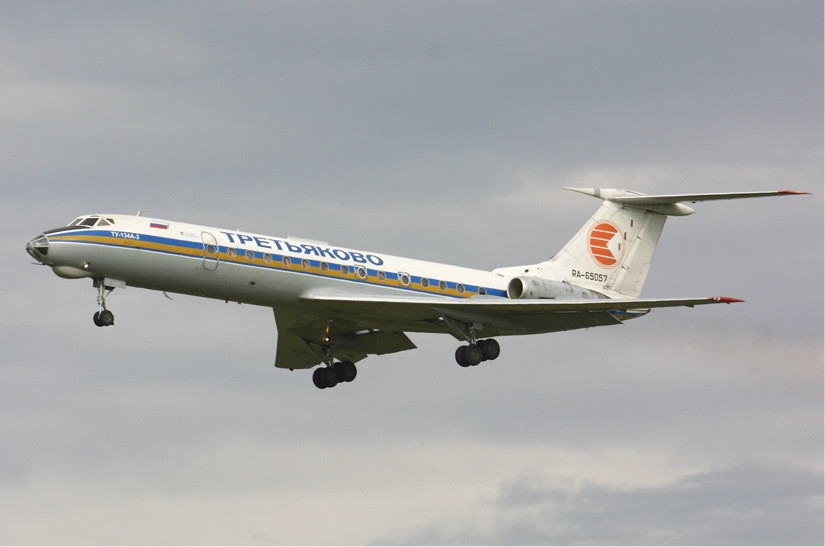
The architecture of the Tu-134 was dominated by its iconic configuration with two rear-mounted Soloviev D-30 engines, attached to the sides of the fuselage. This arrangement, combined with a clean and relatively thin wing, helped to significantly reduce cabin noise and improve overall aerodynamic performance.
The fuselage featured a robust design, typical of the Soviet engineering school, capable of withstanding severe operating conditions. The T-tail, with the horizontal empennages positioned high, was a direct consequence of the rear mounting of the engines, ensuring greater control efficiency in different flight configurations.
The landing gear, massive and designed for landings on less prepared runways, highlighted the Tu-134's vocation for operation in a vast and often challenging territory. It could accommodate between 64 and 96 passengers, depending on the internal configuration, and required a crew of three or four members, including a navigator, a common position on Soviet aircraft.
Onboard Specifications
- ◆Soloviev D-30 rear engines: This innovation reduced noise and vibration in the cabin, improving passenger comfort and wing aerodynamics.
- ◆Glazed nose for the navigator: A distinctive and functional feature, which offered the navigator direct visibility for visual navigation, especially on less equipped routes.
- ◆Reinforced landing gear: Designed for operation on unpaved or semi-prepared runways, demonstrating the aircraft's robustness and adaptability in variable infrastructure environments.
Operational Career & Operators
The Tupolev Tu-134 quickly became the backbone of the fleet of Aeroflot, the Soviet flag carrier, for regional and domestic flights. Its reliability and ability to operate in extreme climates made it an invaluable asset, connecting cities and remote regions of the USSR and the Eastern Bloc.
In addition to Aeroflot, dozens of other airlines, mainly in Warsaw Pact countries and other allied nations, adopted the Tu-134. Its operational longevity was extraordinary; many examples remained in active service for over four decades, with some aircraft still flying into the early 2010s, a testament to its ruggedness.
Despite challenges related to obsolescence and new noise regulations, the Tu-134 has played a crucial role in the air transportation of millions of passengers. Its distinctive silhouette and characteristic engine noise have accompanied entire generations of travellers.
Legacy & Cultural Impact
The Tu-134 is much more than just a plane; it is an icon of Soviet aeronautical engineering and a cultural symbol of the Cold War. His unmistakable silhouette and his peculiar sound have made him the protagonist of numerous films, documentaries and literary works, crystallizing his image in the collective memory.
His long and illustrious career demonstrated the validity of the technical solutions adopted, influencing the development of subsequent Soviet airliners. Although most examples have now been retired, the Tu-134 remains an emblematic example of an era in which engineering responded to specific geostrategic needs.
Today, numerous Tu-134s are preserved in museums around the world, silent witnesses to a bygone era. They continue to inspire aviation enthusiasts, offering a unique insight into the history of aviation and the technological ambition of a superpower.
Telemetria Specs (HUD)
Hangar Trivia & Curiosità
- 💡Le prime versioni del Tu-134 presentavano un caratteristico muso vetrato che ospitava una postazione per il navigatore, una caratteristica comune su molti aerei sovietici dell'epoca, successivamente rimossa nelle varianti più recenti.
- 💡Il Tu-134 era soprannominato 'The Whistling Killer' (L'Assassino Fischietto) a causa del suono acuto e distintivo dei suoi motori turbofan Soloviev D-30, particolarmente udibile durante il decollo.
- 💡È stato uno degli aerei più diffusi nel Blocco Orientale, utilizzato non solo da Aeroflot e da altre compagnie aeree civili, ma anche per il trasporto VIP, l'addestramento dei piloti e missioni militari specializzate.
Archivio Avvistamenti Spotter
Immagini scattate dalla community in tutto il mondo