Trident 2E
Hawker Siddeley
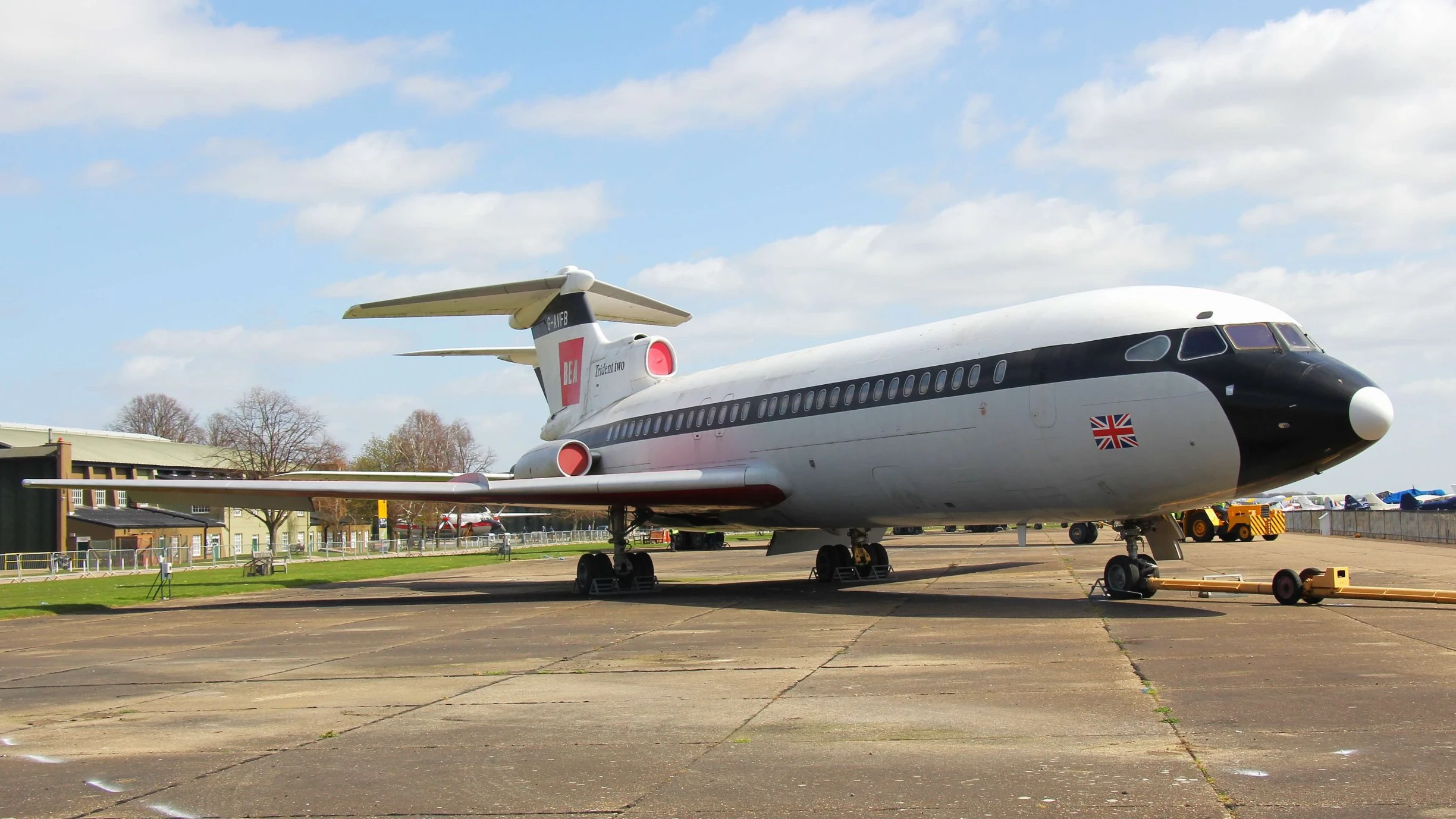
Historical Context & Origins
The genesis of the Hawker Siddeley Trident has its roots in a specific request from British European Airways (BEA) in the late 1950s. The goal was a fast and efficient short-to-medium range jetliner, a design initially known as the de Havilland D.H.121, aimed at setting new standards.
The evolution led to the Trident 2E, which made its first flight in 1967. This version, more powerful and with extended range, was designed to serve a wider route network, consolidating its position in the British commercial aviation landscape.
The Trident 2E represented an innovative response to the need to operate in adverse weather conditions. It was a symbol of English aeronautical ingenuity, ready to challenge the European skies and promote cutting-edge technology in passenger transport.
Architecture & Technological Design
The Trident 2E stood out for its cutting-edge architecture, featuring a tri-engine configuration with thrusters mounted in the tail section and a sleek T-tail. This choice improved aerodynamics and allowed for a quieter cabin, as well as remarkable propulsion efficiency.
The wing was designed for optimal high-speed performance, supported by sophisticated on-board systems, making it a true pioneer. The primary focus was on safety and reliability, crucial elements for commercial operations in an era of growing air traffic.
The real revolution, however, was its autoland system. From the beginning, the aircraft was designed to land automatically with minimal visibility, a remarkable achievement that pioneered all-weather operations and set a new benchmark for the industry.
Onboard Specifications
- ◆Triland autoland system (Cat IIIA/IIIB): Revolutionary fully automatic landing capability with very low visibility, an absolute world record.
- ◆Rolls-Royce Spey Tri-Engine Configuration: Three powerful and reliable turbofan engines, strategically positioned in the tail to maximize aerodynamic efficiency.
- ◆Enhanced Flight Controls and Highly Efficient Control Surfaces: Advanced aerodynamic design for precise control and superior maneuverability in all phases of flight.
Operational Career & Operators
The Trident 2E became the workhorse of British European Airways (BEA), and later British Airways, operating on crucial domestic and European routes. Its speed and ability to operate in almost any weather condition made it an invaluable asset for companies.
Despite strong competition from American aircraft, the Trident also found buyers on the international market. The China Civil Aviation Administration (CAAC) was a significant customer, acquiring several examples that operated for decades, demonstrating robustness and reliability.
Its career was characterized by high reliability and an excellent safety record, cementing its reputation. It continued to fly until the 1990s, demonstrating remarkable operational longevity and contributing to the development of modern air transport.
Legacy & Cultural Impact
The Hawker Siddeley Trident 2E has left an indelible legacy in commercial aviation, primarily as a pioneer of automatic landing operations. The implementation of the Triland system paved the way for all modern automated flight systems that we consider standard today.
It represented an era of bold British innovation in aeronautics, challenging convention and demonstrating the viability of advanced technologies. Although not produced in huge numbers, its contribution to the safety and efficiency of global air traffic is immeasurable.
The Trident 2E remains a symbol of technological progress and vision, remembered by enthusiasts as an aircraft that dared to push the boundaries of the possible. It left a lasting mark on the history of flight, laying the foundation for modern automation and operation in all conditions.
Telemetria Specs (HUD)
Hangar Trivia & Curiosità
- 💡The Trident was the first commercial aircraft to be certified for Category IIIA autoland operations, a significant safety and technological breakthrough.
- 💡It featured a distinctive T-tail and a rear-mounted trijet engine configuration, which was a relatively new design for its era.
- 💡The flight deck of the Trident was notoriously cramped, particularly for its three-person crew, despite its advanced instrumentation.
Archivio Avvistamenti Spotter
Immagini scattate dalla community in tutto il mondo