Super Guppy
Aero Spacelines
Historical Context & Origins
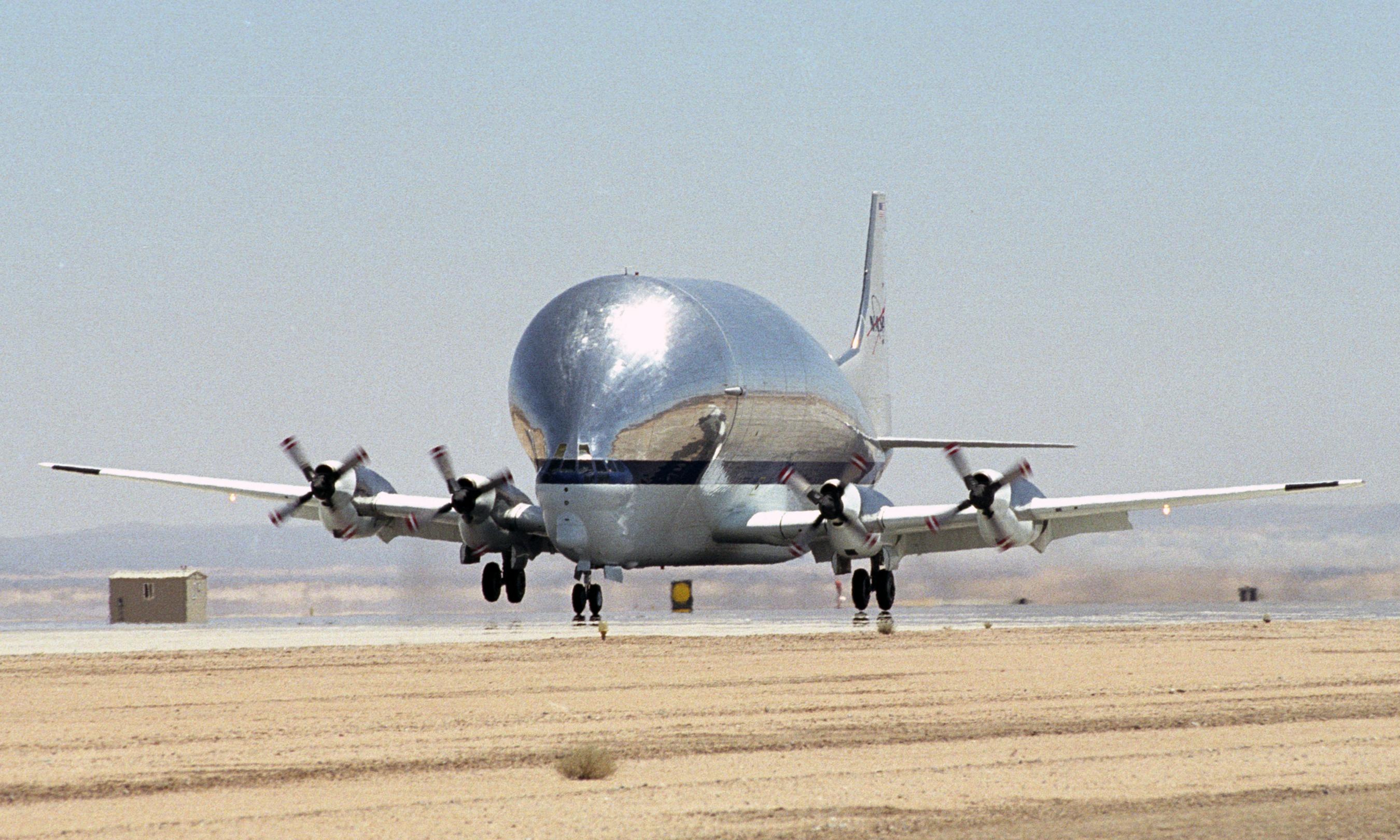
The Aero Spacelines Super Guppy is an aeronautical icon, born from a pressing need: the transport of extra-large components for the American space program. With the space age booming in the 1960s, NASA found itself unable to move rockets and space modules by conventional means.
It was ex-World War II fighter pilot Jack Conroy who took up the audacious challenge. He founded Aero Spacelines with the vision of modifying existing aircraft to create transportation giants, capable of swallowing cargoes of unprecedented size. His first experiment was the "Pregnant Guppy", but the Super Guppy, based on the Boeing 377 Stratocruiser, represented an extraordinary leap in quality.
The first flight of the Super Guppy occurred in 1962, marking the beginning of a new era in aerospace logistics. This plane wasn't just a carrier; it was a revolutionary solution that allowed NASA to assemble its Saturn rockets and Apollo spacecraft with previously unimaginable flexibility.
Architecture & Technological Design
The most distinctive aspect of the Super Guppy is undoubtedly its huge bulging fuselage, which gives it an unmistakable silhouette. To achieve this exceptional volumetric load capacity, engineers had to literally "cut and sew" a Boeing 377, expanding the fuselage diameter to 7.6 meters.
This bold modification was not limited to a mere enlargement. The upper section of the fuselage was significantly extended, transforming the original profile into a gigantic winged tube. The result was an impressive cargo volume of 1,400 cubic meters, essential for housing the rocket segments and spacecraft structures.
Another crucial innovation was the loading system. The nose of the aircraft could be completely opened and hinged 90 degrees, allowing direct frontal access and facilitating the insertion of long, bulky components. Initially powered by piston engines, later versions were upgraded with more powerful and reliable turboprop engines, such as the Allison 501-D22C.
Onboard Specifications
- ◆90 Degree Muzzle Opening: It allowed frontal loading and unloading of large components, revolutionizing logistics.
- ◆"Inflated" fuselage with a diameter of 7.6 meters: It offered an extraordinary load volume of 1,400 cubic meters, essential for space modules.
- ◆Four Allison 501-D22C Turboprop Engines: Provided the power needed to lift and carry massive loads, improving performance and reliability.
Operational Career & Operators
The Super Guppy became the real workhorse for transporting vital parts of America's space programs. It was the only means of transporting the components of the third stage of the Saturn V rocket, entire sections of the Apollo lunar module and even pieces of the Skylab, from one end of the United States to the other.
Its irreplaceable usefulness did not end with the race to the Moon. It also continued to play a critical role in the Space Shuttle program, transporting wings and fuselage segments between manufacturing and assembly sites. Its ability to move bulky cargo by air dramatically shortened transportation times and costs.
Subsequently, some examples were sold to ESA (European Space Agency), where they were used for the transport of satellites and components of the Ariane rockets. Of the five examples ever built, as many as four are still operational or on display, with one example still in active service at NASA.
Legacy & Cultural Impact
The Aero Spacelines Super Guppy isn't just a plane; it is a symbol of bold engineering and creative problem-solving. Its unusual silhouette and success story have made it an icon for space exploration enthusiasts and historians.
It unequivocally demonstrated the feasibility of air transport of hyper-dimensional cargo, paving the way for subsequent developments. Aircraft such as the Airbus Beluga and Boeing Dreamlifter, although more modern and sophisticated, owe much to the pioneering concept pioneered by the Super Guppy.
Its long and illustrious operational career, culminating in current service for NASA to transport components of the Artemis program, is a testament to the robustness and foresight of its design. The Super Guppy remains a vivid example of how innovation can overcome seemingly insurmountable logistical challenges, leaving a lasting legacy in aviation and beyond.
Telemetria Specs (HUD)
Hangar Trivia & Curiosità
- 💡Only five Super Guppy aircraft were ever built across two main variants: the Guppy 201 and the Super Guppy Turbine.
- 💡NASA still operates the last flying Super Guppy Turbine (N941NA) to transport spacecraft components for various missions, like the Orion capsule.
- 💡Its massive cargo hold was specifically designed to accommodate large items such as the S-IVB third stage of the Saturn V rocket, which was too large for conventional cargo planes.
Archivio Avvistamenti Spotter
Immagini scattate dalla community in tutto il mondo