SC.7 Skyvan
Short Brothers
Historical Context & Origins
Born from the need for a light, robust and economical transport aircraft, capable of operating in austere environments, the Short Brothers SC.7 Skyvan took to the skies for the first time in 1963. Designed by Belfast-based British firm Short Brothers, the Skyvan aimed to fill a market gap for a multi-role utility aircraft, capable of tackling short, unprepared runways. Its concept reflected the growing global demand for flexible and resilient air transport solutions.
The development of the Skyvan was initiated as a private project, initially financed by Short Brothers itself, which had a long tradition in the construction of transport aircraft. The objective was to create an aircraft with exceptional STOL (Short Take-Off and Landing) capabilities, which could serve both the civil sector, for regional and cargo routes, and the military sector, for support and logistics missions in remote areas. Its design philosophy was based on simplicity, reliability and operational versatility.
The market the Skyvan was aimed at was vast, ranging from airline operators in developing countries, to armed forces with light tactical transport needs, to humanitarian organisations. The year of its first flight, 1963, marked the beginning of a long and successful career for an aircraft that would prove the validity of its unconventional design.
Architecture & Technological Design
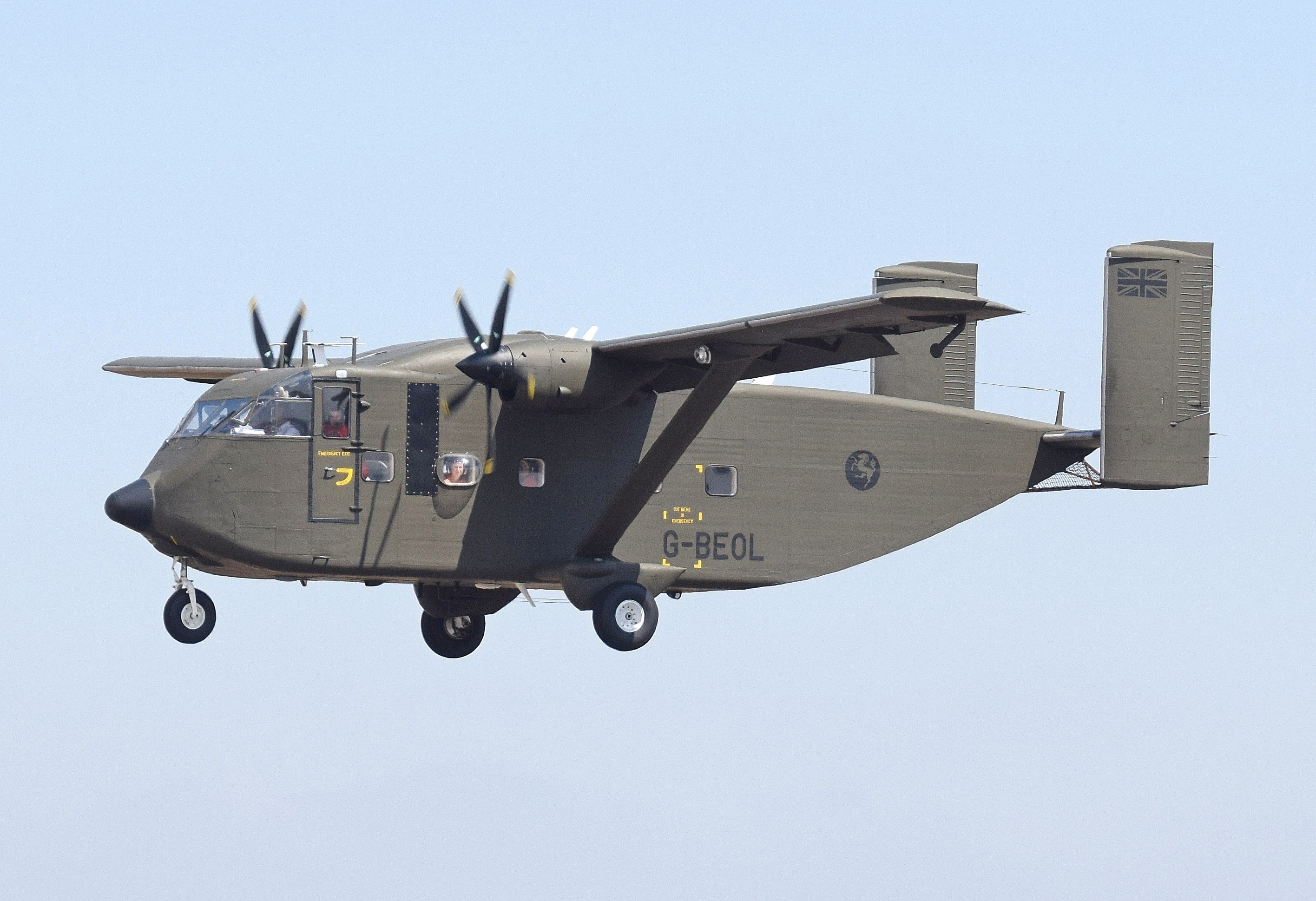
The Short Skyvan's architecture is instantly recognizable by its distinctive square-section fuselage, often nicknamed the "boxcar" or "shed", maximizing interior space and facilitating the loading of bulky cargo. This boxy design was paired with a tall, rectangular, large-area wing, critical to its exceptional STOL performance, allowing takeoffs and landings over extremely short distances.
The Skyvan's twin-engine configuration, with wing-mounted thrusters, ensured reliability and redundancy, crucial for operations in isolated environments. The first versions were equipped with Turbomeca Astazou turbine engines, while the later and more widespread variants were equipped with the robust Garrett TPE331, powerful and reliable turboprops. The fixed, tricycle landing gear was designed to withstand high impacts and operate on unprepared surfaces, further testament to its utilitarian nature.
The aircraft's structure was predominantly light alloy, robust but relatively simple to repair, a non-negligible aspect for operators in remote locations. The design also included a large rear loading ramp, a distinctive feature that greatly increased its versatility, allowing the loading of light vehicles, pallets or large numbers of passengers and paratroopers with ease.
Onboard Specifications
- ◆Intrinsic STOL capability: essential for operating on improvised runways, even in less than 400 meters.
- ◆Full-width rear loading ramp: for handling bulky goods and light vehicles, with direct access to the 6.7 cubic meter cargo compartment.
- ◆Boxcar fuselage design: Maximizes usable cargo volume, up to 19 passengers or 2,000 kg of cargo.
Operational Career & Operators
The Short Skyvan has enjoyed an extremely diverse operational career, becoming a true "workhorse" for numerous operators around the world. Its incredible versatility allowed it to perform roles ranging from passenger and light cargo transport, to search and rescue missions, medical evacuation, maritime patrol and even aerial surveillance. Its robustness and ability to operate in prohibitive conditions made it indispensable.
It has been deployed by over 50 civilian and military operators in more than 30 countries, from small regional airlines to militaries. Military users include the air forces of Argentina, Austria, Oman, Singapore and Guyana, which have used it for tactical transport, parachute drops and surveillance. In the civilian sector, the Skyvan has been instrumental in connecting isolated communities, transporting essential goods and people to mountainous or island regions without comprehensive airport infrastructure.
Even today, several examples of Skyvans remain in active service, a testament to their extraordinary longevity and reliability. Its unmistakable figure has become familiar in the skies of areas such as Alaska, Africa and South America, where its ability to land anywhere has proven its irreplaceable value. Its presence has often been associated with humanitarian and development missions.
Legacy & Cultural Impact
The Short SC.7 Skyvan has left a significant legacy in aviation, especially in the field of utility transport aircraft. Its "boxcar" design and exceptional STOL capabilities demonstrated the validity of a design approach focused on functionality and operational resilience, influencing the development of subsequent aircraft. It has become a symbol of reliability and practicality, often affectionately nicknamed "the only plane that can carry an airplane" due to its shape.
The success of the Skyvan laid the foundation for Short Brothers' subsequent family of transport aircraft, such as the Short 330 and Short 360. These models took up and expanded the concept of wide body and high load capacity, evolving towards larger regional airliners but maintaining the utilitarian spirit of their predecessor. The Skyvan demonstrated that an unconventional design can translate into unmatched operational effectiveness in specific market niches.
Culturally, the Skyvan is often associated with the image of the aircraft that "gets where others can't", embodying the spirit of adventure and the connection of remote places. Its recognizable silhouette continues to fascinate aviation enthusiasts, celebrated as a classic example of pragmatic and innovative British engineering that has had a lasting impact on global light air transport.
Telemetria Specs (HUD)
Hangar Trivia & Curiosità
- 💡The Skyvan earned the nickname "The Flying Shoebox" due to its distinctive, angular fuselage design, which maximized internal cargo volume.
- 💡It was specifically designed for excellent Short Take-Off and Landing (STOL) performance, enabling it to operate from very short, unprepared airstrips in remote locations.
- 💡Its large, full-width rear loading ramp was a key feature, allowing for easy loading of bulky cargo, vehicles, or for efficient paradropping operations.
Archivio Avvistamenti Spotter
Immagini scattate dalla community in tutto il mondo