S.M.95
Savoia-Marchetti
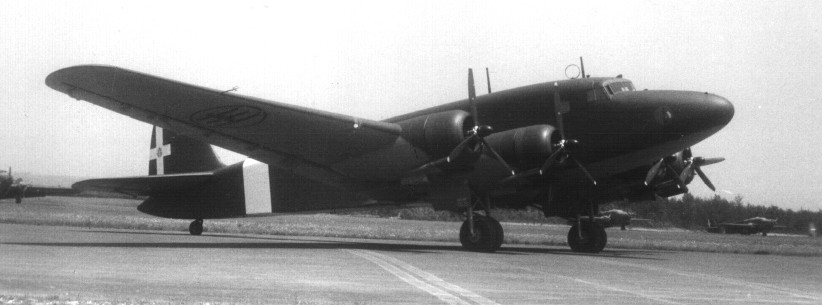
Historical Context & Origins
The Savoia-Marchetti S.M.95 emerged in a crucial period of Italian history, with its first flight in 1943, in the midst of the Second World War. Designed as an advanced civil airliner, it represented Savoia-Marchetti's ambitious response to the need for a robust, long-range four-engined transport aircraft, capable of succeeding the company's famous three-engined aircraft, such as the S.M.79 and the S.M.82.
Despite the adverse war context, which delayed its development and limited its production, the SM95 was conceived to embody a new generation of Italian transport. Its genesis reflected the vision of an Italy projected towards the reaffirmation of its own air routes, an ideal that clashed dramatically with the reality of the conflict.
Architecture & Technological Design
The S.M.95 stood out for its four-engined low-wing monoplane architecture, a configuration that gave superior stability and performance compared to previous three-engined aircraft. Its construction was an interesting hybrid: a mixed structure in metal and wood, with parts covered in canvas and others in light alloys, a technical compromise dictated both by Italian construction experience and by the material shortages of the war period.
The beating heart of the aircraft was made up of four Alfa Romeo 128 RC.18 radial engines, delivering approximately 860 HP each. This propulsion system guaranteed the S.M.95 the power necessary to operate over long distances with considerable loads, standing out for its reliability and relative operating economy in an era of limited resources.
Onboard Specifications
- ◆Four Alfa Romeo 128 RC.18 radial engines (860 HP each), for robust and reliable performance.
- ◆Mixed wood-metal structure with canvas and light alloy covering, an innovative fusion of construction techniques.
- ◆Autonomy of approximately 2,000-2,500 km and maximum speed of 370-380 km/h, for medium-long range routes.
Operational Career & Operators
Given its appearance at the height of the war, the S.M.95 was mainly used as a military transport aircraft for the Regia Aeronautica and, subsequently, for the National Republican Air Force. Its ability to transport a crew of 4-5 people and approximately 18-30 passengers (or equivalent loads) made it valuable for logistics and liaison missions, albeit in extremely limited numbers.
After the war, a small number of examples, estimated only 9 or 10 units produced, found use with civilian operators. Alitalia was among the first companies to exploit the SM95, using it to restore national routes and, later, some international routes, contributing to the reconstruction of the Italian civil aviation fabric in an era of scarcity of modern aircraft.
Legacy & Cultural Impact
The S.M.95 never achieved the fame or large-scale production of other Savoia-Marchetti masterpieces, but its existence is a testament to perseverance and Italian ingenuity even in the most adverse circumstances. It represented a major evolutionary step towards larger, more powerful transport aircraft, anticipating concepts that would become standard in post-war commercial aviation.
Its legacy lies in its role as a technological bridge, connecting pre-war construction philosophies with post-war needs. Despite being an unfortunate pioneer due to the timing of its launch, the S.M.95 remains a significant chapter in the history of the Italian aeronautics, a symbol of an industrial capacity that was able to react and adapt.
Telemetria Specs (HUD)
Hangar Trivia & Curiosità
- 💡Despite its 1943 first flight during WWII, the S.M.95 was largely conceived for post-war civil aviation, designed to help re-establish Italian air routes and transport capabilities.
- 💡Only a very limited number of S.M.95s were actually built, with estimates ranging from six to eight units, mainly due to the severe economic and industrial constraints of wartime and immediate post-war Italy.
- 💡Although produced as a tri-motor, the S.M.95's design was adaptable, with proposals and early considerations for a four-engine configuration to enhance performance, which was never mass-produced.
Archivio Avvistamenti Spotter
Immagini scattate dalla community in tutto il mondo