S.55P
Savoia-Marchetti
Historical Context & Origins
The 1920s were a golden era of aviation, a time of bold challenges and world records that redefined the boundaries of what was possible. The growing need to connect continents and overcome vast expanses of water pushed aeronautical engineers towards increasingly innovative and daring solutions. In this context, Italy established itself as the undisputed leader in the design of seaplanes.
It was in this scenario of aeronautical ferment that Savoia-Marchetti, already famous for the iconic S.55, introduced the Savoia-Marchetti S.55P. With its first flight in 1926, this variant emerged as a refined version, specifically adapted and configured for carrying passengers and commercial cargo.
It wasn't just a seaplane, but a symbol of progress and ambition, designed to make transsea travel a reliable and accessible reality, bringing a new level of comfort and safety to an industry still in its infancy.
Architecture & Technological Design
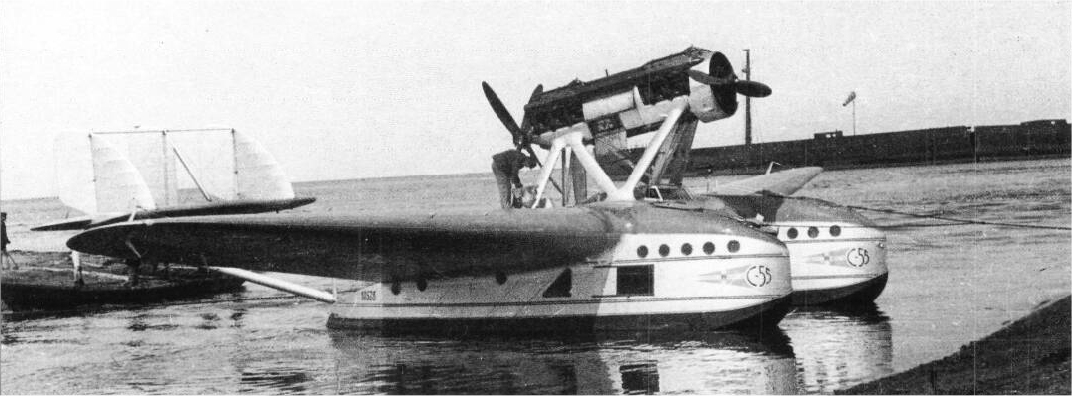
The S.55P was radically distinguished by its bold and highly functional architecture, a true jewel of aeronautical engineering. Its unmistakable double hull configuration, similar to a flying catamaran, offered superior stability on the water and allowed for an innovative and balanced distribution of the payload.
Above the powerful central wing, the pair of engines was mounted in a push-pull tandem configuration, an avant-garde solution for the time. This engineering arrangement drastically reduced aerodynamic drag and optimized power output, ensuring exceptional performance for an aircraft of its category and size.
The construction involved a clever mix of wood and metal, with canvas and plywood coverings, elements that gave structural strength without compromising the fundamental buoyancy and lightness essential for a seaplane. Every single detail was meticulously studied for the long and demanding sea journeys.
Onboard Specifications
- ◆Twin-engine tandem configuration: Two Isotta Fraschini Asso 750 engines (or similar), positioned centrally above the wing, one in a pulling configuration and the other pushing, for maximum propulsive efficiency and lower drag.
- ◆Double hull structure: Two independent fuselages acted as floats and housed passengers or cargo, improving hydrodynamic stability and safety when landing and taking off on water.
- ◆Load capacity and extended range: Designed to carry up to 10-12 passengers or a significant load of mail, with fuel tanks sized to cover transoceanic distances, making it ideal for emerging trade routes.
Operational Career & Operators
The Savoia-Marchetti S.55P found primary and strategic use in emerging Italian and international airlines, including the pioneering Società Aerea Mediterranea (SAM). It was the protagonist of numerous commercial flights, connecting maritime cities and remote islands with a regularity and efficiency unthinkable until a few years before, opening new frontiers for transport.
Its exceptional reliability and unique ability to operate effectively in aquatic environments made it an invaluable asset for the transportation of passengers, air mail and cargo. The routes served were fundamental for the development of communications and trade in the vast Mediterranean basin and, later, beyond its borders.
Although less celebrated for transatlantic records than some more daring military variants of the S.55, the "P" model cemented its reputation as the "pony express" of the sea skies, setting the stage for the future of long-distance passenger air transport and helping to normalize air travel.
Legacy & Cultural Impact
The S.55P, despite being a version focused on transport and less on the spectacular nature of extreme feats compared to Italo Balbo's S.55, contributed in a silent but profoundly significant way to the evolution of commercial aviation. Its innovative engineering and reliability influenced the design of numerous future seaplanes.
It fully embodied the confidence and optimism of the era, demonstrating in a concrete way that long-distance air travel was no longer a mere dream for fearless adventurers, but a practical, safe and commercially viable reality. It has paved the way for new global connections and the overcoming of geographical barriers that seemed insurmountable.
Today, the Savoia-Marchetti S.55P is remembered as a true pioneer of scheduled air transport, a tangible testimony of Italian ingenuity and a fundamental link in the evolutionary chain that led to modern aviation. Its story is a tribute to the vision, innovation and courage of those who dared to challenge the skies and oceans.
Telemetria Specs (HUD)
Hangar Trivia & Curiosità
- 💡Its distinctive design, featuring twin hulls connected by a single large wing and a central crew pod, made it instantly recognizable globally.
- 💡The S.55 series achieved international fame through record-breaking flights, including Italo Balbo's mass transatlantic formations of S.55s in the early 1930s.
- 💡Engines were typically mounted in a tandem 'push-pull' configuration above the wing, a unique arrangement for efficient power delivery.
Archivio Avvistamenti Spotter
Immagini scattate dalla community in tutto il mondo