Roland
Rohrbach
Historical Context & Origins
The post-World War I era imposed severe restrictions on the German aviation industry, banning the production of military aircraft. This challenging period, however, became a catalyst for civilian innovation, pushing companies to focus on developing robust, efficient and safe passenger aircraft.
In this climate of rebirth and ingenuity, Rohrbach Metall-Flugzeugbau GmbH emerged, under the visionary leadership of Dr. Adolf Rohrbach. The company stood out for its unwavering belief in all-metal construction, a then cutting-edge philosophy that promised greater durability and superior performance than traditional wood and canvas structures.
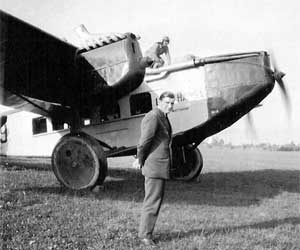
The Rohrbach Roland, whose conception took shape from this vision, made its first flight in 1926. Designed specifically as a passenger airliner, the Roland responded to the growing need for reliable and comfortable air connections, marking the beginning of a new era for commercial aviation in Europe.
Architecture & Technological Design
The hallmark of the Roland was its revolutionary construction architecture. He was one of the pioneers to widely adopt all-metal construction, predominantly using duralumin. This material, very advanced for its time, guaranteed superior structural resistance, greater longevity and simplified maintenance compared to traditional aircraft.
The design featured a cantilever high-wing configuration, an engineering choice that eliminated the need for external struts or tie rods, significantly reducing drag. This solution also offered passengers an unrivaled panoramic view, improving the travel experience.
Generally, the Roland was a tri-engine, a configuration that provided both greater power for carrying sizable payloads and a crucial safety factor thanks to thruster redundancy. Reliable engines such as the BMW V or the Pratt & Whitney Hornet were often employed, with one engine in the nose and two mounted under the wings.
Onboard Specifications
- ◆All-metal construction in duralumin: A futuristic choice that gave the aircraft exceptional structural strength and operational longevity superior to wood and canvas biplanes.
- ◆Tri-engine configuration: Equipped with three engines (e.g. BMW V or Pratt & Whitney Hornet), it guaranteed not only greater power for load and speed, but also a crucial level of safety thanks to engine redundancy.
- ◆Cantilever high wing: An innovative design that eliminated external tie rods, reducing parasitic drag and offering an exceptional panoramic view from the passenger cabin, improving on-board comfort.
Operational Career & Operators
The Rohrbach Roland found its main application and maximum operational splendor at the nascent German airline Lufthansa. It was a real workhorse, fundamental for the expansion and structuring of the first air routes in Europe, effectively connecting the main cities of the continent.
With a carrying capacity of approximately 10-12 passengers, a considerable number by the standards of the time, the Roland operated on medium-range routes. Its reputation for reliability and the relative comfort offered by its cabin contributed significantly to building public confidence in commercial air travel.
Although the production of the Roland was not large, with the number of examples estimated at around dozen units, its impact was profound. Each aircraft played an essential role, demonstrating the economic feasibility and safety of scheduled air transport, overcoming the difficulties imposed by post-war restrictions.
Legacy & Cultural Impact
The Rohrbach Roland's legacy goes far beyond its limited number of units produced. It represented a milestone in the development of all-metal, multi-engine airliners, validating this technology as the future standard for commercial aviation in terms of robustness, safety and operational efficiency.
The Roland contributed substantially to outlining the image of future air transport, accelerating the acceptance and adoption of scheduled flights by the general public. Although not as famous as other iconic aircraft, its influence on subsequent passenger aircraft designs is undeniable, especially in its construction philosophy.
Ultimately, the Rohrbach Roland embodies the spirit of innovation and resilience of German aeronautical engineering in a period of profound transformation. He was a silent pioneer, whose technical and operational impact laid a solid foundation for the golden era of airliners that would follow, making him a seminal chapter in the history of civil aviation.
Telemetria Specs (HUD)
Hangar Trivia & Curiosità
- 💡Its all-metal construction using duralumin was highly advanced and unusual for 1926, when most aircraft were still made of wood and fabric.
- 💡It was one of the first aircraft specifically designed for commercial passenger transport in Germany after World War I, significantly contributing to the development of Lufthansa.
- 💡The Roland I and Roland II variants were produced, featuring different engine configurations and slight design improvements during its operational life.
Archivio Avvistamenti Spotter
Immagini scattate dalla community in tutto il mondo