P.166
Piaggio
Historical Context & Origins
In post-war Italy, Piaggio Aero Industries, already known for the innovative P.136 amphibious seaplane, identified the need for a multi-purpose land aircraft, capable of excelling in both executive transport and specialist roles. This scenario stimulated the start of an ambitious new project.
The idea was to adapt the successful "pusher" propulsion configuration of the P.136 to an entirely new airframe, optimized for land operation. Thus was born the Piaggio P.166, a twin-engine aircraft that embodied the ingenuity and elegance of Italian aeronautical design.
The first flight of the P.166 occurred in 1957. This event marked the beginning of a long and honored career for the aircraft, which immediately stood out for its unique architecture and the promise of exceptional versatility, laying the foundations for numerous variants and diversified uses.
Architecture & Technological Design
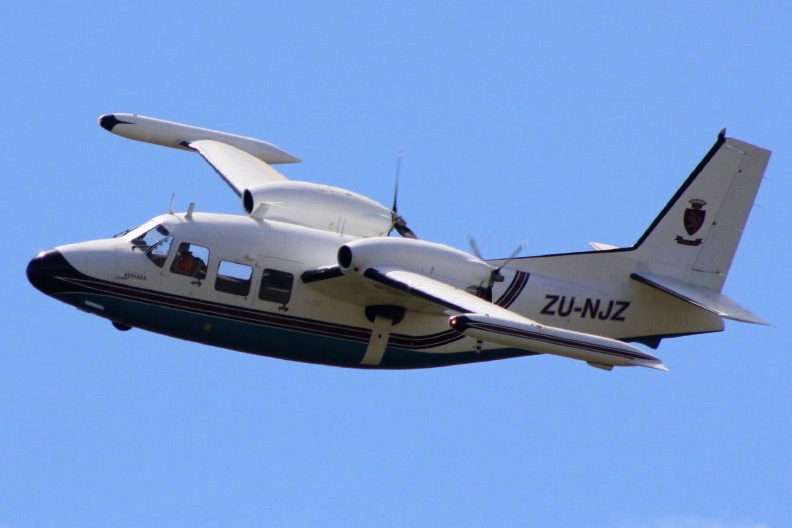
The P.166 is a clear example of functional and innovative design. Its distinctive inverted gull wing, mounted high on the fuselage, not only gave it an unmistakable aesthetic, but also ensured excellent visibility and a strong and lightweight structural configuration.
The most iconic feature of the P.166 was undoubtedly its twin-engine pusher configuration, with the Lycoming engines mounted on the wings and the propellers positioned at the rear. This solution reduced cabin noise and improved structural safety in the event of a landing.
The fuselage, wide and generous, was designed to offer maximum flexibility. It could accommodate 6-8 passengers in executive configuration, or be quickly reconfigured for cargo transport, photographic reconnaissance, maritime surveillance or training.
Onboard Specifications
- ◆Engines in pusher configuration: Reduced cabin noise and offered greater structural safety by protecting the propellers.
- ◆Inverted Gull Wing: Contributed to distinctive aesthetics and excellent low-speed flight characteristics.
- ◆Modular and spacious fuselage: It allowed multiple internal configurations, from passenger transport to cargo transport or special missions.
Operational Career & Operators
The Piaggio P.166 quickly earned a reputation as a reliable and versatile aircraft, finding use in myriad civil and military contexts globally. Its robustness made it ideal for operations even in less equipped or remote environments.
Numerous air forces and civilian operators adopted the P.166. In Italy, the Guardia di Finanza used it extensively for coastal surveillance and maritime patrol missions, while the Air Force used it for liaison and light transport roles.
Internationally, the P.166 also enjoyed success, particularly in Australia, where its P.166BL2 "Portofino" and P.166C variants were appreciated for their ability to operate in remote regions and to transport personnel and materials. Its operational longevity testifies to the validity of the project.
Legacy & Cultural Impact
The Piaggio P.166 was not just an airplane, but a symbol of the Italian aeronautical ingenuity of its time. It demonstrated that it was possible to combine innovation, aesthetics and practicality in a single package, serving as a bridge between the era of seaplanes and that of multi-role land aircraft.
Its distinctive silhouette, with pusher engines and gull wing, made it immediately recognizable and engraved it in the collective imagination of aviation enthusiasts. Even today, several examples are preserved or fly in private hands, keeping its history alive.
The legacy of the P.166 lies in its ability to adapt and its resilience. It paved the way for multi-purpose aircraft concepts and consolidated Piaggio's reputation as a manufacturer capable of producing innovative and durable aircraft, leaving an indelible mark on the global aeronautical landscape.
Telemetria Specs (HUD)
Hangar Trivia & Curiosità
- 💡It features a unique 'gull-wing' design, where the wings are angled upwards near the fuselage and then flatten out, with engines mounted above the wing.
- 💡The P.166 is distinctive for its pusher propeller configuration, meaning the propellers are located at the rear of the engine nacelles and push the aircraft.
- 💡Developed from the Piaggio P.136 amphibian, the P.166 was primarily designed for land-based operations but retained a robust structure, making it highly adaptable for various roles.
Archivio Avvistamenti Spotter
Immagini scattate dalla community in tutto il mondo