Metro III
Swearingen
Historical Context & Origins
The decade of the 1980s saw an explosion in regional air traffic, driven by deregulation and growing demand for point-to-point connections. In this dynamic scenario, Swearingen Aircraft, an already established name in the commuter aircraft scene, was ready to present a significant evolution of its successful Metroliner project, raising the standards of capacity and performance.
The Metro III, which first flew in 1980, was not a revolution from scratch, but rather the culmination of years of refinement of a winning concept. Building on the solid foundations of the Metro I and II models, Swearingen aimed to overcome capacity and speed limitations, offering an aircraft capable of competing effectively in an increasingly demanding market for short- and medium-haul flights.
Architecture & Technological Design
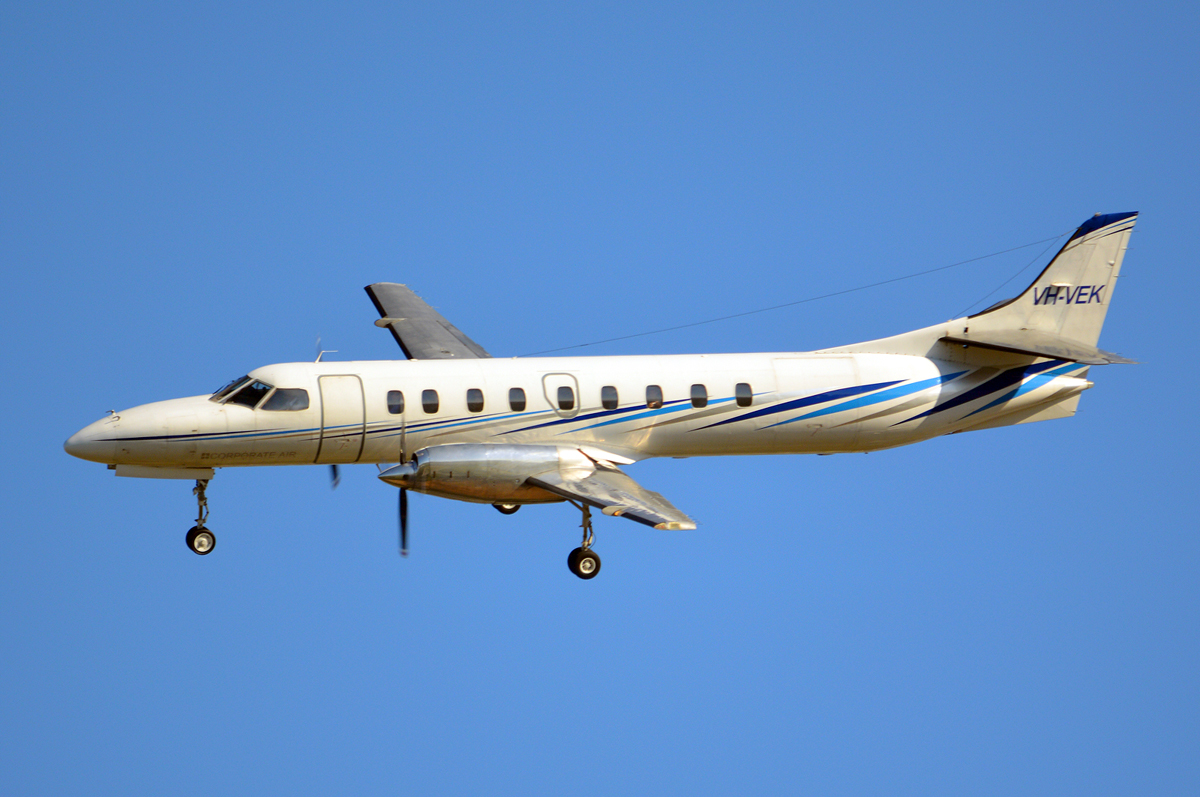
The design of the Swearingen Metro III represents an ingenious combination of robustness and aerodynamic functionality, designed specifically for the rigorous demands of regional air transport. Its airframe, maintaining the recognizable elongated silhouette of the Metroliner family, was optimized to increase capacity and improve flight performance, cementing its reputation as a reliable workhorse.
The technical innovations introduced were aimed at maximizing operational efficiency. It was notable for a redesigned wing with an increased span, which not only improved lift and reduced drag, but also integrated distinctive tip-tanks for extended range. This configuration, combined with more powerful turboprop engines, ensured greater load capacity and notable performance in "hot and high" conditions.
Onboard Specifications
- ◆Upgraded Garrett TPE331-11U engines: These turboprops offered considerably more power than previous versions, resulting in improved climb performance, higher cruise speeds and excellent reliability.
- ◆Increased wingspan with integrated tip-tanks: The increase in wingspan, combined with the integration of additional tip tanks, has improved aerodynamic efficiency, stability and autonomy, making the Metro III ideal for longer regional routes.
- ◆Advanced anti-icing system: Crucial for operations in various weather conditions, this system ensured the safety and reliability of the aircraft in environments with risk of icing, expanding its operational versatility.
Operational Career & Operators
The Swearingen Metro III quickly established itself as a dominant player in the regional air transport industry, operating for countless airlines around the world. From small commuter carriers in the United States to remote routes in Australia and Canada, its reliability and economical operation made it a favorite choice for connecting communities often overlooked by major airlines.
Its versatility extended far beyond simple passenger transport. The Metro III also excelled in the role of cargo feeder, carrying mail and parcels for logistics giants, and found use in special missions as a company aircraft, air ambulance or surveillance plane. Its ability to operate from short and unprepared runways made it a real "workhorse" for the most disparate needs.
Legacy & Cultural Impact
The legacy of the Swearingen Metro III is engraved in regional aviation history, representing an iconic model of propeller-driven transport aircraft. His prolonged operational career, which continues today, especially in the cargo sector, testifies to the solidity of his project and the foresight of his conception. It proved that a robust and efficient design can stand the test of time.
Still in service in many parts of the world, the Metro III has left an indelible mark on the way small communities are connected and goods transported. It helped shape the modern concept of regional air transport, influencing subsequent generations of aircraft and maintaining a prominent place in the collective memory of aviation enthusiasts, a symbol of pragmatic engineering and operational resilience.
Telemetria Specs (HUD)
Hangar Trivia & Curiosità
- 💡It is part of the long-running Metroliner series, which began with the SA226TC Metro and evolved through several improved versions over decades.
- 💡The Metro III gained recognition for its ability to operate from shorter, unpaved runways, making it highly adaptable for remote regional services.
- 💡Beyond civilian use, variants like the C-26 Metroliner have served extensively with military forces globally for transport and surveillance missions.
Archivio Avvistamenti Spotter
Immagini scattate dalla community in tutto il mondo
Vettori Rilevati (Flotta Attiva)


Hahn Air
In Flotta: x5 u.

Perimeter Aviation
In Flotta: x10 u.

Ameriflight
In Flotta: x10 u.
Key Lime Air
In Flotta: x10 u.
Luxair
In Flotta: x14 u.
Horizon Air
In Flotta: x15 u.
Northern Air Cargo
In Flotta: x11 u.
Aeronaves TSM
In Flotta: x11 u.
WDL Aviation
In Flotta: x4 u.
Bin Air
In Flotta: x13 u.Vettori Rilevati (Flotta Storica / Dismessa)


European Aviation
Stato: Dismesso

Crossair
Stato: Dismesso
Air Regional
Stato: Dismesso
PAL Airlines
Stato: Dismesso
Southern Air Transport
Stato: Dismesso
Naske Air
Stato: Dismesso
Abacus Air
Stato: Dismesso
HADAG Air
Stato: Dismesso
Hössl & Winkler
Stato: Dismesso
RFG – Regionalflug
Stato: Dismesso
Delta Air Lines
Stato: Dismesso
Ratioflug Luftfahrtunternehmen
Stato: Dismesso
Dauair
Stato: Dismesso
Nürnberger Flugdienst
Stato: Dismesso
City-Flug
Stato: Dismesso

Holiday Airlines
Stato: Dismesso
Luftfahrtgesellschaft Walter
Stato: Dismesso