Martin M-130
Martin
Historical Context & Origins
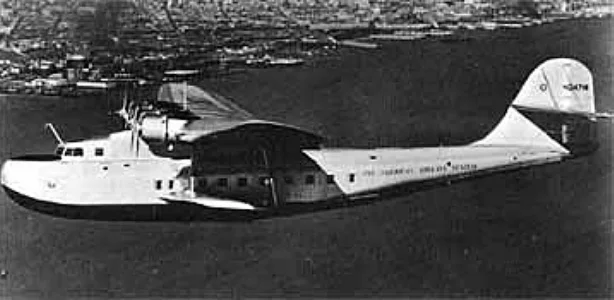
The Martin M-130 was a legendary four-engine commercial flying boat designed and built by the Glenn L. Martin Company in the early 1930s for Pan American Airways. Conceived to overcome the immense ocean distances of Pacific routes, the aircraft made its first flight on December 30, 1934.
Only 3 aircraft were built in total (named *China Clipper*, *Philippine Clipper*, and *Hawaii Clipper*). These planes marked the beginning of Pan Am's legendary "Clipper" era, inaugurating the first scheduled transpacific airmail service in 1935 and, later, passenger transport.
These giants of the sea and air offered unprecedented transoceanic range for their time, reducing Pacific crossings to a few days of staged flights.
Architecture & Technological Design
The architecture of the Martin M-130 was massive, featuring an all-metal aluminum hull with lateral hydro-stabilizers (known as "sea wings"), patented by Martin, which also served as auxiliary fuel tanks.
Propulsion was provided by four Pratt & Whitney R-1830 Twin Wasp radial engines of 830 horsepower each, enabling a cruising speed of approximately 260 km/h and a maximum range of over 5,000 km under full load.
The passenger accommodations were exceptionally luxurious, designed to carry 36 to 48 passengers in upscale lounges convertible into sleeping berths for overnight flights, supported by a crew of 14 members providing first-class service.
On-Board Specifications
- ◆Four Twin Wasp radial engines mounted on the high wing for a total power of approximately 3,300 hp.
- ◆Lateral sea wings for hydrodynamic stability in water and extra fuel storage.
- ◆Luxurious passenger salon featuring an on-board galley and sleeping berths for overnight crossings.
Operational Career & Airlines
The Martin M-130 was operated exclusively by Pan American Airways on the pioneering transpacific route from San Francisco to Manila, with technical stops at Honolulu, Midway, Wake, and Guam.
Unfortunately, the operational history of these three aircraft ended tragically. All three airframes were destroyed in catastrophic accidents: the *Hawaii Clipper* disappeared mysteriously in the Pacific in 1938, the *Philippine Clipper* crashed in 1943, and the famous *China Clipper* sank in 1945 following a night emergency landing.
Despite the tragic loss of the fleet, the M-130 proved that regular transoceanic air transport was technically feasible and commercially viable.
Legacy & Cultural Impact
The Martin M-130 remains an immortal icon of aviation history, immortalized in films, books, and photographs of the era. The *China Clipper* became a symbol of American technological progress in the 1930s.
Today, no complete examples of this historic flying boat survive, but its achievements paved the way for subsequent large passenger flying boats like the Boeing 314, defining the pioneering spirit of transoceanic travel.
Telemetry Specs (HUD)
Hangar Trivia & Facts
- 💡Completed its maiden flight in 1934 before entering active service.
- 💡Designed specifically as a Idrovolante di linea a lungo raggio to meet the requirements of contemporary airlines.
- 💡Features a configuration with 4 × Pratt & Whitney R-1830 Twin Wasp ensuring excellent high-altitude flight performance.
Archivio Avvistamenti Spotter
Immagini scattate dalla community in tutto il mondo