M.B.308
Aermacchi
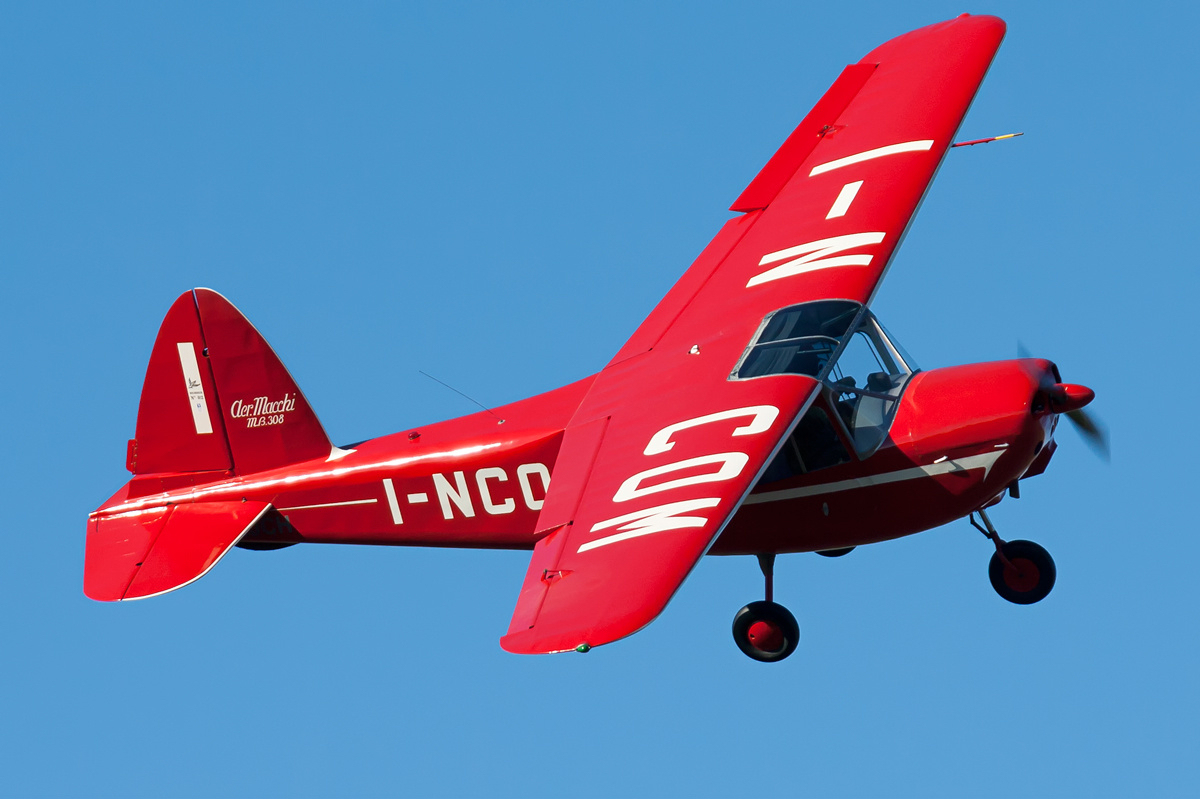
Historical Context & Origins
In the vibrant but difficult scenario of post-World War II Italy, a pressing need emerged to rebuild light civil and military aviation. The national aeronautical industries, severely tested by the conflict, were looking for new production horizons, focusing on economical, robust and versatile aircraft, capable of supporting economic recovery and the training of new pilots.
Engineer Ermanno Bazzocchi, Aermacchi's brilliant and visionary mind, responded to this need with a project that embodied Italian practicality and ingenuity. His intent was to create a light aircraft, easy to fly and maintain, intended for both training and tourism. The first flight of the Aermacchi M.B.308 took place in 1948, marking an important step in the country's aeronautical rebirth.
Architecture & Technological Design
The M.B.308 was conceived as a high-wing monoplane, a configuration that guaranteed excellent visibility and remarkable stability in flight, ideal characteristics for a training and liaison aircraft. Its simple but effective architecture was the result of careful design, aimed at maximizing reliability and minimizing production and maintenance costs.
The aircraft's construction was mixed, a common approach at the time to balance strength and lightness. The fuselage featured a welded steel tube structure covered in canvas, while the wings combined wooden elements with canvas covering. This construction choice made the M.B.308 easily repairable and adaptable to the resources available after the war.
Onboard Specifications
- ◆High-wing configuration: Excellent visibility for pilots and inherent stability, ideal for initial training and tourist flying.
- ◆Mixed wood and metal structure with canvas covering: Optimal compromise between lightness, robustness and ease of repair and maintenance, crucial in the post-war era.
- ◆Fixed landing gear, conventional type with tail wheel: Constructive simplicity and reliability, allowing operations even on semi-prepared or grass runways.
Operational Career & Operators
The Aermacchi M.B.308 quickly established itself as the workhorse of Italian aeroclubs, providing the essential platform for training a new generation of civilian aviators. Its ease of piloting and low operating costs made it extremely popular, helping to democratize access to flying in Italy.
Although its main role was civilian, the M.B.308 was also used by the Italian Air Force in limited quantities for liaison and basic training tasks. With over 180 examples produced in different variants, including an amphibious version, the aircraft demonstrated the versatility and solid engineering of the Italian design.
Legacy & Cultural Impact
The Aermacchi M.B.308 transcends the mere status of a flying machine; it is a symbol of Italian resilience and ingenuity in the difficult phase of reconstruction. It represented a bridge between the glorious but traumatic pre-war aeronautical tradition and the post-war renewal of the sector, training thousands of pilots.
Even today, several examples of M.B.308 are jealously preserved and flying, testifying to the robustness of the design and the affection that this aircraft has been able to generate. His figure is often evoked as an icon of Italian light aviation, a timeless classic that continues to inspire enthusiasts and collectors.
Telemetria Specs (HUD)
Hangar Trivia & Curiosità
- 💡Fu uno dei primi aerei prodotti da Aermacchi dopo la Seconda Guerra Mondiale, segnando il ritorno dell'azienda alla produzione di velivoli leggeri.
- 💡Alcuni M.B.308 furono prodotti su licenza in Argentina dalla Aerotecnica S.A., dove furono designati Aerotecnica A.T.2.
- 💡L'M.B.308 era noto per la sua stabilità in volo e la sua capacità di operare da piste non preparate, rendendolo ideale per l'uso in zone rurali.
Archivio Avvistamenti Spotter
Immagini scattate dalla community in tutto il mondo