M-130
Martin
Historical Context & Origins
In the aeronautical landscape of the 1930s, an era of bold achievements and pioneering vision, Pan American World Airways (Pan Am) was looking for an aircraft capable of making the dream of transoceanic flights a reality. It was in this context that the Martin M-130 saw the light of day, designed specifically for the grueling routes across the Pacific Ocean. Its first flight in 1935 marked the beginning of a new era for commercial aviation.
The need was clear: a robust seaplane, with unprecedented autonomy and capable of carrying passengers and mail across immense expanses of ocean, where land airports were non-existent. The Glenn L. Martin Company accepted the challenge, developing an aircraft that would not only meet these stringent requirements but exceed them, redefining the standards of long-range flight.
Architecture & Technological Design
The Martin M-130 was a majestic all-metal seaplane, a cutting-edge technical feature for its time, ensuring robustness and durability. Its cantilevered high-wing configuration housed four powerful Pratt & Whitney R-1830 Twin Wasp radial engines, strategically positioned to maximize the lift and propulsion needed for takeoff from water.
The hull design was a masterpiece of hydrodynamic engineering, optimized to ensure stability in the water and minimize aerodynamic drag in flight. The extremely refined interiors offered a level of comfort and luxury unthinkable for the time, with spaces dedicated to passengers and crew, in anticipation of journeys lasting tens of hours.
Onboard Specifications
- ◆Super high fuel capacity: Essential for long trans-Pacific routes.
- ◆Advanced navigation equipment: Crucial for ocean orientation.
- ◆Reinforced hull structure: To ensure resistance to impacts on the water.
Operational Career & Operators
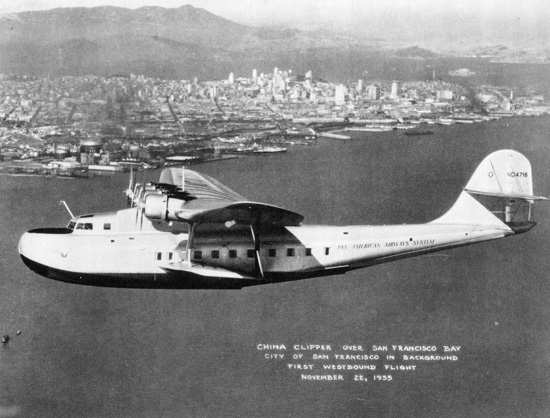
The Martin M-130 became the symbol of Pan Am's trans-Pacific expansion. Only three examples were built, christened the "China Clipper", "Philippine Clipper" and "Hawaii Clipper", names that evoked a sense of adventure and mystery. These giants of the skies were the protagonists of the first trans-Pacific air mail service, inaugurated in November 1935, from San Francisco to Manila.
The "Clippers" established vital routes connecting the United States with Hawaii, Midway, Wake, Guam, and the Philippines, radically transforming commerce and communications. Their career was epic, but also tragic: two of the three M-130s were lost during World War II under different circumstances, while the third was subsequently scrapped.
Legacy & Cultural Impact
The Martin M-130 was not just an airplane; he was a pioneer, an icon of the Golden Age of transoceanic flight. Its success unequivocally demonstrated the commercial and technical feasibility of long-range flights, paving the way for even larger and more sophisticated aircraft, such as the legendary Boeing 314 Clipper.
The "China Clipper" in particular entered the collective imagination, symbolizing luxury, exploration and global connectivity. It has left an indelible mark on the history of aviation, serving as a catalyst for the development of infrastructure and technologies that we now take for granted in the world of global air travel.
Telemetria Specs (HUD)
Hangar Trivia & Curiosità
- 💡Furono costruiti solo tre esemplari di M-130: il "China Clipper", il "Philippine Clipper" e l'"Hawaiian Clipper".
- 💡Il "China Clipper" completò il primo volo commerciale trans-Pacifico da San Francisco a Manila nel novembre 1935.
- 💡Gli M-130 furono cruciali per le rotte "Clipper" di Pan Am, stabilendo collegamenti vitali prima della Seconda Guerra Mondiale.
Archivio Avvistamenti Spotter
Immagini scattate dalla community in tutto il mondo