Laté 28
Latecoere
Historical Context & Origins
In the innovative flurry of the post-war period, French civil aviation sought to expand its postal and passenger routes, particularly to Africa and South America. The Latécoère company, already a pioneer with its "Lignes Aériennes Latécoère" (future Aéropostale), needed a superior aircraft to meet the growing challenges of these bold and forward-thinking enterprises.
This context gave birth to the Latecoere Laté 28, a robust and versatile monoplane, whose first flight took place in 1927. The aircraft was conceived as an evolution of its predecessors, specifically designed to overcome the limits of autonomy and payload, fundamental characteristics for transoceanic ambitions and desert routes.
The Laté 28 represented the direct response to the need for a vehicle capable of combining speed, reliability and considerable transport capacity, essential qualities for the postal air service which was about to rewrite the geography of the world. He was destined to become a legend of pioneering aviation.
Architecture & Technological Design
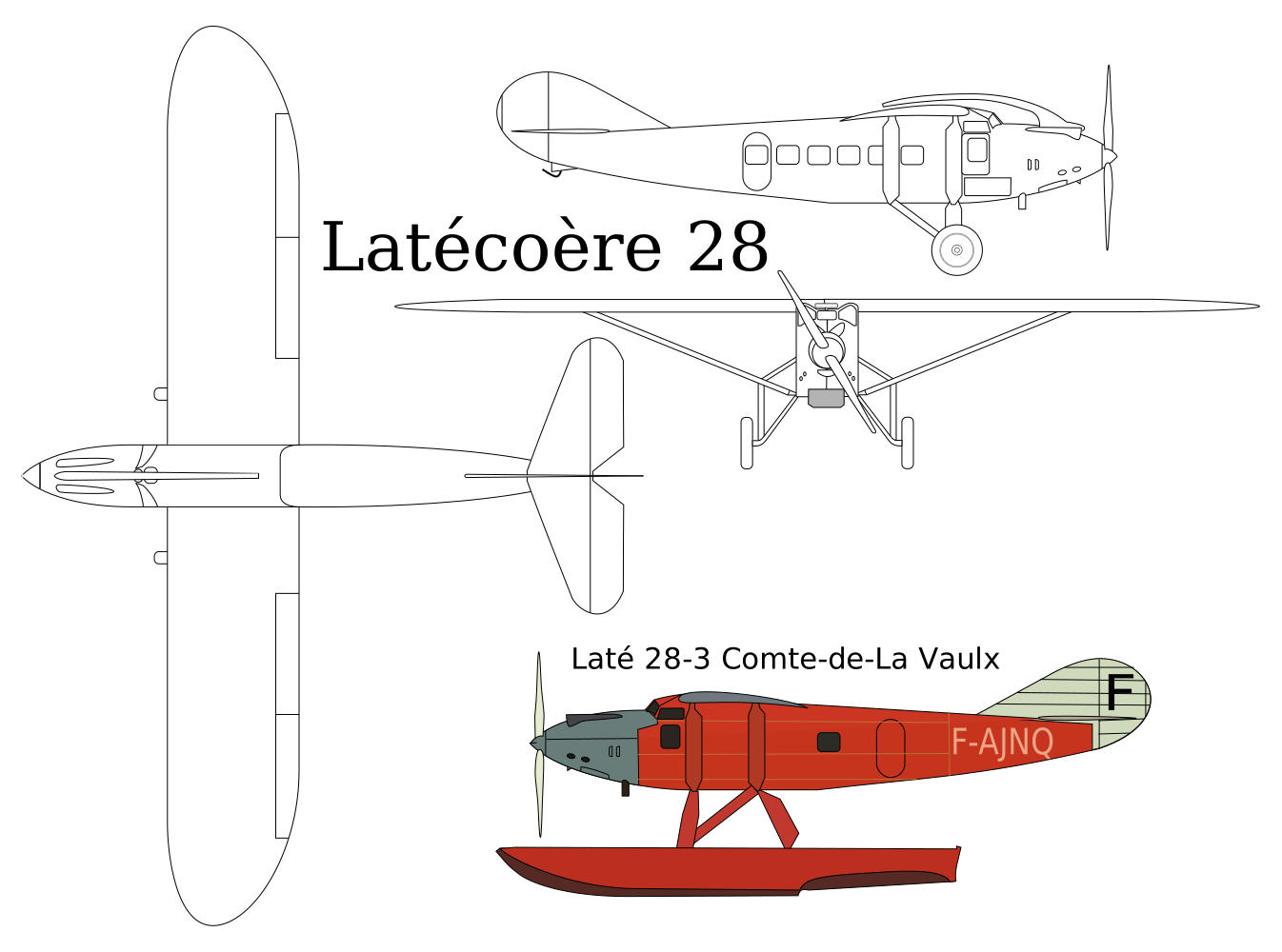
The architecture of the Laté 28 was that of a high-wing monoplane with a rectangular-section fuselage, made of welded steel tubes and covered in canvas, ensuring a robust and easy-to-repair structure. This classic configuration was optimized for maximum aerodynamic efficiency and to withstand the severe operating conditions of intercontinental routes.
The beating heart of the Laté 28 was usually a Hispano-Suiza 12Lbr engine with 600 HP or, in some variants, a Renault 12Jb, giving the aircraft the power necessary for long flights with heavy loads. Its structural robustness and the reliability of the engine were essential prerogatives for the safety of air connections.
A distinctive feature was the closed cockpit, a rarity for the time, which offered greater comfort and protection to the crew, significantly improving operating conditions during the grueling hours of flight. This design contributed to its reputation as a cutting-edge aircraft.
Onboard Specifications
- ◆Exceptional load capacity: Essential for transporting mail and goods over long distances.
- ◆Extended autonomy: It allowed you to cover transatlantic and intercontinental routes without frequent refueling.
- ◆Structural and engine reliability: Crucial for safe operations in extremely diverse climatic and geographic environments.
Operational Career & Operators
The Laté 28 quickly became the ace in the hole of Aéropostale, the iconic French airline. His career is inextricably linked to the epic exploits of legendary pilots such as Jean Mermoz, who on 12 May 1930 carried out the first non-stop transatlantic postal flight between Saint-Louis in Senegal and Natal in Brazil, aboard a Laté 28.3, renamed "Comte de la Vaulx".
These daring crossings were not without danger, including extreme weather conditions and the complexity of air navigation at the time. Laté 28 demonstrated incredible resilience, overcoming technical and environmental challenges and opening new avenues for global communication, drastically shortening distances.
In addition to postal transport, some versions of the Laté 28 were also used for luxury passenger services, although its primary role remained as a mail carrier, a symbol of progress and human determination to connect the world through the sky.
Legacy & Cultural Impact
The Latecoere Laté 28 was not just an airplane; it was a symbol of the audacity and pioneering spirit of French aviation in the 1920s and 1930s. His exploits contributed significantly to the creation of regular and reliable air routes, laying the foundations for modern commercial aviation and connecting previously isolated continents.
Its legend is intrinsically linked to the heroic deeds of the Aéropostale pilots, figures who inspired writers such as Antoine de Saint-Exupéry, whose works immortalized the epic of the "sky couriers" and the reliability of their aircraft. The Laté 28 perfectly embodies that golden age of aviation in which human courage merged with technological innovation.
His legacy lies in proving that long-range flights and intercontinental routes were possible, paving the way for the development of ever more sophisticated aircraft. The Laté 28 remains a milestone in aviation history, a testament to the vision and engineering that shaped the way we travel and communicate.
Telemetria Specs (HUD)
Hangar Trivia & Curiosità
- 💡Jean Mermoz made the first non-stop South Atlantic crossing with a Laté 28 on May 12-13, 1930, flying from Saint-Louis, Senegal, to Natal, Brazil.
- 💡Antoine de Saint-Exupéry, famous author of "The Little Prince," piloted Laté 28s for Aéropostale, flying mail routes over North Africa and South America.
- 💡The Laté 28 was instrumental in expanding Aéropostale's network, enabling reliable airmail delivery over challenging terrains and vast oceans, significantly shortening communication times.
Archivio Avvistamenti Spotter
Immagini scattate dalla community in tutto il mondo