Languedoc SE.161
Costruttore Sconosciuto
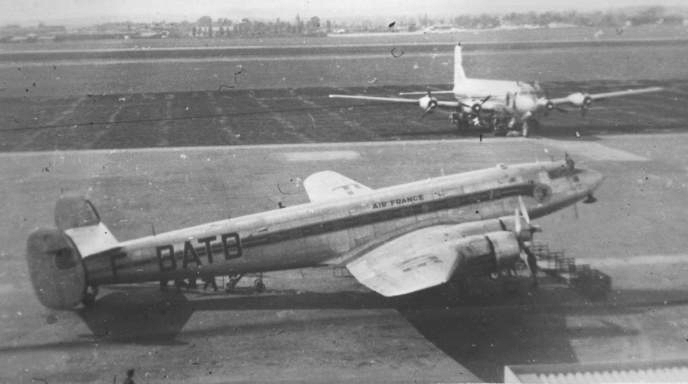
Historical Context & Origins
The Languedoc SE.161 emerges from a period of profound transformation and hope, in the immediate post-war period. With its first flight in 1945, it positioned itself as a symbol of the rebirth of French civil aviation, an essential bridge between an era ravaged by conflict and a future of air connections.
The project has its roots in the Bloch MB.161, a pre-war passenger aircraft designed for Air France, which unfortunately could not see the operational light due to the German invasion. Its reworking by SNCASO (Société Nationale des Constructions Aéronautiques du Sud-Ouest) gave life to the Languedoc, inheriting a solid design basis.
The primary objective was ambitious: to provide France and Europe with a robust and reliable medium-range airliner. It was supposed to rebuild the air transport networks, fundamental for the economic and social recovery of the continent.
Architecture & Technological Design
The Languedoc SE.161 presented itself as a majestic four-engine low-wing cantilever, a well-proven technical configuration that promised stability and adequate performance for air travel of the time. Its all-metal structure, robust and durable, guaranteed the reliability necessary to operate in an infrastructure still in the process of being restored.
Initially powered by four Gnome-Rhône 14N radial engines, the aircraft subsequently underwent the introduction of more modern and powerful engines such as the Pratt & Whitney R-1830 Twin Wasp or the Hercules for some variants, improving its performance and efficiency. This engine flexibility was crucial to adapt to post-war availability.
The design included a retractable tricycle landing gear, a modern feature that helped improve in-flight aerodynamics, distinguishing it from many other transitional aircraft and underlining the intention to create a cutting-edge aircraft for its time.
Onboard Specifications
- ◆Passenger capacity: Up to 33-44 seats, depending on the internal configuration.
- ◆Operational autonomy: Approximately 2,000 km, ideal for European and national routes.
- ◆Cruising speed: Approximately 380 km/h, respectable by 1940s standards.
Operational Career & Operators
The Languedoc SE.161 quickly became a mainstay of the Air France fleet, which was its main operator. It served with dedication on national and international short-medium range routes, connecting the main European cities and significantly contributing to the reconstruction of post-war air links.
Despite its importance in the French context, the Languedoc faced stiff competition from more popular and often more advanced American aircraft, such as the Douglas DC-4. Its total production, of approximately 100 specimens, reflects its specific role and its limited global diffusion.
Some examples were converted for cargo missions or for military purposes, demonstrating the versatility of its architecture. The Languedoc was a workhorse for a crucial period, filling the shortage of civil aircraft in Europe.
Legacy & Cultural Impact
The Languedoc SE.161 remains an eloquent symbol of French determination to rebuild its aviation industry and transport network after the devastation of war. It was a vital link in the chain of aeronautical development, providing experience and a proving ground for future generations of French aircraft.
Although his operational career was not among the longest or most globally dominant, his contribution was invaluable for its time. It represented the first large-scale attempt to re-establish a French civilian presence in post-war skies, laying the foundation for future successes.
His legacy lies in his ability to rekindle the flame of civil aviation, demonstrating that even from the ashes of war, innovation and resilience could make a nation fly again. The Languedoc is a fundamental, albeit often underestimated, chapter in European aeronautical history.
Telemetria Specs (HUD)
Hangar Trivia & Curiosità
- 💡The Languedoc was originally designed by Bloch as the MB.161, with development halted during World War II and later resumed by SNCASE (Société Nationale de Constructions Aéronautiques du Sud-Est).
- 💡It suffered from a problematic service history, frequently experiencing technical issues such as landing gear collapses and engine reliability problems, earning it a less-than-favorable reputation.
- 💡Despite its shortcomings, the SE.161 played a crucial role in re-establishing Air France's routes in the immediate post-war era before being progressively replaced by more reliable aircraft like the Douglas DC-4.
Archivio Avvistamenti Spotter
Immagini scattate dalla community in tutto il mondo