L-200 Morava
LET
Historical Context & Origins
After the devastation of World War II, Czechoslovakia faced a growing need for multi-purpose light aircraft, capable of supporting both executive transport and general aviation. In this post-war scenario, the LET (Let Kunovice) company emerged as a key player in the national aviation industry, focused on reconstruction and innovation.
The need was for a modern, economical and reliable twin-engine aircraft, which could operate from less prepared runways and offer superior performance to the single-engine aircraft of the time. The L-200 Morava project was born precisely to fill this gap, with the aim of creating a cutting-edge aircraft by the standards of the 1950s.
The first flight of the XLD-600 prototype occurred in 1957, marking the beginning of a success story and immediately demonstrating the potential of the design. This crucial event paved the way for mass production and its rapid spread, not only in Czechoslovakia but throughout the Eastern Bloc and beyond.
Architecture & Technological Design
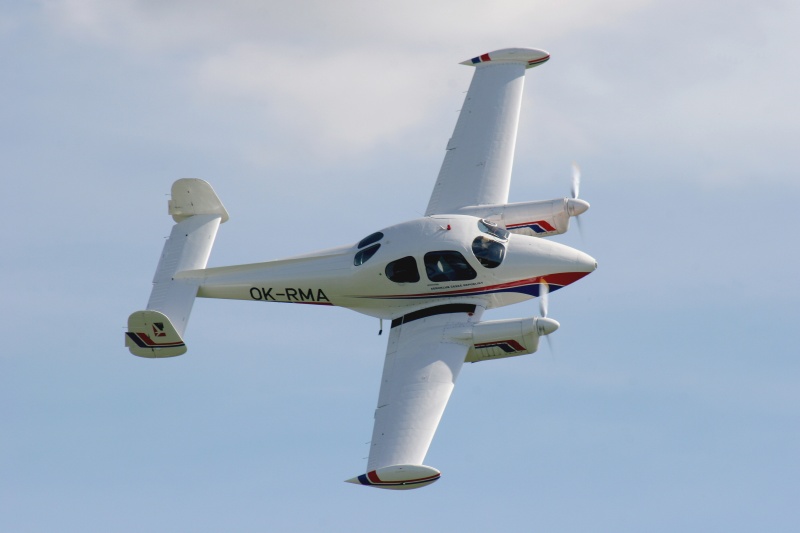
The LET L-200 Morava was designed as an all-metal low-wing monoplane, a configuration that provided strength, excellent aerodynamics and ease of maintenance. The choice of a semi-monocoque structure in light alloy guaranteed an optimal combination of weight and structural resistance, crucial for an aircraft intended for different roles.
Propulsion was entrusted to two reliable Walter M-337 or M-332, supercharged piston engines, capable of delivering 210 HP (M-337) or 160 HP (M-332) each, positioned in wing nacelles. This twin-engine configuration not only increased safety by allowing single-engine flight, but also provided the power needed for decent payload capacities and cruising speeds.
The design of the cockpit and passenger section was innovative for its time, with large windows for optimal visibility and an interior configurable to carry up to 4 passengers or equivalent cargo. The attention to ergonomics and comfort made the Morava particularly popular for medium-range flights and charter operations.
Onboard Specifications
- ◆Twin-engine capability: Ensuring improved reliability and safety, essential for passenger transport and specialized roles.
- ◆All-metal construction: Greater strength, operational life and reduced maintenance requirements compared to mixed constructions.
- ◆Retractable landing gear: Significantly improved aerodynamic performance, contributing to higher cruising speeds and greater range.
Operational Career & Operators
The Morava quickly found use in a wide range of roles. It became the aircraft of choice for executive transport and as an air taxi, connecting urban centers and remote locations with remarkable efficiency. Its versatility also made it ideal for pilot training and as an ambulance plane, demonstrating considerable adaptability.
It operated widely not only in Czechoslovakia and the Eastern Bloc countries, but was also successfully exported to countries such as Egypt, India, the United Kingdom and even Australia. This wide diffusion testified to its validity and ability to adapt to different operational and climatic contexts, consolidating its international reputation.
Its robustness, reliability and ease of maintenance contributed to its long operational career, with many examples remaining in active service for decades. Even today, some L-200 Moravas continue to fly in private hands, a testament to the engineering quality and inherent reliability of the design.
Legacy & Cultural Impact
The LET L-200 Morava left an indelible mark on Czechoslovakian and world aviation. It played a crucial role in the development of general aviation and regional air transport, serving as a trailblazer for subsequent twin-engine models produced by LET, such as the more famous L-410 Turbolet.
Its ubiquitous presence in the skies of Eastern Europe and beyond has helped define the image of the reliable and affordable light transport aircraft. It is considered a symbol of post-war Czechoslovak aeronautical engineering, capable of competing effectively with Western designs.
Even today, the Morava is admired by aviation enthusiasts for its clean aesthetics, its stable flying qualities and its historical importance. It represents not only a piece of aviation history, but also an enduring example of how a well-conceived design can ensure longevity and significant cultural impact far beyond its time of production.
Telemetria Specs (HUD)
Hangar Trivia & Curiosità
- 💡Il nome "Morava" deriva dalla regione omonima nella Repubblica Ceca, dove si trova la fabbrica Let Kunovice.
- 💡Fu progettato per sostituire l'Aero Ae-45, offrendo maggiore capacità e prestazioni migliorate rispetto al suo predecessore.
- 💡Oltre 360 unità furono costruite, e l'aereo fu ampiamente esportato, diventando uno degli aeromobili leggeri bimotore più riusciti della Cecoslovacchia.
Archivio Avvistamenti Spotter
Immagini scattate dalla community in tutto il mondo