L-1649 Starliner
Lockheed
Historical Context & Origins
In the lively post-war civil aviation rush, the aviation industry was in turmoil, with growing demand for long-haul flights. Lockheed, building on the success of the Constellation family, found itself having to respond to the challenge launched by the Douglas DC-7C "Seven Seas", which offered revolutionary autonomy. What was at stake was to dominate the transoceanic routes.
To maintain its leadership and provide a definitive answer, Lockheed began development of the L-1649 Starliner, the engineering pinnacle of the Constellation line. This project was not a simple evolution, but a radical redefinition, aimed at creating the largest and most high-performance piston aircraft ever produced by the company, capable of connecting continents non-stop.
The first flight occurred in 1956, positioning the Starliner as the true trans-Atlantic and trans-Pacific propeller-driven liner par excellence. It was conceived to embody luxury and reliability in the pre-jet era, promising an unprecedented travel experience to passengers on the most sought-after intercontinental routes.
Architecture & Technological Design
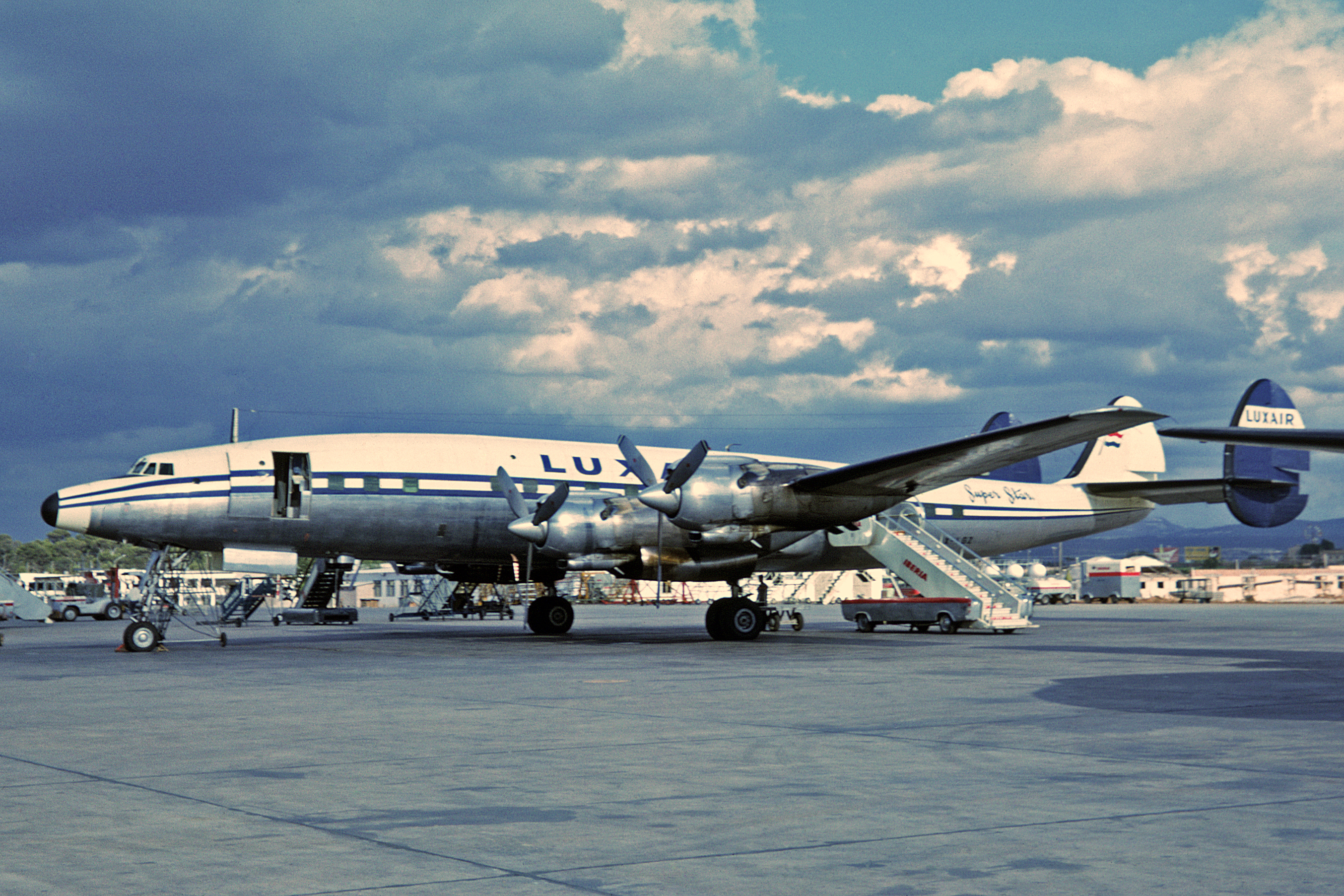
The heart of the Starliner's innovation lay in its completely new wing, long and thin, with a higher aspect ratio than any other piston airliner of the time. This configuration, with a wing area of 153.3 m² and a span of 46.43 meters, guaranteed extraordinary aerodynamic efficiency and minimal drag.
The fuselage maintained the characteristic "double bubble" shape of the previous L-1049 Super Constellation, but had been strengthened to accommodate the new loads and greater ranges. The real propulsive force was entrusted to four Wright R-3350-EA2 Turbo-Compound radial engines, each capable of delivering 3,400 horsepower. These complex powertrains used turbines to recover energy from exhaust gases, increasing efficiency.
These design and propulsion choices resulted in exceptional performance. The Starliner could cover immense distances, reaching a range of over 9,700 km and a cruising speed of approximately 520 km/h. It was the embodiment of propeller-driven technological progress, an aircraft of majestic beauty and advanced engineering.
Onboard Specifications
- ◆Newly designed wing: With a span of 46.43 meters and a span of 27% compared to its predecessors, optimized for long-range flight.
- ◆Wright R-3350-EA2 Turbo-Compound Engines: Four units, each with 18 cylinders and an output of 3,400 HP, known for their complexity and efficiency.
- ◆Maximum range of over 9,700 km: It allowed non-stop transatlantic flights, such as New York-Rome, a fundamental achievement for the time.
- ◆Passenger capacity: Variable from 48 seats in luxury configuration up to 99 seats in denser configurations.
Operational Career & Operators
The Starliner entered service in 1957, just before the advent of the jet age, enjoying a brief but glorious period. The main carriers to operate the L-1649 were TWA (Trans World Airlines), which called it "Jetstream", and Lufthansa. These giants of the air dominated the most prestigious routes.
TWA, in particular, employed the Starliner for its non-stop transatlantic flights, from New York to European cities such as Rome and Paris, setting new standards of comfort and speed for the time. Lufthansa also used it extensively to connect Germany to the United States, cementing its reputation as a cutting-edge airliner.
Despite its superlative performance, the Starliner's airline career was significantly limited by the incredible and rapid development of jet aircraft. Its production stopped at only 44 examples, as airlines were already looking at the Boeing 707 and Douglas DC-8, which promised superior speed and range.
Legacy & Cultural Impact
The Lockheed L-1649 Starliner is universally recognized as the swansong of the era of large four-engine piston aircraft. It represents the pinnacle of propeller-driven aeronautical engineering, demonstrating the maximum potential achievable with this technology before the jet revolution.
His brief but intense operational career transformed him into an icon of a bygone era, a symbol of elegance and luxury in 1950s air travel. Despite its limited production, each example was a masterpiece of design and power, celebrated by aviation enthusiasts.
Today, surviving Starliners, some restored and preserved, continue to evoke a sense of nostalgia for a golden age of aviation. Its history recalls a period of epochal transition, in which man challenged the limits of distance with the grace and power of flying machines that shaped the future of air transport.
Telemetria Specs (HUD)
Hangar Trivia & Curiosità
- 💡The L-1649 was often marketed as the "Super Star Constellation" by airlines like TWA, emphasizing its extended range and capabilities.
- 💡It held the record for the longest non-stop commercial flight (New York to Athens, 1957) until the advent of jet airliners.
- 💡Its distinctive, massive new wing was completely redesigned from earlier Constellation models, significantly enhancing its fuel efficiency and range.
Archivio Avvistamenti Spotter
Immagini scattate dalla community in tutto il mondo