Ju 52/3m
Junkers
Historical Context & Origins
The Junkers Ju 52, affectionately known as "Tante Ju" (Aunt Ju), represents an indelible icon of 20th century aviation, with its first flight in 1932. Born in an era of fervent innovation and growing need for reliable air connections, it reflected the vision of Hugo Junkers, pioneer of German aviation and promoter of integral metal construction.
Originally conceived as a single-engine heavy transport (the Ju 52/1m), the design soon revealed power and safety limitations for commercial ambitions. To respond to the demand for greater payload and reliability over long ranges, Junkers developed the three-engine configuration, destined to become the symbol of the aircraft.
This strategic decision, which led to the birth of the Ju 52/3m, transformed a promising prototype into an unstoppable workhorse. Robustness and versatility made it immediately attractive for the nascent airlines and, unfortunately, also for the armed forces, marking a multifaceted and long-lasting destiny.
Architecture & Technological Design
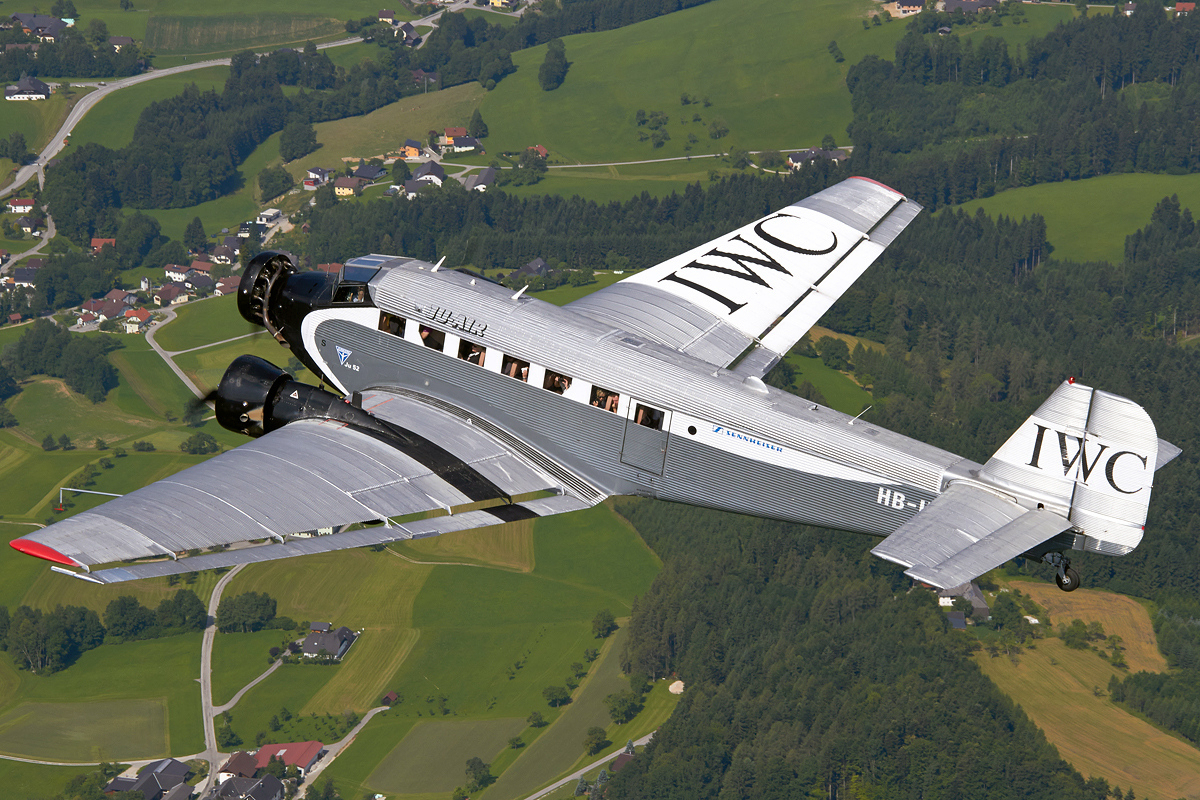
The architecture of the Junkers Ju 52/3m is a triumph of functional engineering, immediately distinguishable by its distinctive corrugated duralumin skin. This innovation, a Junkers trademark, was not only aesthetic but provided remarkable structural rigidity with low weight, crucial for performance and resistance in often extreme operating conditions.
The three-engine configuration, typically powered by radial engines such as the BMW 132 (licensed by Pratt & Whitney Hornet), ensured sufficient power for significant loads and vital redundancy in the event of failure. This aspect enormously increased the confidence of operators and passengers in the safety of the aircraft.
The fixed, robust, fairingless landing gear was another testament to the practicality and minimal maintenance oriented design philosophy. This choice, while increasing aerodynamic resistance, allowed the Ju 52 to operate from improvised runways, a fundamental requirement for pioneering routes and military operations.
Onboard Specifications
- ◆Corrugated Duraluminium Skin: Key construction innovation that offered exceptional structural strength and lightness.
- ◆Tri-motor configuration: Essential for reliability, safety and load capacity, suitable for long flights.
- ◆Double-layer Junkers Flaps: Lifting devices that improved control at low speeds and reduced takeoff and landing distances.
Operational Career & Operators
The operational career of the Ju 52/3m was extraordinarily extensive, starting as the flagship of civil airlines. Lufthansa was among the first carriers to adopt it, using it on European, African and South American routes, consolidating its reputation as an extremely reliable passenger and cargo aircraft.
With the advent of the Second World War, the role of the Ju 52/3m underwent a radical transformation. It became the main transport aircraft of the Luftwaffe, performing crucial roles in logistical support, troop transport and, famously, in airborne operations such as the invasion of Crete (Operation Merkur). His ability to operate in difficult conditions made him indispensable on all fronts.
Even after the end of the conflict, the robustness and simplicity of the Ju 52 allowed numerous examples to continue flying with civilian airlines in several countries, including France (as AAC.1 Toucan) and Spain (as CASA 352). An operational longevity that few other aircraft of the time could boast, confirming its engineering.
Legacy & Cultural Impact
The legacy of the Junkers Ju 52/3m is deep and lasting. It is universally recognized as a symbol of the pioneering German aeronautical engineering of the 1930s and 1940s, representing a bridge between primitive aviation and the advent of modern transport aircraft. His iconic image has remained imprinted in the collective memory.
The "Tante Ju" has become an icon of reliability, resistance and versatility, capable of adapting to extremely diverse roles, from luxurious passenger transport to essential military support. His unmistakable silhouette and his story full of anecdotes have made him the protagonist of countless documentaries, films and books, perpetuating his myth.
Even today, a few restored examples continue to fly in air shows or as historic aircraft, enchanting enthusiasts and offering a tangible link to the golden age of aviation. Its longevity and ability to capture the imagination attest not only to its design excellence but also to its profound cultural impact, making it a true flying monument.
Telemetria Specs (HUD)
Hangar Trivia & Curiosità
- 💡Its distinctive corrugated duralumin skin, a signature of Junkers aircraft, provided structural rigidity and resistance to torsion while keeping weight low.
- 💡Nicknamed "Tante Ju" (Aunt Ju) by German soldiers and civilians alike, reflecting its ubiquitous presence and reliable, workhorse nature.
- 💡Although primarily a transport, some Ju 52s were modified with bomb racks and used as improvised bombers in the early stages of WWII, notably during the invasion of Poland and Norway.
Archivio Avvistamenti Spotter
Immagini scattate dalla community in tutto il mondo
Vettori Rilevati (Flotta Attiva)

Middle East Airlines
In Flotta: x4 u.

Lufthansa
In Flotta: x12 u.

Air France
In Flotta: x5 u.
Finnair
In Flotta: x14 u.
South African Airways
In Flotta: x11 u.

Iberia
In Flotta: x12 u.

Forze aeree svizzere
In Flotta: x7 u.
Luftwaffe
In Flotta: x4 u.
Líneas Aéreas del Estado (LADE)
In Flotta: x7 u.