Ilya Muromets
Sikorsky
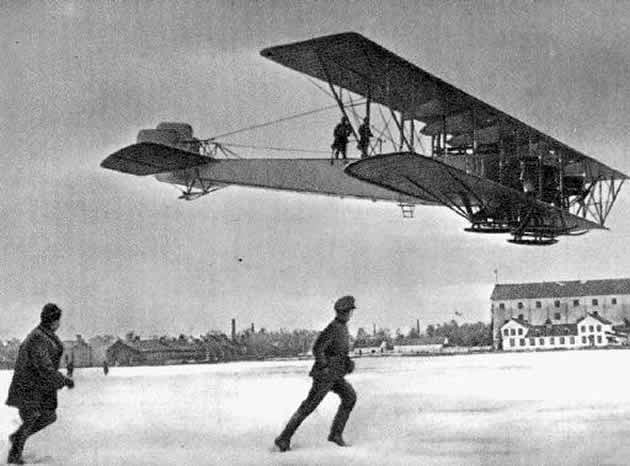
Historical Context & Origins
The dawn of the 20th century was a period of incredible excitement for aviation, and precisely in this scenario a brilliant figure emerged: Igor Sikorsky. A visionary Russian engineer, Sikorsky set out to overcome the limits of single-seat and single-engine airplanes, designing an aircraft of proportions and capabilities never seen before. His audacity led to the birth of Ilya Muromets, a giant of the skies that would redefine the very concept of aircraft.
With its first flight in 1914, the Ilya Muromets was not just an airplane, but a true technological statement of intent. It took its name from the legendary Russian epic hero, a symbol of strength and resistance, to underline the power and majesty of the project. This choice reflected the ambition of an empire projected towards modernity, ready to dominate not only the earth, but also the skies.
Born as a luxury civil transport aircraft, equipped with unthinkable comforts for the time, its destiny was quickly reconverted by the imminent needs of the First World War. Its grandeur and load capacity made it the ideal candidate for a strategic role, transforming it into the first multi-engine heavy bomber in history.
Architecture & Technological Design
The Sikorsky Ilya Muromets was a biplane of colossal dimensions for its time, featuring a sturdy wooden structure covered with canvas. Its multi-engine configuration, initially four, but in some variants even eight, represented a quantum leap in aeronautical engineering, guaranteeing unprecedented power and redundancy. The engines were typically arranged in push-pull configurations between the wings, maximizing efficiency.
One of the most revolutionary features was the adoption of an enclosed and heated cockpit, as well as a compartment for passengers or crew members. This comfort was unheard of, even offering toilets and berths in some civilian versions. The accessibility of the cabin and the possibility of moving inside during the flight were innovations that anticipated the standards of commercial aviation by decades.
From a military point of view, its architecture allowed the installation of multiple defensive machine gun positions and a considerable bomb load. The ability to carry a large crew and heavy armament clearly distinguished it from the small aircraft of the time, making it a true forerunner of modern strategic bombers.
Onboard Specifications
- ◆Enclosed and heated passenger cabin with lighting and toilet, a luxury never seen before.
- ◆World's first multi-engine heavy bomber with revolutionary load capacity and autonomy.
- ◆Modular and redundant propulsion system, capable of operating even with a failed engine.
Operational Career & Operators
Entering service with the Imperial Russian Air Force during World War I, the Ilya Muromets quickly became a legend. Its ability to carry bomb loads of several hundred kilograms and to defend itself effectively with its numerous machine gunners made it a formidable opponent. His imposing size instilled psychological fear in enemy troops.
Between 1915 and 1917, Ilya Muromets' fleet flew approximately 400 bombing sorties, releasing over 65 tons of bombs. Despite the intensity of the missions and the presence of enemy aircraft, incredibly low losses were recorded: only one example shot down by a German fighter and a few others lost due to accidents or mechanical failures. This is a testament to its robustness and the effectiveness of its defenses.
After the Russian civil war, some aircraft attempted to be converted to civilian transport, offering scheduled flights between Moscow and Kharkov. Although the experiment did not last long due to economic and technical difficulties, it demonstrated the inherent versatility of the design and Sikorsky's futuristic vision in conceiving a multipurpose aircraft.
Legacy & Cultural Impact
The Ilya Muromets has earned an indelible place in aviation history not only as the first strategic bomber, but as the true progenitor of airliners and long-range bombers. His bold concept of a large, multi-engined aircraft with a passenger cabin paved the way for every future development in heavy aviation.
Igor Sikorsky's innovation with the Ilya Muromets demonstrated to the world the feasibility and effectiveness of large aircraft, profoundly influencing aircraft design for decades to come. Its operational resilience and performance during the war defied initial skepticism, demonstrating that size and complexity could coexist with reliability and success.
This pioneer of the skies is not only a symbol of Russian engineering of the early 20th century, but also a testament to human ingenuity. The Ilya Muromets remains an icon, a flying monument celebrating the beginning of the era in which aviation became not just a means of flying, but a true instrument of power and progress.
Telemetria Specs (HUD)
Hangar Trivia & Curiosità
- 💡Fu il primo aereo quadrimotore al mondo specificamente progettato come bombardiere pesante, aprendo la strada ai concetti di bombardamento strategico.
- 💡Rivoluzionario per la sua epoca, alcune varianti presentavano una cabina di pilotaggio chiusa, una toilette e persino un sistema di riscaldamento, offrendo un comfort senza precedenti per l'equipaggio.
- 💡Durante la Prima Guerra Mondiale, nonostante le sue dimensioni massicce, l'Ilya Muromets dimostrò una notevole affidabilità operativa, con un solo aereo perso a causa dell'azione nemica.
Archivio Avvistamenti Spotter
Immagini scattate dalla community in tutto il mondo