Il-86
Costruttore Sconosciuto
Historical Context & Origins
In the 1970s, the Soviet Union aspired to introduce its own wide-body to meet growing demand for long-range, high-capacity flights. The goal was to replicate the success of Western giants such as the Boeing 747 and McDonnell Douglas DC-10, but with a distinctly Soviet engineering approach. The project was entrusted to the Ilyushin design bureau.
Aeroflot's requirement was clear: a passenger aircraft capable of carrying over 350 people over significant distances, offering comfort and reliability. The program formally began in 1972, but the challenges were considerable, from the shortage of suitable engines to the need to develop an entirely new wide-body structure.
The first flight of the Ilyushin Il-86 occurred on December 22, 1976, marking a milestone in Soviet civil aviation. This event symbolized the Eastern Bloc's ambition to compete on the global aviation stage, demonstrating cutting-edge technical and manufacturing capabilities for its time.
Architecture & Technological Design
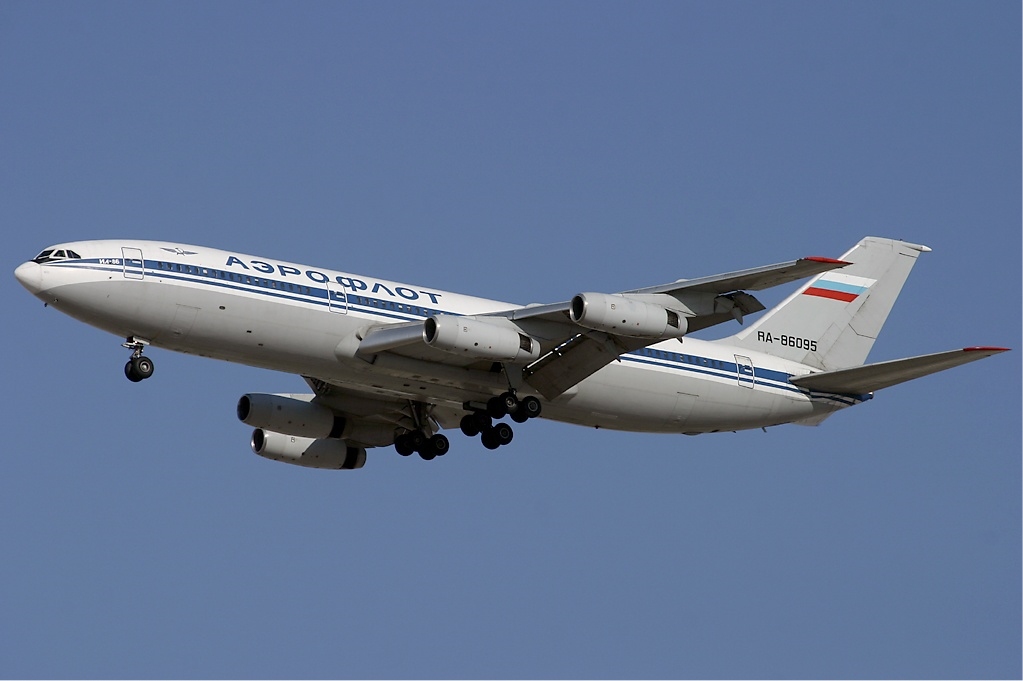
The Il-86 presented itself as a four-engine wide-body, the first of its kind produced in the USSR, characterized by a robust and functional aesthetic. Its aerodynamic configuration was typical of airliners of the time, with swept wings and a T-shaped empennage. The four Kuznetsov NK-86 turbofans, mounted in underwing nacelles, provided the necessary thrust.
One of its most distinctive innovations was the "walk-in" boarding system, which allowed passengers to access the aircraft directly from the apron via integrated ladders, without the need for jet bridges. This unique design facilitated operations at less well-equipped airports, reducing turnaround times and increasing operational autonomy.
The twin-aisle fuselage offered a spacious interior configuration, designed to maximize passenger and baggage capacity. The lower deck was not only used for cargo, but also included an advanced baggage handling system at passenger level, allowing for quick storage and collection of personal belongings.
Onboard Specifications
- ◆Wide twin-aisle fuselage: Designed to accommodate up to 350 passengers (and more in charter configurations), offering more space and comfort than previous models.
- ◆Integrated self-supporting stairways ("air-stairs"): Three cargo compartments, one for luggage and two with stairs that open directly onto the runway, eliminating dependence on airport infrastructure.
- ◆Simplified baggage handling system: Passengers could store their hand luggage in designated compartments on the lower deck before boarding the main passenger cabin.
Operational Career & Operators
The Il-86 entered service with Aeroflot in 1980, just in time for the Moscow Olympic Games, where it played a crucial role in transporting athletes and spectators. It quickly became the backbone of the Soviet national airline's long- and medium-range flights, connecting major cities of the USSR and several international destinations in Europe and Asia.
Despite its imposing size, the Il-86 earned a reputation for operational reliability and robustness, demonstrating remarkable resilience even in adverse weather conditions. Its ability to operate from airports with limited infrastructure, thanks to integrated ladders, made it particularly versatile and valuable.
Although its commercial success outside the USSR was limited, with a few examples exported mainly to ex-Soviet carriers and some friendly countries, the Il-86 maintained a vital role for decades. Most examples were decommissioned in the early 2000s, due to engine obsolescence and new noise regulations.
Legacy & Cultural Impact
The Ilyushin Il-86 represents a fundamental chapter in the history of Soviet aviation, being the first and only wide-body of its kind produced in the USSR. A symbol of bold engineering and technological autonomy, it demonstrated the Soviet aviation industry's ability to design and build large aircraft, despite economic and political difficulties.
Its innovative design, particularly the integrated ladders, reflected a pragmatic approach to the operational needs of the time. Although it did not achieve the global fame of its Western competitors, the Il-86 carried millions of passengers, facilitating mass air travel in an era of great expansion.
Today, the Il-86 is remembered as a giant of the Soviet skies, an icon of a bygone era. Few examples remain in service, mostly for military or cargo transport purposes, but its legacy as a pioneer of wide-body aviation in Russia and the former Soviet bloc countries remains undisputed and celebrated by aviation enthusiasts.
Telemetria Specs (HUD)
Hangar Trivia & Curiosità
- 💡It was sometimes nicknamed "Desk" due to its unique passenger self-boarding system, where passengers would walk up integral airstairs to an internal vestibule to store coats and small carry-on items before moving into the main cabin.
- 💡The Il-86 was one of the few Soviet airliners certified under international noise regulations (ICAO Chapter 3) without major modifications, though later in its service life, some regions imposed restrictions.
- 💡Only 106 units were built between 1976 and 1994, making it a relatively rare wide-body compared to its Western counterparts like the Boeing 747 or Airbus A300.
Archivio Avvistamenti Spotter
Immagini scattate dalla community in tutto il mondo
Vettori Rilevati (Flotta Attiva)


Vettori Rilevati (Flotta Storica / Dismessa)

Armenian Airlines
Stato: Dismesso

China Xinjiang Airlines
Stato: Dismesso
Armavia
Stato: Dismesso
Vnukovo Airlines
Stato: Dismesso
Transeuropean Airlines
Stato: Dismesso
Pulkovo Aviation Enterprise
Stato: Dismesso
Air Kazakhstan
Stato: Dismesso
Russian Sky Airlines
Stato: Dismesso