Il-14
Costruttore Sconosciuto
Historical Context & Origins
The Ilyushin Il-14 emerged in the post-war Soviet aeronautical landscape as a concrete response to the urgent need to modernize the civil and military air transport fleet. After World War II, the Soviet Union still relied heavily on the Lisunov Li-2, a licensed version of the venerable Douglas DC-3, a rugged but now obsolete aircraft.
The direct predecessor, the Ilyushin Il-12, although it represented a step forward, presented some critical issues, in particular problems related to the performance of the engines in extreme conditions and the efficiency of the defrosting systems. The Ilyushin design bureau, under the leadership of Sergei Ilyushin, therefore devoted itself to refined evolution, rather than radical redesign.
The goal was clear: to create a medium-class twin-engine transport aircraft that was extremely reliable, robust and capable of operating in all weather conditions and on poorly prepared runways, indispensable features for the vast and often remote regions of the Soviet Union. The first flight of the Il-14 occurred on 13 July 1948, marking the beginning of a long and honored career.
Architecture & Technological Design
The Il-14 retained the conventional architecture of its predecessor, an all-metal low-wing monoplane, but incorporated significant aerodynamic and structural improvements. The fuselage was redesigned to accommodate a greater number of passengers and ensure greater comfort, including a fundamental pressurized cabin, absent on the Il-12, which allowed flights at higher altitudes.
The propulsive heart of the Il-14 consisted of two fourteen-cylinder radial engines Shvetsov ASh-82T, each capable of delivering 1,900 horsepower. These engines, compared to those of the Il-12, were significantly more powerful, reliable and equipped with improved cold start systems, crucial for the harsh Russian winter temperatures. The introduction of triple-bladed reversible pitch propellers improved landing performance.
The attention to robustness extended to the reinforced landing gear, designed to withstand landings on unprepared or semi-prepared surfaces, confirming the Il-14's vocation for operations in hostile environments. Its construction and maintenance simplicity made it a workhorse in contexts where technological sophistication was often an obstacle.
Onboard Specifications
- ◆Cabin pressurization for greater comfort and operation at high altitudes.
- ◆Advanced de-icing and anti-icing systems for wings, empennages and propellers, improving safety in adverse conditions.
- ◆Improved navigation and radio assistance instruments for all-weather operations and night flights.
Operational Career & Operators
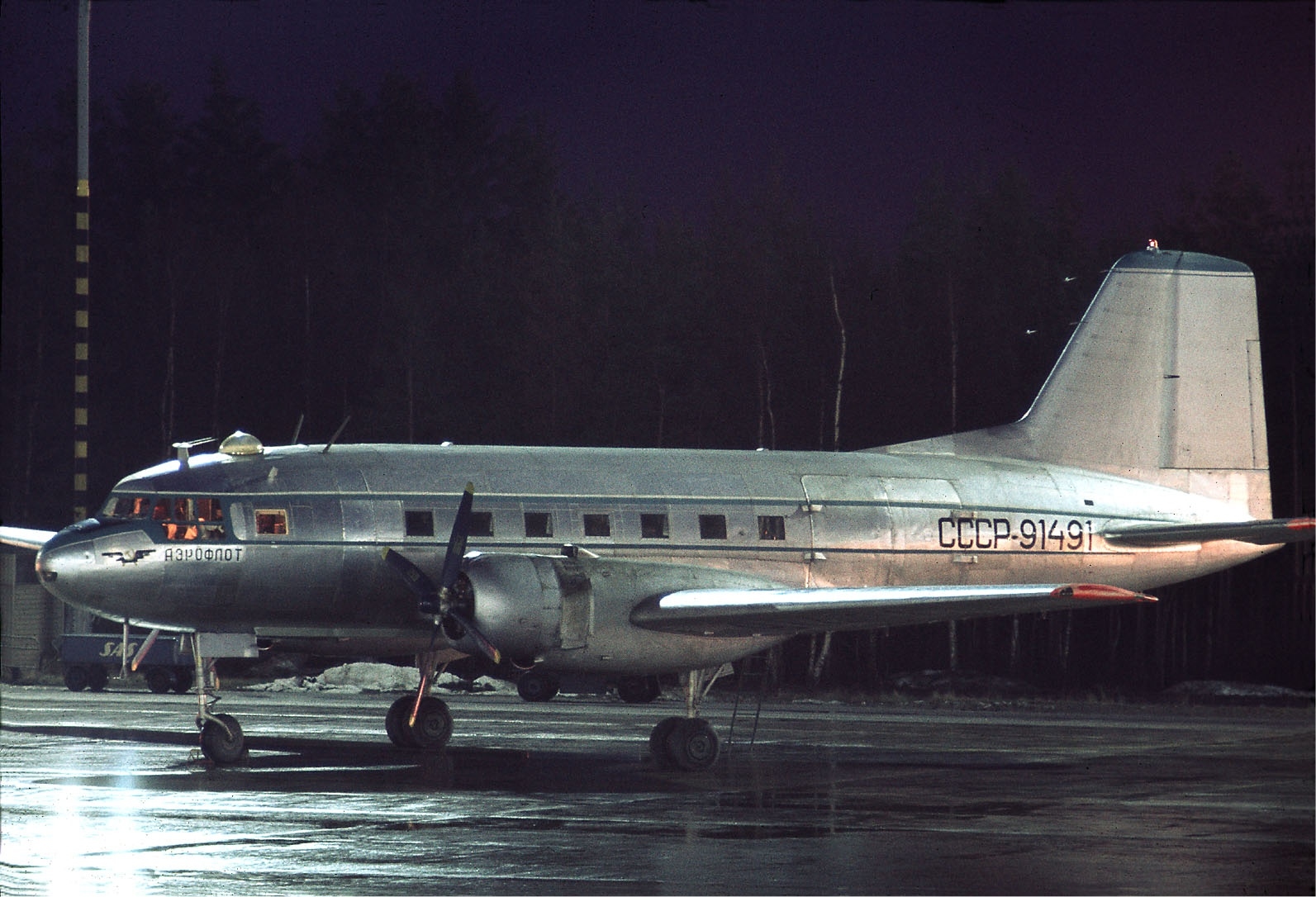
The Ilyushin Il-14 quickly became the mainstay of the fleet of Aeroflot, the Soviet national airline, for short- and medium-range flights, both domestic and international. It carried 18 to 32 passengers or up to 3,200 kg of cargo, connecting cities and remote regions of the USSR and significantly contributing to the development of civil air transport in the Eastern Bloc.
Its robustness and reliability also made it popular among the air forces and flag carriers of numerous allied countries. It was exported and used in over 30 nations, including Warsaw Pact countries such as East Germany (where it was produced under license as the Avia 14), Czechoslovakia, Poland, and other nations such as China, Syria, Egypt, Afghanistan, and Cuba.
Many examples were also used in military roles, such as troop transport, reconnaissance, VIP or parachute drop aircraft. Its operational longevity is remarkable, with some examples continuing to fly into the 1980s and beyond in secondary roles or for minor operators, testifying to the solidity of its design.
Legacy & Cultural Impact
The Ilyushin Il-14 represents an enduring symbol of post-war Soviet aeronautical engineering, embodying the values of reliability, ruggedness and functionality. Its ability to operate in extreme conditions and on limited infrastructure has made it an irreplaceable vehicle for the expansion of air routes into large areas, often without transport alternatives.
It played a crucial role in training generations of Soviet and Allied pilots and technicians, helping to lay the foundation for the development of larger, more sophisticated transport aircraft, such as later turboprops and jets. Its simplicity and easy maintenance made it an economical and effective choice for many years.
Although few examples are still operational today, the Il-14 remains an important presence in numerous aeronautical museums around the world, a tangible testimony to an era when aviation began to connect the world, facing and overcoming environmental and logistical challenges with pragmatic and resilient engineering.
Telemetria Specs (HUD)
Hangar Trivia & Curiosità
- 💡The Il-14 was mass-produced under license in Czechoslovakia (as Avia 14) and East Germany (as VEB Flugzeugwerke Dresden).
- 💡Many examples remained in active service, particularly in remote regions, for several decades after its initial production ceased.
- 💡It featured improved propeller design and a 'hot-wing' de-icing system compared to its predecessor, the Il-12.
Archivio Avvistamenti Spotter
Immagini scattate dalla community in tutto il mondo