Heron
de Havilland
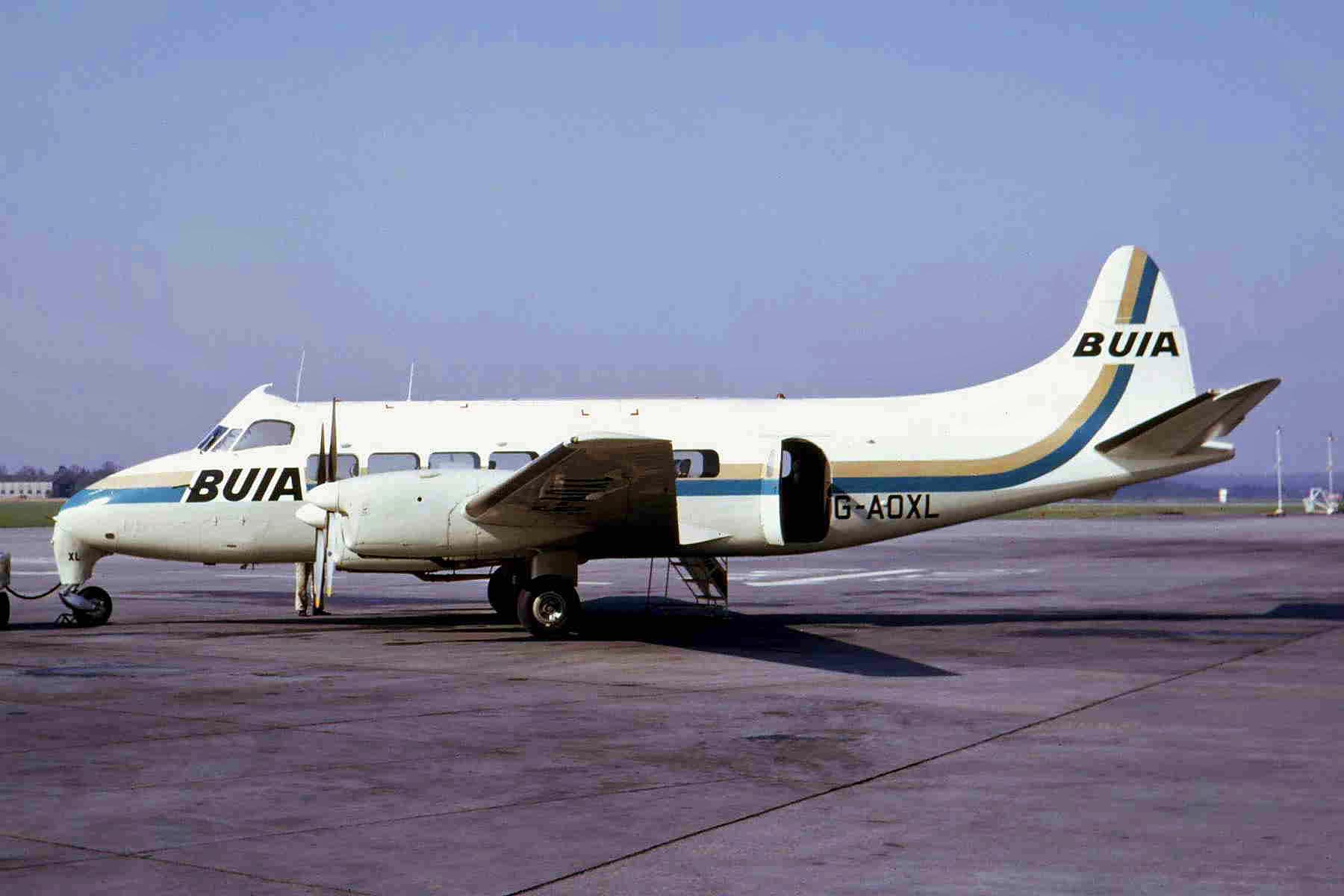
Historical Context & Origins
The de Havilland Heron, whose first flight was in 1950, emerged in an era of fervent post-war regional air travel reconstruction and expansion. After the great success of the twin-engine de Havilland Dove, the British company recognized the growing demand for a larger and more robust, but equally reliable airliner, capable of operating on short routes and from airports with limited infrastructure.
The intent was to offer an aircraft that combined the proven reliability of the Dove with increased passenger carrying capacity. The Heron design (internal designation DH.114) was conceived as a four-engine aircraft, a choice that guaranteed greater operational safety, particularly appreciated by airlines serving remote destinations or on marine routes.
De Havilland aimed for a design that was economical to produce and maintain, and above all, simple to operate in contexts where technological sophistication might pose an obstacle. This philosophy guided every aspect of the Heron's development, making it a pioneer in its segment.
Architecture & Technological Design
The de Havilland Heron was an all-metal low-wing monoplane, featuring a conventional but exceptionally robust structure. Its non-pressurized design simplified construction and maintenance, reducing operating costs and making it ideal for low-to-medium altitude flights, typical of regional routes.
One of the most distinctive and functional design choices was the adoption of a fixed tricycle landing gear. This decision, in contrast to most contemporary aircraft, eliminated the complexity, weight and maintenance requirements of a retractable system, emphasizing reliability and reduced operating costs.
The Heron was equipped with four de Havilland Gipsy Queen 30 piston engines, mounted on the wings. Although it was not a particularly fast aircraft, the four-engine configuration guaranteed considerable redundancy and safety, a crucial aspect for operators who had to fly in sparsely populated areas or on long water routes.
Onboard Specifications
- ◆Robust Non-Pressurized Structure: Maximum reliability and reduced maintenance for short route operations.
- ◆Fixed Tricycle Trolley: Mechanical simplification, weight reduction and greater resistance to wear on unprepared tracks.
- ◆Essential and Reliable Avionics: Designed to be intuitive and require minimal maintenance, suitable for pilots with varied experience.
Operational Career & Operators
The de Havilland Heron quickly became a "workhorse" for numerous airlines and operators around the world. Its versatility allowed it to operate in a wide range of contexts, from hot and dusty African runways to cold Scandinavian routes, demonstrating remarkable adaptability.
Airlines such as BEA (British European Airways), and numerous operators in Australia, Africa, North America and the Caribbean, including Braathens SAFE and Malayan Airways, used it to connect isolated communities and develop new regional routes. Its ability to carry up to 17 passengers made it cost-effective.
In addition to its civilian role, the Heron also served in several air and sea forces as a light transport, utility and VIP training aircraft, including the Royal Air Force and the Royal Navy. Its operational longevity and ability to operate in harsh conditions made it a valuable asset for decades.
Legacy & Cultural Impact
The de Havilland Heron's legacy lies in its demonstration that simplicity, ruggedness and reliability could translate into sustained commercial and operational success. It has contributed significantly to the development of regional air transport, connecting countless communities and opening up new economic and social opportunities.
Many Heron examples have had exceptionally long operational lives, with some remaining in active service for over 50 years, a testament to the soundness of its original design. This makes it an icon of British aeronautical engineering.
Even today, several de Havilland Heron are preserved in museums or have been restored for historic flights, continuing to capture the imagination of aviation enthusiasts. Its unmistakable profile and varied operational history make it a symbol of an era when aviation began to make the world smaller and more accessible for all.
Telemetria Specs (HUD)
Hangar Trivia & Curiosità
- 💡The Heron was a direct, larger derivative of the twin-engined de Havilland Dove, sharing many components and design philosophies.
- 💡Several Herons were later converted to turboprop power by companies like Riley Aircraft, significantly extending their operational lifespan into the jet age.
- 💡A de Havilland Heron served with the Queen's Flight of the United Kingdom, providing transport for members of the British Royal Family.
Archivio Avvistamenti Spotter
Immagini scattate dalla community in tutto il mondo
Vettori Rilevati (Flotta Attiva)


Martinair
In Flotta: x5 u.

Turkish Airlines
In Flotta: x12 u.

Air Paris
In Flotta: x7 u.
Garuda Indonesia
In Flotta: x15 u.

Luftwaffe
In Flotta: x10 u.

All Nippon Airways
In Flotta: x15 u.

Royal Air Force
In Flotta: x11 u.
Air Pacific
In Flotta: x9 u.Vettori Rilevati (Flotta Storica / Dismessa)

Pluna
Stato: Dismesso
Indian Airlines
Stato: Dismesso
Channel Express
Stato: Dismesso

Itavia
Stato: Dismesso
Südflug International
Stato: Dismesso
BWIA West Indies Airways
Stato: Dismesso
EAS Europe Aero Service
Stato: Dismesso
British European Airways
Stato: Dismesso
Air Ivoire
Stato: Dismesso
Sabena
Stato: Dismesso
Nigeria Airways
Stato: Dismesso
Fjellfly
Stato: Dismesso
ACES Colombia
Stato: Dismesso

Aviaco
Stato: Dismesso
Japan Air System
Stato: Dismesso