Hermes
Handley Page
Historical Context & Origins
The Handley Page Hermes emerged from a crucial period of transition in British aviation, just after the Second World War. With the pressing need to rebuild their civilian fleet and compete in the emerging passenger air transport market, the UK's aviation industries were pressed to develop new aircraft. Handley Page, with its rich history, answered this call.
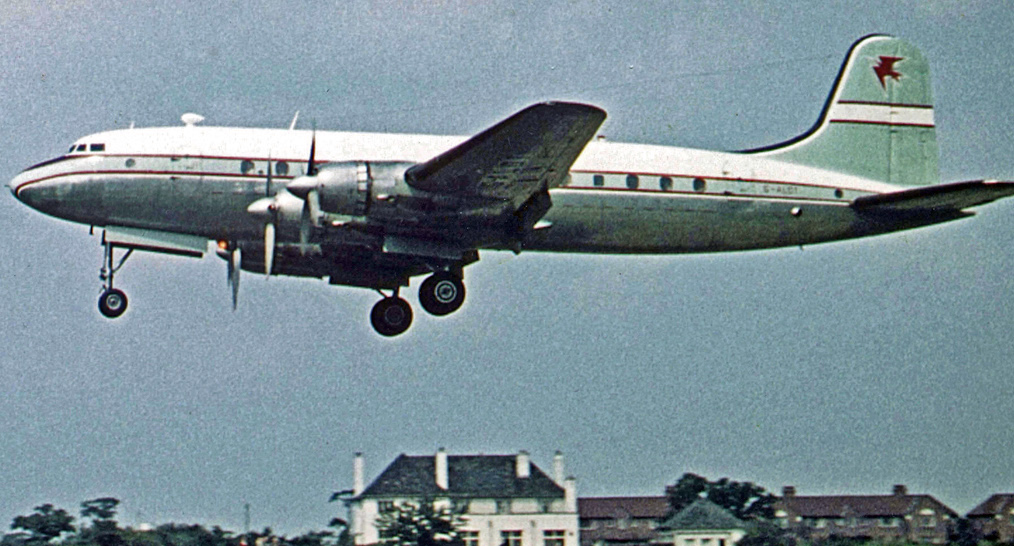
The Hermes (designated HP.67) was initially conceived as a civilian version of the rugged Handley Page Hastings military transport aircraft, itself derived from the Halifax bomber. This dual origin aimed to capitalize on an already mature project, accelerating development. The first prototype, Hermes I, made its maiden flight on 2 December 1945, which unfortunately ended in a crash due to control failure.
This first, tragic flight did not stop the program, but highlighted the need for further refinements. Attention quickly shifted to the Hermes IV variant, which incorporated significant improvements and would become the production backbone, intended to serve the long-haul routes of the British Overseas Airways Corporation (BOAC).
Architecture & Technological Design
The Hermes was a sleek, low-wing cantilever monoplane, featuring a streamlined, aerodynamic fuselage, designed to optimize speed and passenger comfort. Its structure was light alloy, robust and reliable, typical of solid post-war British engineering. The design sought a balance between load capacity, range and performance.
The main production version, the Hermes IV, was powered by four Bristol Hercules 763 radial engines, renowned for their reliability and power output. These engines allowed the aircraft to reach a competitive cruising speed for the time, operating at altitudes that guaranteed greater comfort thanks to the pressurized cabin.
Retractable tricycle landing gear was another modern feature, offering greater stability during ground operations and during takeoff and landing. With a typical capacity of 40-63 passengers, the Hermes offered a spacious and relatively luxurious environment for travelers of the time, although not without competition.
Onboard Specifications
- ◆Pressurized cabin for high-altitude comfort, reducing passenger fatigue.
- ◆Bristol Hercules 763 engines, fourteen-cylinder radial engines, renowned for their robustness.
- ◆Retractable tricycle landing gear, a modern solution for greater stability and aerodynamics.
Operational Career & Operators
The operational career of the Handley Page Hermes was almost exclusively linked to BOAC, which ordered 25 examples of the Hermes IV variant. The first Hermes IV entered service with the company on 6 August 1950, flying on routes to Africa and, subsequently, to the Middle East and Far East. They gradually replaced the Avro Yorks, offering a qualitative leap in terms of speed and comfort.
Despite successful service and praise for its reliability, the Hermes had a relatively short operational life as BOAC's flagship airliner. The advent of jet aircraft such as the De Havilland Comet and more advanced turboprops such as the Bristol Britannia resulted in their rapid retirement from the main BOAC fleet by 1955.
Many of the Hermes IVs were then sold to charter operators and secondary airlines, including Airwork, Skyways and Britavia, who used them for passenger and cargo services, proving their versatility and durability even in a less prestigious role, until their final retirement in the early 1960s.
Legacy & Cultural Impact
The Handley Page Hermes represents a significant, if often overlooked, chapter in the history of British civil aviation. It was a key transition aircraft, bridging the gap between war-era piston-engined aircraft and the jet and turboprop revolution. Its development and service helped keep the British aircraft industry alive during a crucial period.
Although it did not achieve the iconic fame of contemporaries such as the Douglas DC-6 or the Lockheed Constellation, the Hermes played a vital role for BOAC, allowing it to reassert its presence on long-haul routes and offer a competitive service. It was a symbol of post-war British ingenuity, even if the rapidity of technological evolution limited its longevity.
Today, the Hermes is remembered as an example of the rush to technological development that characterized the years following the conflict. Its story reminds us of the importance of intermediate steps in aeronautical evolution, which often lay the foundation for subsequent innovations, cementing Handley Page's reputation as a pioneer in the industry.
Telemetria Specs (HUD)
Hangar Trivia & Curiosità
- 💡The Hermes was a civilian derivative of the Handley Page Hastings military transport aircraft, sharing many components but featuring a redesigned fuselage.
- 💡The first prototype, an H.P.68 Hermes I, made its maiden flight in 1945 but tragically crashed during its second flight due to elevator control issues.
- 💡Despite its intended role as a major post-war British airliner, only 29 Hermes aircraft were built, leading to a relatively short operational life before being superseded by newer jet designs.
Archivio Avvistamenti Spotter
Immagini scattate dalla community in tutto il mondo