H.P.42
Handley Page
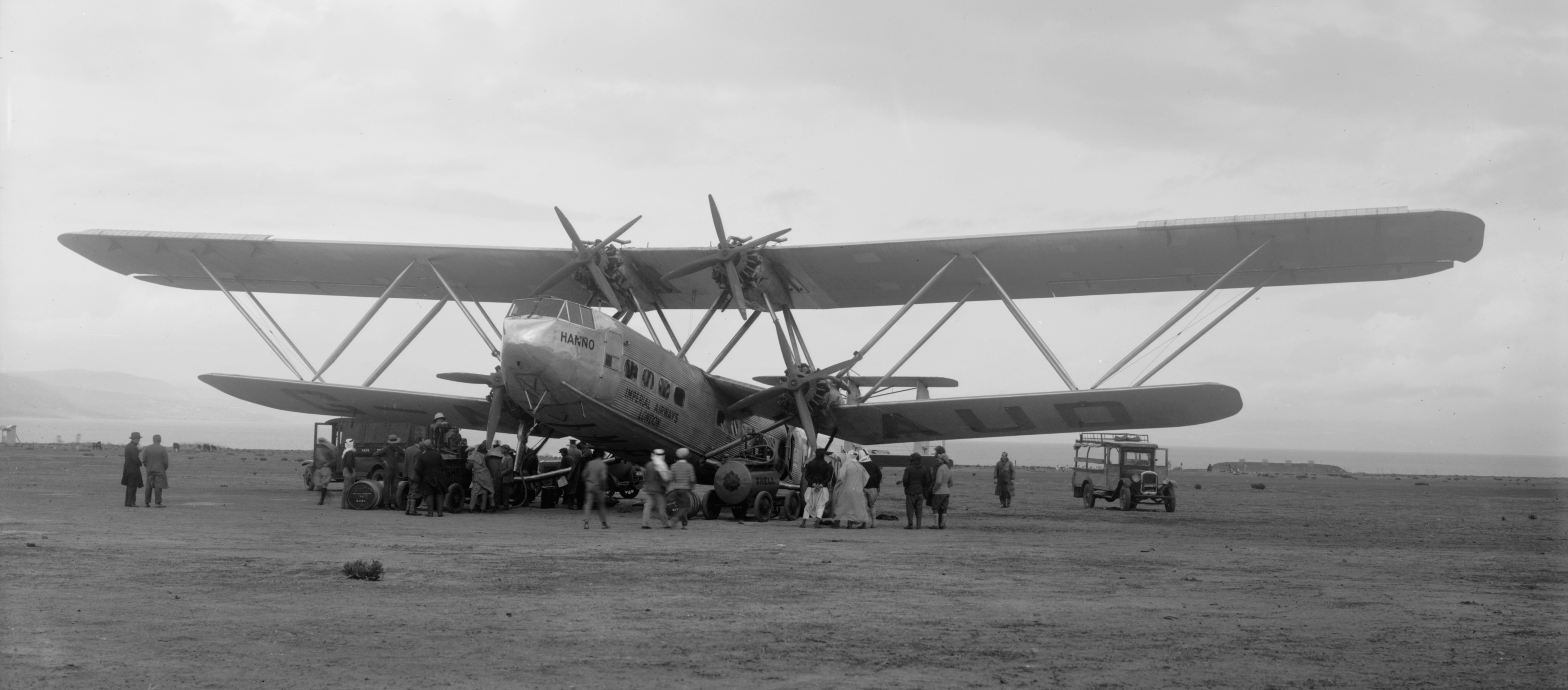
Historical Context & Origins
The Handley Page H.P.42, which first flew in 1930, emerged as a bold response to the growing demands of intercontinental air transport. In an era where speed was not the top priority, the British company Imperial Airways sought aircraft that could offer an unprecedented level of comfort, reliability and safety for its imperial routes.
This legendary biplane was specifically designed to embody the vision of a "flying hotel", carrying passengers in luxury and dignity across vast territories. Handley Page, already renowned for its large aircraft, took up the challenge, developing a robust and innovative aircraft, capable of operating in different climatic and environmental conditions.
The H.P.42 was destined to become the flagship of Imperial Airways' fleet, connecting Europe with Africa and Asia. Its concept was aimed at exceeding the expectations of travelers of the time, offering a calm and relaxing flying experience, far from the turbulence and discomfort of the first commercial aircraft.
Architecture & Technological Design
The H.P.42 stood out for its impressive four-engine biplane architecture, a configuration that guaranteed exceptional lift and considerable redundancy in terms of propulsion. Its advanced bimetallic structure, combining steel and duralumin, represented a significant innovation, ensuring superior strength and durability compared to wooden aircraft of the time.
Powered by four radial engines, initially Bristol Jupiter IXF and later Bristol Pegasus, positioned on the wings, the H.P.42 developed a combined power of over 2,000 horsepower. This configuration ensured not only the ability to lift a considerable load, but also a stable and predictable flight, crucial for the long planned routes.
Although it was not a fast aircraft, with a cruising speed of just 155 km/h, its stability and attention to passenger comfort were unparalleled. The wing design, with a large wingspan and a thick section, contributed to its considerable load capacity and its renowned docility in flight.
Onboard Specifications
- ◆Soundproof and heated cabins: they guaranteed an exceptionally comfortable journey for the time, isolating passengers from the noise of the engines and the elements.
- ◆Premium Inflight Service: Included a dedicated kitchen and staff, offering hot meals and drinks, elevating the flight experience to that of a luxury hotel.
- ◆Advanced bimetallic structure: gave the aircraft superior strength and durability, reducing maintenance needs and increasing operational safety.
Operational Career & Operators
The operational career of the Handley Page H.P.42 was almost exclusively linked to Imperial Airways, for which a total of eight examples were built. These were divided into two classes: four "Heracles" (H.P.42W, for European and Middle Eastern routes) and four "Hannibal" (H.P.42E, for routes to the Far East and Africa).
The H.P.42s became synonymous with reliability and safety, a true pillar of imperial routes. They flew tirelessly between London, Paris, Cairo, Karachi and Cape Town, building an impeccable reputation: it is notable that no passenger lost their life aboard an H.P.42 during its commercial service.
These giants of the air, though slow, were prized for their ability to carry high-profile passengers, colonial officials and mail in an environment of unparalleled luxury. They were true "air liners", emblems of technological progress and the expansion of the British Empire.
Legacy & Cultural Impact
The Handley Page H.P.42 has left an indelible legacy in aviation history, serving as the benchmark for comfort and safety in scheduled air travel. It proved that air travel could be not only efficient, but also luxurious and enjoyable, influencing the design of future airliners.
Its cultural impact was significant, symbolizing the confidence and progress of the British Empire in the era between the two world wars. Many of the H.P.42s were requisitioned and converted for military transport at the start of World War II, a fate common to many civilian aircraft of the time.
Tragically, none of the original eight examples of the H.P.42 survived, all lost in accidents or scrapped during the conflict. Despite their physical absence, the Handley Page H.P.42 remains an icon, remembered as a pioneer of commercial aviation, an aircraft that elevated air travel to an art.
Telemetria Specs (HUD)
Hangar Trivia & Curiosità
- 💡Detiene la singolare distinzione nella storia dell'aviazione di non aver mai subito una singola vittima tra i passeggeri durante l'intero servizio operativo, testimonianza del suo design robusto.
- 💡L'H.P.42 fu progettato dando priorità al comfort dei passeggeri e all'affidabilità rispetto alla velocità, offrendo cabine spaziose e servizio di bordo, rendendolo un'opzione di viaggio di lusso per l'epoca.
- 💡Ognuno degli otto aerei costruiti ricevette un nome che iniziava con la lettera 'H', come 'Hannibal', 'Hanno', 'Hadrian' ed 'Heracles', riflettendo la sua classe e il suo ruolo.
Archivio Avvistamenti Spotter
Immagini scattate dalla community in tutto il mondo