G 38
Junkers
Historical Context & Origins
The period between the two world wars was an era of fervent aeronautical innovation, especially in Germany, where the restrictions of the Treaty of Versailles stimulated extraordinary ingenuity in civil aviation. In this climate of technological rebirth, Hugo Junkers, a visionary pioneer, conceived the idea of a revolutionary airliner, capable of challenging conventions and redefining air transport.
The Junkers G 38, whose first flight took place in 1931, was not simply an aircraft, but the materialization of Junkers' philosophy: to build robust, efficient and all-metal aircraft, capable of offering unprecedented comfort and safety. This giant of the skies was born from the need to connect ever greater distances, providing a stable and capacious platform for passengers and goods.
Architecture & Technological Design
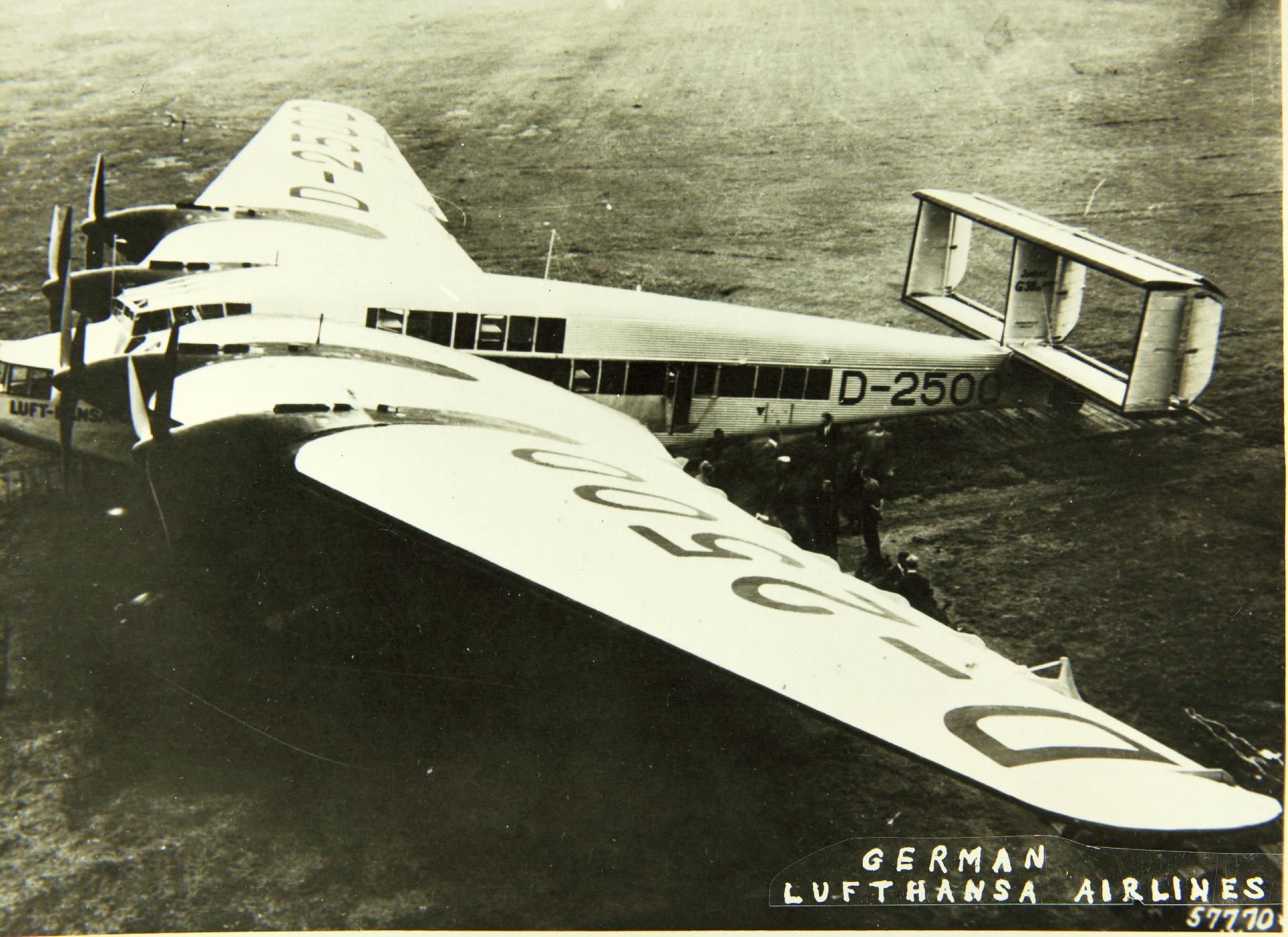
The architecture of the G 38 was absolutely cutting edge for its time, embodying the "thick wing" concept that Junkers had promoted for decades. This design not only provided exceptional lift, but also allowed parts of the structure, including the four engines and even passenger sections, to be integrated within it, making it almost a "flying wing" in the true sense of the word.
The construction was entirely in Duralumin, the light and resistant metal patented by Alfred Wilm, and featured the distinctive corrugated skin typical of Junkers aircraft. This structural choice gave the G 38 extraordinary robustness, crucial for an aircraft of such size and ambition, while maintaining a manageable weight for the desired performance.
Onboard Specifications
- ◆Passenger compartment inside the wings: A real innovation for the time, which offered an unprecedented view and spacious comfort in windows located directly on the extrados of the wing.
- ◆In-Flight Engine Access: Technicians could perform maintenance and minor repairs to the internal engines during flight, an unprecedented safety and operational feature that increased reliability over long hauls.
- ◆Full metal structure and corrugated leather: Typical Junkers signature, it guaranteed structural strength and lightness, albeit with a slight increase in aerodynamic resistance, demonstrating the engineering audacity of the design.
Operational Career & Operators
Only two examples of the Junkers G 38 were built, but their operational career was significant. The first, initially registered as D-2000 and then D-APIS, and the second as D-AMOR, immediately became the flagships of the Lufthansa fleet. They operated on prestigious routes, including the connection between Berlin and London, impressing with their size and the luxury offered.
These giants of the skies not only carried passengers, but were also used for cargo flights and as Germany's technological ambassadors, demonstrating to the world its regained aeronautical excellence. The G 38 was a living symbol of German engineering, capable of combining innovation and reliability, earning itself a place of honor in the history of commercial aviation.
Legacy & Cultural Impact
The Junkers G 38 represents a milestone in the development of large airliners and the "thick-wing" design. Although few examples were built, its influence on subsequent aeronautical engineering is undeniable, pushing the limits of what was technologically possible and inspiring generations of designers.
Its design audacity, particularly the integration of passengers and engines within the wing structure, continues to be a subject of study and admiration. The G 38 is not just a piece of aviation history, but an icon of an era when human ingenuity dared to challenge the skies with revolutionary visions, leaving a lasting legacy in the pantheon of great aircraft.
Telemetria Specs (HUD)
Hangar Trivia & Curiosità
- 💡Il Junkers G 38 fu l'aereo terrestre più grande del mondo al momento del suo primo volo, superando in apertura alare anche il famoso Dornier Do X per velivoli terrestri.
- 💡Il suo design unico permetteva ai passeggeri di avere finestrini direttamente all'interno delle ali, offrendo prospettive di volo insolite e un senso di spaziosità.
- 💡Furono costruiti solo due esemplari del G 38; il primo servì Lufthansa e fu poi venduto alla Japan Air Transport, mentre il secondo rimase con Lufthansa e fu usato anche per scopi militari.
Archivio Avvistamenti Spotter
Immagini scattate dalla community in tutto il mondo

