G.18
Fiat
Historical Context & Origins
In the 1930s, Italy was experiencing an era of fervent aeronautical development, with the clear ambition of establishing itself as a world power also in the field of civil air transport. In this dynamic scenario, Fiat Aviazione, already an industrial giant, was preparing to launch innovative aircraft for national and international routes.
It was in this context that the Fiat G.18 project was born, conceived by the brilliant engineer Giuseppe Gabrielli. With its first flight in 1935, the G.18 was proposed as a modern twin-engine transport, designed to offer speed, comfort and reliability in an era of transition from biplane to monoplane, marking a significant step for Italian aviation.
Architecture & Technological Design
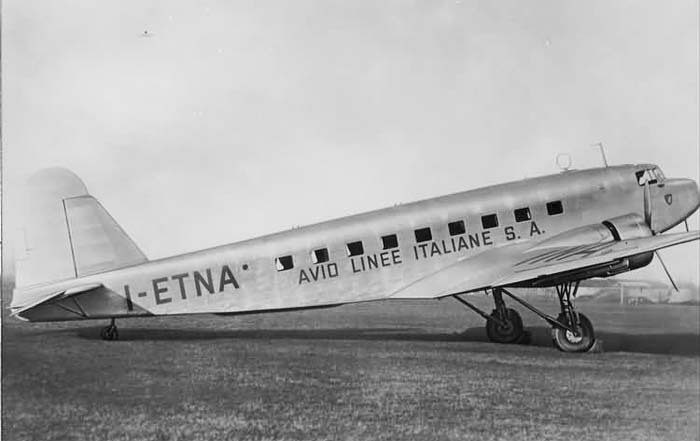
The Fiat G.18 was an elegant low-wing monoplane, a cutting-edge configuration for its time that guaranteed superior aerodynamic efficiency. Its all-metal structure, primarily duralumin, represented a notable advance in terms of strength and lightness, distinguishing it from many contemporaries who still employed mixed constructions.
Initially powered by two Fiat A.59 R.C. radial engines. 800 hp, license-produced versions of the Pratt & Whitney R-1690 Hornet, the aircraft offered respectable performance. Subsequently, the G.18V variant was equipped with the more powerful 1,000 HP Fiat A.80 R.C.41, further improving its capabilities and cruising speed.
Another distinctive feature was the hydraulically retractable landing gear, an advanced technological solution that drastically reduced aerodynamic drag, significantly contributing to reaching the maximum speed of 400 km/h and optimizing the range for medium-range travel.
Onboard Specifications
- ◆Reliable and powerful radial engines: Fiat A.59 R.C. (800 HP) or, in the G.18V version, the more performing A.80 R.C.41 (1,000 HP).
- ◆Hydraulically retractable landing gear: a key element to reduce drag and increase top speed.
- ◆Ampia cabina passeggeri con isolamento acustico: progettata per accogliere 18 passeggeri in un ambiente confortevole per l'epoca.
Operational Career & Operators
The operational career of the Fiat G.18 was closely linked to the airline Avio Linee Italiane (ALI), a subsidiary of Fiat itself. The G.18 quickly became the backbone of major routes, connecting Italian cities and operating on international routes including destinations such as London, Paris and Berlin, demonstrating the aircraft's reliability and capabilities.
With the start of the Second World War, all 9 examples produced (6 G.18 and 3 G.18V) were requisitioned by the Regia Aeronautica. They were mainly used as transport aircraft for troops and materials, playing a crucial role in logistical operations, particularly on the Mediterranean and North African fronts, where their robustness was put to the test.
Despite their limited number, the G.18s stood out for their operation in difficult contexts, contributing significantly to the Italian war efforts, despite not being designed for combat roles. Their versatility and ability to operate in adverse conditions made them a valuable asset.
Legacy & Cultural Impact
The Fiat G.18, despite being a pioneering aircraft for Italy, was partly overshadowed by American aircraft such as the Douglas DC-2 and DC-3, which dominated the global market. However, its contribution to the development of Italian civil aviation is undeniable, demonstrating the ability of the national industry to produce transport aircraft up to international standards.
Many of the technologies used, such as the all-metal structure, the retractable landing gear and the use of powerful radial engines, were cutting edge for the period and laid the foundations for future Italian aeronautical developments. The G.18 embodied the technological ambition of Italy at the time.
Although it has not achieved mass production or iconic fame, the Fiat G.18 remains an important symbol of Italian ingenuity and desire to compete in the global aviation industry. Its history, although short and limited in number, bears witness to a period of great excitement and innovation for our country's aviation.
Telemetria Specs (HUD)
Hangar Trivia & Curiosità
- 💡Only six examples of the Fiat G.18 were ever built, making it a relatively rare aircraft.
- 💡Despite its intended civilian role, some G.18s were later pressed into military transport service during World War II for the Regia Aeronautica.
- 💡The G.18's design, particularly its clean lines and retractable landing gear, was quite advanced for a mid-1930s passenger aircraft, showcasing Fiat's engineering capabilities.
Archivio Avvistamenti Spotter
Immagini scattate dalla community in tutto il mondo