Fw 200 Condor
Focke-Wulf
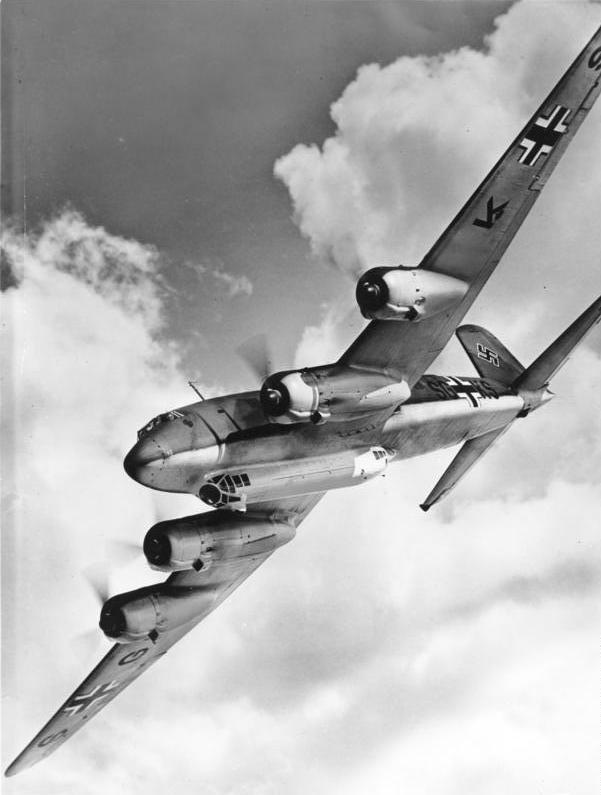
Historical Context & Origins
The Focke-Wulf Fw 200 Condor, with its first flight in 1937, represented a bold step forward in German aviation, starting life as an elegant long-range civilian airliner. Designed by the brilliant Kurt Tank for Focke-Wulf, it intended to compete directly with the American giants on the transatlantic routes.
Its initial conception aimed to offer unprecedented luxury and speed, configured to carry up to 26 passengers. The vision was to connect Europe and the Americas more quickly and efficiently, an ambition that was quickly demonstrated by a series of internationally acclaimed record flights.
This versatile platform, however, soon attracted the attention of the Luftwaffe. Its exceptional autonomy and payload capabilities made it an ideal candidate for conversion into a maritime reconnaissance and long-range bomber, a fate that would profoundly shape its operational career.
Architecture & Technological Design
The Fw 200 Condor was a low-wing monoplane, characterized by an entirely metallic construction which guaranteed its robustness and lightness for the time. This architecture was cutting-edge, designed to maximize aerodynamic efficiency and long-range flight performance.
Propulsion was entrusted to four radial engines, initially the Pratt & Whitney Hornet S1E-G for the civilian version, then replaced by powerful BMW 132H or, in subsequent phases, by Bramo 323 R-2 Fafnir in the military versions. This four-engine configuration gave the Condor crucial reliability for long ocean missions.
Although elegant in its civilian configuration, the military conversion required significant structural reinforcements and the addition of defensive positions. Underwing nacelles, a dorsal turret and a ventral were integrated, transforming it from a placid passenger to a fearsome "Scourge of the Atlantic", albeit with some intrinsic structural weaknesses.
Onboard Specifications
- ◆Modular cargo capacity: A large bomb/cargo bay adaptable for different military or civilian configurations, essential for its versatility.
- ◆Advanced Radio Navigation System: Crucial for long-range maritime patrol missions, enabling operations in adverse weather conditions and across vast ocean spaces.
- ◆Extended ventral gondola (Bola-Gondel): A distinctive feature of the military versions, designed to accommodate a 20 mm cannon or machine guns, as well as a possible search radar, significantly increasing its offensive and defensive capacity.
Operational Career & Operators
The career of the Fw 200 Condor began gloriously with Lufthansa, culminating in record flights that demonstrated its exceptional capabilities, such as the non-stop Berlin-New York flight in just over 24 hours in 1938. These successes made it a symbol of German aeronautical engineering.
With the onset of World War II, the Condor was rapidly militarized and integrated into the Luftwaffe. Mainly employed as a long-range maritime reconnaissance and anti-ship bomber in the North Atlantic, it became the sworn enemy of Allied convoys, earning the nickname "Scourge of the Atlantic" from Winston Churchill.
In addition to its operational role, some Condors were converted into VIP transport aircraft, the most famous of which was Adolf Hitler's personal example, the "Weihe II". Despite its initial effectiveness, its structure originally intended for civilian use proved vulnerable to combat damage and the stresses of bombing, leading to a high casualty rate.
Legacy & Cultural Impact
The Focke-Wulf Fw 200 Condor left a complex legacy, a symbol of both engineering genius and the challenges imposed by war. Its transformation from elegant airliner to feared maritime predator highlights its inherent versatility and long-range multi-role aircraft potential.
Although her military career was hampered by structural limitations, the Condor unequivocally demonstrated the strategic importance of ocean reconnaissance and long-range anti-ship attack capability. It was a conceptual precursor for future strategic bombers and modern maritime patrol aircraft.
Today, the Fw 200 Condor is remembered as an icon of World War II aviation, a bridge between the era of pioneering commercial aviation and the brutal demands of global conflict, whose story still resonates with aviation enthusiasts for its innovation and dramatic impact.
Telemetria Specs (HUD)
Hangar Trivia & Curiosità
- 💡Fu originariamente progettato da Kurt Tank per il trasporto passeggeri civile, completando il suo primo volo transatlantico senza scalo nel 1938.
- 💡Adolf Hitler utilizzò un Fw 200 Condor modificato, chiamato 'Immelmann III', come suo aereo di trasporto personale.
- 💡La sua struttura, ottimizzata per l'uso civile, si rivelò fragile sotto lo stress del combattimento e con carichi pesanti di bombe e carburante, contribuendo a un alto tasso di logoramento.
Archivio Avvistamenti Spotter
Immagini scattate dalla community in tutto il mondo