F.61 Goliath
Farman
Historical Context & Origins
After the devastation of the First World War, the French aeronautical industry was faced with the challenge of converting its immense production capacity from military purposes to civilian uses. It was in this scenario of excitement and innovation that the Société des Avions Henri et Maurice Farman conceived an aircraft destined to write a new chapter in the history of flight. The need was clear: a robust and reliable aircraft for the transport of passengers and cargo, which could lead aviation towards a commercial future.
The Farman F.61 Goliath was not born from nothing, but was the direct evolution of the Farman F.60 heavy bomber, a giant of the skies that had demonstrated its solidity and load capacity during the conflict. Farman engineers, guided by the vision of Henri Farman, redesigned it for a peaceful role, maintaining its robustness but optimizing its interior for traveler comfort. Its first flight occurred in 1919, marking the beginning of a new era for civil and commercial aviation.
Architecture & Technological Design
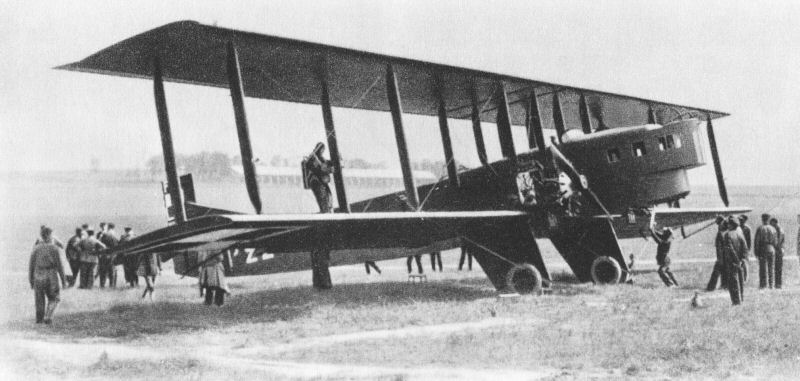
The Farman F.61 Goliath was an impressive biplane with a configuration that embodied the robustness and simplicity typical of the era. Its structure was made mainly of wood and canvas, standard aviation materials of the early 1900s, but assembled with a skill that gave the aircraft exceptional structural solidity. Its large wings provided considerable lifting capacity, crucial for carrying significant loads or large numbers of passengers.
Propulsion was entrusted to two radial engines, usually the powerful Salmson 9Z with 260 HP each, positioned between the two wings in separate nacelles. This twin-engine configuration not only provided the power needed for its size, but also offered a crucial safety margin for long journeys over sea or unfamiliar lands. The passenger cabin, closed and heated, was a revolutionary element, designed to offer unthinkable comfort for the time and anticipating future standards of airline aircraft.
Onboard Specifications
- ◆Advanced Passenger Capacity: Designed to accommodate up to 12-14 passengers, a surprising number for the early post-war years, in a surprisingly comfortable cabin.
- ◆Reliable Twin Engine Configuration: Equipped with two 260 HP Salmson 9Zs (or similar engines such as Renault or Lorraine-Dietrich), ensuring the necessary redundancy for the first long-distance commercial flights.
- ◆Large Operational Autonomy: With a range of approximately 400 kilometers and a maximum speed of 140-150 km/h, it allowed direct connections between the main European capitals, inaugurating a new era of connectivity.
Operational Career & Operators
The Farman F.61 Goliath quickly became the pioneer of regular commercial flights, a true workhorse of civil aviation. His operational career is inextricably linked to the first international flight with paying passengers between Paris and London, a historic event that occurred on 8 February 1919. This flight demonstrated to the world the feasibility and reliability of long-distance civil air transportation, paving the way for an entirely new industry.
New airlines, such as Lignes Farman, used it extensively on routes connecting Paris with London, Brussels and Amsterdam, contributing to the creation of the first European airline network. It wasn't just a passenger plane; its considerable load capacity also made it valuable for the transport of goods and mail, helping to lay the foundations for modern air cargo operations. Its robustness and reliability in often difficult operating conditions made it a symbol of progress and determination.
Legacy & Cultural Impact
The impact of the Farman F.61 Goliath on aviation was profound and long-lasting. It demonstrated unequivocally that air travel was no longer exclusive to adventurers or military personnel, but a safe and viable mode of travel for the general public. Its success contributed to radically transforming the public perception of the airplane, from a war machine to an instrument of connectivity, commerce and civil progress.
The "Goliath", with its evocative name suggesting its imposing size and extraordinary capabilities, became a symbol of French daring and ingenuity in the interwar period. It paved the way for the development of larger, more sophisticated passenger aircraft, establishing the criteria for comfort, safety and reliability that would become industry standards. His legacy lies in making the sky accessible to all, laying the foundation for the golden era of modern commercial aviation.
Telemetria Specs (HUD)
Hangar Trivia & Curiosità
- 💡Il Goliath effettuò uno dei primi voli commerciali internazionali nel febbraio 1919, collegando Toussus-le-Noble (Francia) a Kenley (Regno Unito).
- 💡Era noto per la sua cabina spaziosa, capace di trasportare tra 12 e 14 passeggeri, una capacità considerevole per l'epoca.
- 💡Il suo design robusto gli permise di continuare a servire come bombardiere e aereo da trasporto con diverse forze aeree anche dopo il suo debutto civile.
Archivio Avvistamenti Spotter
Immagini scattate dalla community in tutto il mondo