F.121 Jabiru
Farman
Historical Context & Origins
The early 1920s were a time of fervor for aviation, with the industry seeking to overcome the limitations imposed by the First World War by moving towards larger, more capable aircraft. In this dynamic scenario, the famous Farman company set itself the ambitious goal of dominating the long-range air transport sector.
It was in this context of expansion that the Farman F.121 Jabiru made its first flight in 1923. Conceived as an imposing four-engined aircraft, its name, "Jabiru", evoked a large aquatic bird, suggesting not only its considerable size, but also a vocation for long journeys and robustness.
The Farman F.121 project aimed to meet the growing demand for civil transport aircraft and, potentially, long-range bombers. It combined significant cargo capacities with a state-of-the-art level of passenger comfort, reflecting the vision of a future in which air travel would be accessible and reliable.
Architecture & Technological Design
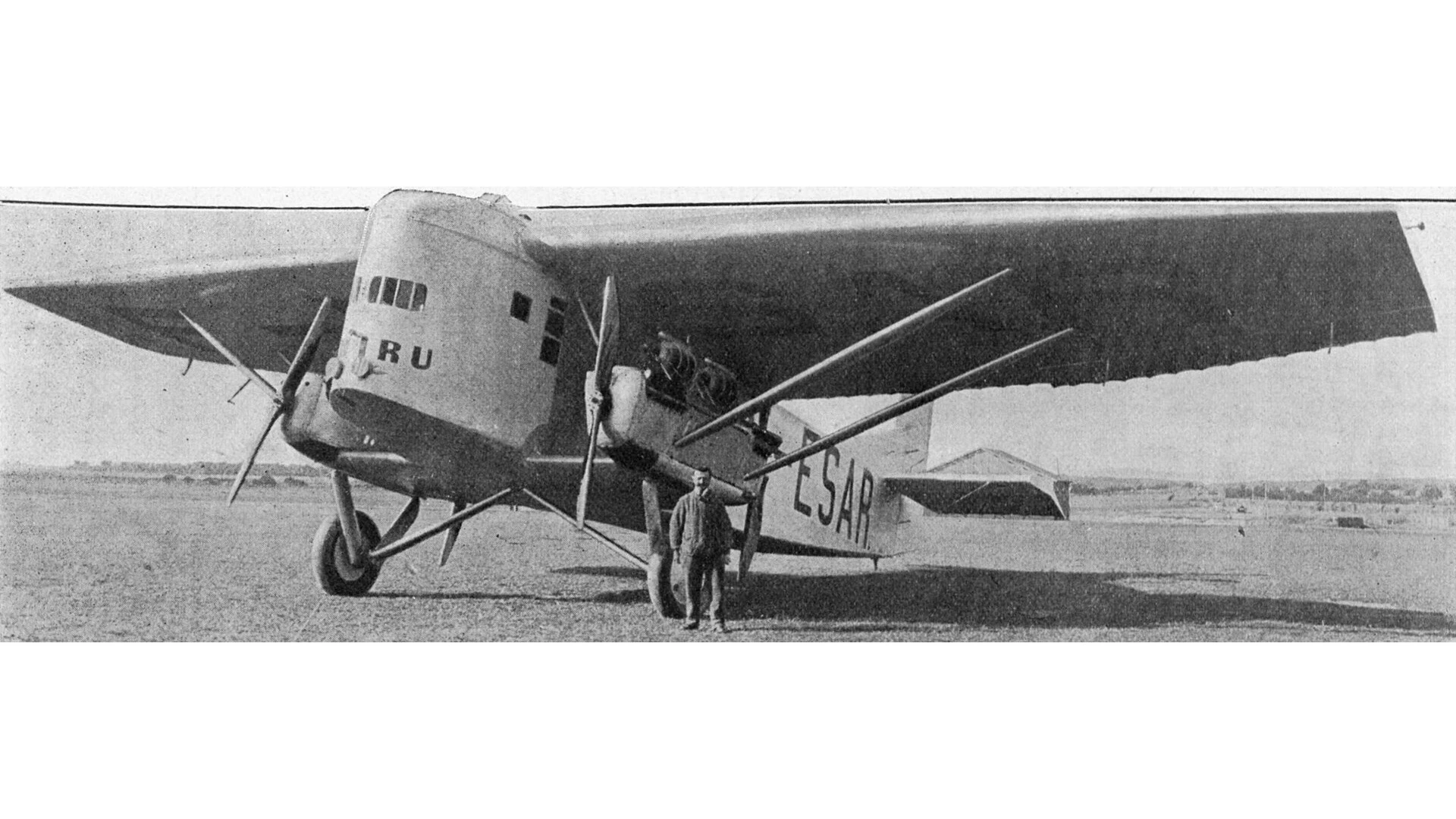
The Farman F.121 Jabiru was a four-engine biplane with a bold configuration for its time, embodying Farman's innovative engineering philosophy. Its imposing structure, with a large fuselage, was designed to maximize internal space and aerodynamic efficiency, despite its considerable size.
Its most distinctive feature was the propulsion system: four Lorraine-Dietrich 12Eb engines of 450 HP each. These were housed in two faired nacelles, mounted between the wings, one on each side of the fuselage. Each nacelle contained two engines in a tandem configuration, with a pulling and pushing propeller, a powerful and complex solution to optimize thrust.
Construction relied on proven techniques, with a sturdy wood and canvas structure, expertly designed to withstand the stresses of long-range flight and heavy loads. The passenger cabin, an example of luxury and functionality, offered a heated and comfortable environment, a rarity by the standards of the early 1920s.
Onboard Specifications
- ◆Four-engine configuration in tandem nacelles: Four Lorraine-Dietrich 12Eb engines (450 hp each) housed in push-pull pairs.
- ◆Enclosed and heated passenger cabin: A considerable luxury for its time, designed to provide comfort on long flights.
- ◆Sturdy wood and canvas construction: Traditional materials, but with advanced engineering to ensure strength and safety.
Operational Career & Operators
Despite its ambitions and technological innovation, the operational career of the Farman F.121 Jabiru was relatively short and limited, mainly due to high costs and increasing competition. Its primary destination was luxury passenger transport on medium-long haul European routes.
The Jabiru was briefly operated by Farman's own airline, Société Générale de Transport Aérien (SGTA), on routes connecting key cities such as Paris, London and Brussels. Here it demonstrated stability and comfort, helping to lay the foundations for the concept of continental scheduled air transport.
However, the complex design, particularly the configuration of the engines, made maintenance expensive and operating costs high, limiting its diffusion and commercial longevity. It was only produced in a small number of examples, giving way to subsequent projects with simpler and cheaper engine architectures.
Legacy & Cultural Impact
The Farman F.121 Jabiru, although not achieving massive commercial success, left an indelible mark in the history of aviation as a pioneer of long-range multi-role aircraft. It demonstrated the feasibility of large aircraft with comfortable passenger cabins, pushing the limits of aeronautical design of the time.
Its bold four-engine tandem configuration was a crucial experiment, providing valuable data for future development of multi-propeller aircraft, although the solution did not establish itself as the standard. The Jabiru embodied the ingenuity and experimentation that characterized the post-war golden years of French aviation.
The legacy of the Jabiru lies in its function as a "bridge" between the era of modified warplanes and that of modern airliners. Its challenges and innovations shaped the evolution of commercial aviation, remaining a fascinating symbol of an era when the aviation industry dared to dream big.
Telemetria Specs (HUD)
Hangar Trivia & Curiosità
- 💡It was named "Jabiru" after a large stork, symbolizing its intended long-range capabilities.
- 💡The F.121 was notable for mounting each of its four piston engines in separate nacelles positioned between the upper and lower biplane wings.
- 💡Despite its innovative design and capacity for 12 passengers, only two Farman F.121 Jabirus were ever built, limiting its operational history.
Archivio Avvistamenti Spotter
Immagini scattate dalla community in tutto il mondo