EMB 110 Bandeirante
Embraer
Historical Context & Origins
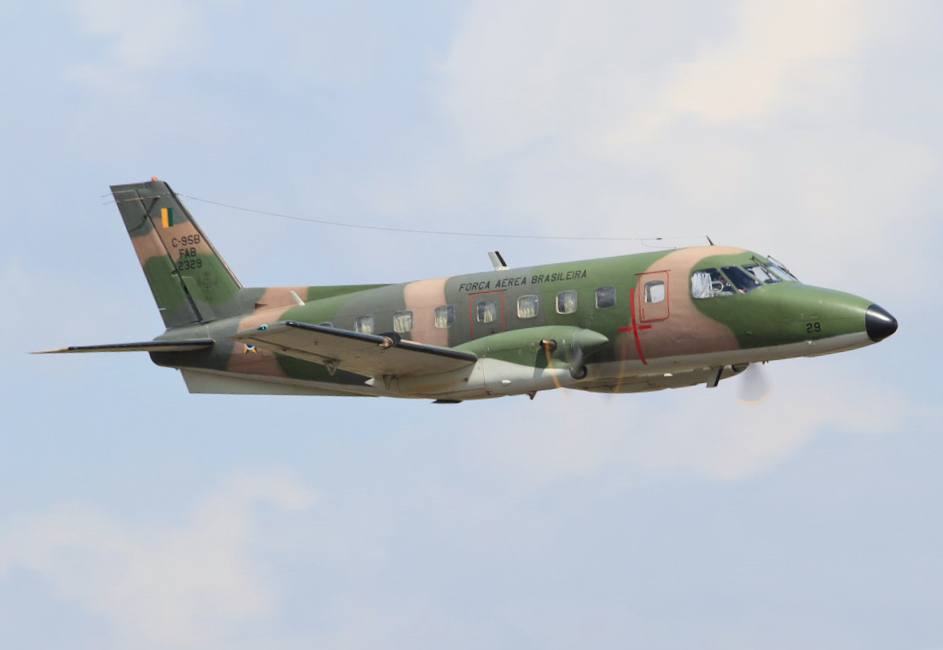
The Embraer EMB 110 Bandeirante is not just an airplane, but the embodiment of a national dream and the birth certificate of the Brazilian aviation industry. Born from the IPD-6504 project of the Centro Tecnico Aerospacial (CTA) and developed by the Instituto de Pesquisa e Desenvolvimento (IPD) starting in 1965, its aim was to provide a reliable regional transport aircraft for the vast and often rugged geographies of Brazil.
The prototype, designated YC-95, made its maiden flight on 26 October 1968, marking a historic milestone. The success of the project was such that, to industrialize its production and start a real national aeronautical industry, the following year the Brazilian government founded the Empresa Brasileira de Aeronáutica, or Embraer, with the Bandeirante as its first serial product.
Architecture & Technological Design
The Bandeirante is a high-wing twin-turboprop, designed with a philosophy of robustness and versatility. Its architecture was intrinsically designed to operate from short and semi-prepared runways, common characteristics in the interior regions of Brazil, making it ideal for transporting passengers, cargo and special missions even in challenging geographical contexts.
Powered by two Pratt & Whitney Canada PT6A engines, famous for their reliability and ease of maintenance, the aircraft could accommodate from 15 to 21 passengers depending on the configuration. Its structure entirely in aluminum alloy, robust but relatively light, gave the Bandeirante remarkable operational resistance and a long useful life.
Onboard Specifications
- ◆Intrinsic STOL capability: Designed for short take-offs and landings, even from unpaved runways, thanks to the high wing and powerful engine-propeller combination.
- ◆Robust Structure and Tricycle Fixed Landing Gear: An intentionally simple, ruggedized design, with a rugged fixed landing gear, optimized for resilience and minimal maintenance in harsh operating environments.
- ◆Modular analog avionics: Simple but reliable on-board systems, designed to be easily repairable and upgradeable, ensuring operation even in remote regions with limited technical resources.
Operational Career & Operators
The Bandeirante quickly became the backbone of Brazilian regional air transportation, used by airlines such as Rio-Sul and VASP Expresso. Its versatility also made it famous in the military field, with the Força Aérea Brasileira (FAB) employing different variants (C-95, P-95 for maritime patrol) in various roles, from tactical transport to training.
The success was not limited to national borders; the Embraer EMB 110 was exported to over 30 countries, finding use in regional fleets, cargo operators, air ambulance services and instrumental calibration missions. Its adaptability and low operating costs have resulted in a surprising operational longevity, with many examples still in active service decades after their first flight.
Legacy & Cultural Impact
The Bandeirante is much more than just a plane; it is the founding pillar of Embraer, the company that today is a global aviation giant. Its success demonstrated Brazil's engineering and manufacturing capacity, paving the way for subsequent highly successful models such as the EMB 120 Brasilia and the entire ERJ family of regional jets.
Its cultural impact lies in having democratized air transport in vast areas of Brazil and the developing world, connecting remote communities and facilitating economic development. The EMB 110 remains a symbol of innovation, resilience and national pride, a true "bandeirante" that charted new routes for progress and for Brazilian aviation.
Telemetria Specs (HUD)
Hangar Trivia & Curiosità
- 💡Il nome "Bandeirante" rende omaggio agli esploratori portoghesi che nel XVII secolo penetrarono l'interno del Brasile, riflettendo lo spirito pionieristico dell'aereo.
- 💡Fu il primo aereo interamente progettato e prodotto in serie da Embraer, giocando un ruolo fondamentale nel lanciare l'azienda brasiliana a livello internazionale nel settore aeronautico.
- 💡Molte varianti militari del Bandeirante furono utilizzate dalla Força Aérea Brasileira (FAB) per trasporto truppe, ricognizione marittima, evacuazione medica e altri compiti speciali, dimostrando la sua incredibile versatilità.
Archivio Avvistamenti Spotter
Immagini scattate dalla community in tutto il mondo