Eagle
Curtiss
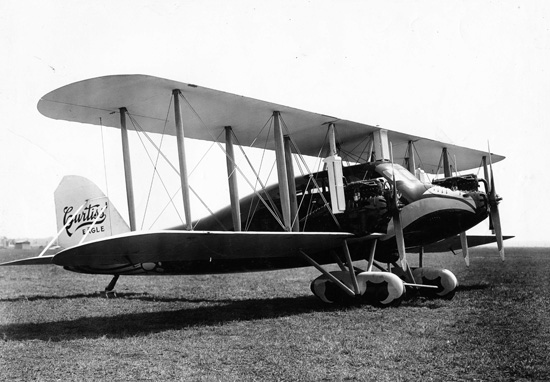
Historical Context & Origins
After the Great War, the aviation industry found itself at a crossroads, rapidly transitioning from war production to civilian production. Against this backdrop of fervent innovation and hope, the Curtiss Aeroplane and Motor Company, under the visionary leadership of Glenn H. Curtiss, sought to define the future of passenger transportation.
The Curtiss Eagle, which made its first flight in 1919, emerged as a bold attempt to capitalize on the experience gained during the conflict and apply it to the emerging demand for commercial air travel. It was intended to stand out from converted warplanes, offering an aircraft specifically designed for the comfort and safety of passengers.
Architecture & Technological Design
The Eagle was an impressive aircraft for its time, characterized by a triplane configuration that offered exceptional lift and intrinsic stability, fundamental qualities for transporting people. This design choice aimed to ensure safer operations and easier control, which are crucial for public trust.
Its most revolutionary innovation was the enclosed and heated cockpit, a rarity in an era dominated by open cockpits. Powered by three Curtiss K-6 engines of 150 horsepower each, two located between the lower wings and the central one in the nose, the Eagle offered the redundancy needed for long-distance flight.
Onboard Specifications
- ◆Fully enclosed, luxuriously furnished and heated cabin for 6-8 passengers, an unheard of luxury for the times.
- ◆Triplane architecture for maximum lift and operational safety, even at lower speeds, improving handling.
- ◆Tri-engine propulsion (3x Curtiss K-6) which ensured greater reliability and flight ability even with one engine failing.
Operational Career & Operators
Despite its advanced features, the Eagle's operational career was relatively short and limited. Only a few examples were produced, mainly used by the Curtiss Exhibition Company for demonstration flights and exclusive charter services, showcasing the potential of air transport.
The aircraft became a symbol of the nascent airlines, although its large-scale diffusion was hampered by high costs, the lack of adequate infrastructure and competition from cheaper or less complex models. The airline market was still in its infancy, and the Eagle was perhaps too ahead of its time.
Legacy & Cultural Impact
Although it did not achieve mass commercial success, the Curtiss Eagle is recognized as a key pioneer in the evolution of civil aviation. It was one of the first aircraft to concretely demonstrate the feasibility and benefits of comfortable, multi-engine passenger transport.
Its bold concept, from the closed cabin to the three-engine system, laid the foundation for the development of future airliners, indirectly influencing subsequent designs. The Eagle remains a symbol of American ingenuity and the vision that transformed the sky from a battlefield to a highway for humanity.
Telemetria Specs (HUD)
Hangar Trivia & Curiosità
- 💡The Eagle was one of the earliest purpose-built multi-engine airliners designed in the United States, showcasing early commercial aviation ambitions.
- 💡Its distinctive triplane wing configuration, unusual for airliners, was chosen to generate sufficient lift for its weight and passenger capacity.
- 💡The aircraft featured an enclosed cabin for up to eight passengers, a significant comfort innovation when most flying involved open cockpits.
Archivio Avvistamenti Spotter
Immagini scattate dalla community in tutto il mondo