Dove
de Havilland
Historical Context & Origins
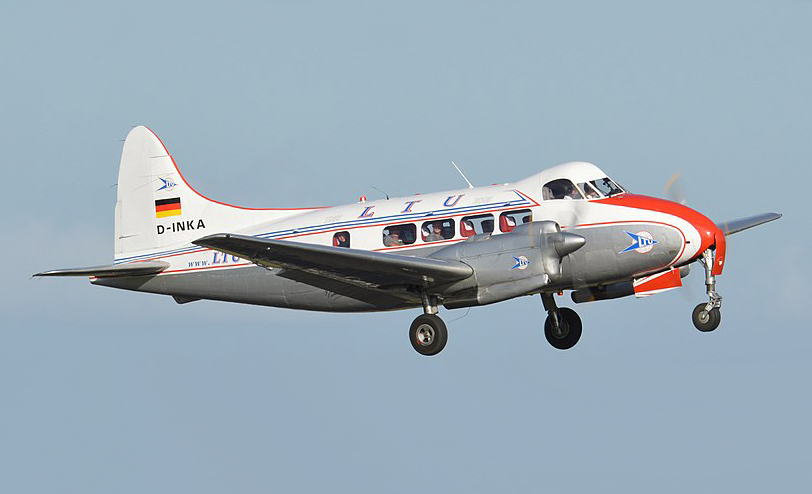
The de Havilland Dove emerged in a crucial period, when Europe and the entire world began to rebuild from the ashes of the Second World War. The need for a reliable and versatile civil aircraft, capable of connecting cities and regions efficiently, was pressing. De Havilland, already a giant of British aviation, responded to this need with a far-sighted project.
With its first flight on 25 September 1945, as soon as the conflict ended, the Dove embodied hope and progress. It was developed to replace the biplanes and early monoplanes used for short-range passenger and cargo services, offering a more modern and high-performance solution. This aircraft soon became a symbol of the revival of the British aviation industry.
Architecture & Technological Design
The Dove was conceived as a twin-engine low-wing monoplane, characterized by an all-metal construction, a significant innovation for the time compared to aircraft with mixed structure. This design choice guaranteed greater robustness, durability and ease of maintenance, crucial elements for commercial operations. Its elegant and functional silhouette became immediately recognisable.
Powered by two de Havilland Gipsy Queen 70 piston engines, the Dove offered an optimal balance of power, efficiency and reliability. These air-cooled straight-six engines, equipped with constant-speed propellers, provided solid performance for carrying 8-11 passengers or equivalent cargo. The cabin, although compact, was designed for surprisingly high comfort.
Retractable landing gear, an advanced feature for an aircraft of its category at the time, contributed to clean aerodynamics and improved flight performance. The overall design reflected a deep understanding of the needs of the post-war civilian market, balancing operational economy with high capabilities.
Onboard Specifications
- ◆All-metal structure in light alloy: Guarantee of resistance and longevity with low weight.
- ◆De Havilland Gipsy Queen 70 Mk.2 inline engines: Six-cylinder, air-cooled, known for reliability and low drag.
- ◆Three-bladed constant speed propellers: Optimizes performance over a wide range of speeds and altitudes.
Operational Career & Operators
The de Havilland Dove proved to be an extraordinary commercial success, with over 500 examples produced and sold worldwide. Its versatility was unparalleled: it was used as a regional airliner, executive transport for companies and personalities, air ambulance, and even for photographic reconnaissance and geological surveys. Its robustness made it ideal for operating even from unprepared slopes.
Numerous small airlines, charter operators and militaries in over 30 countries chose Dove for its efficiency and proven reliability. In particular, it became a pillar for the development of regional air routes, connecting communities and facilitating trade in an era of rapid globalization. Its operational life often exceeded decades, a testament to its engineering excellence.
Legacy & Cultural Impact
The de Havilland Dove was not just a successful aircraft; he was a pioneer who profoundly influenced the design of subsequent civil aircraft. Its twin-engine architecture, metallic construction and attention to passenger comfort set new standards for its category. Many of the lessons learned from the Dove were applied to de Havilland's future designs, including the larger, four-engined Heron.
Even today, several examples of Dove are preserved in museums or are active as vintage aircraft, participating in air rallies and keeping its legendary status alive. Its iconic figure, with its characteristic rounded nose and clean lines, has remained etched in the history of aviation, representing an era of innovation and rebirth. The Dove remains a timeless classic, loved by pilots and enthusiasts.
Telemetria Specs (HUD)
Hangar Trivia & Curiosità
- 💡It was one of the first British aircraft to feature reversible-pitch propellers, enhancing braking and maneuverability on the ground.
- 💡Many Doves were luxuriously refitted as executive aircraft, extending their service well into the jet age due to their comfort and reliability.
- 💡The Dove shared innovative construction techniques, like Redux bonding, with the later, larger de Havilland Comet airliner.
Archivio Avvistamenti Spotter
Immagini scattate dalla community in tutto il mondo