DHC-8-100
de Havilland Canada
Historical Context & Origins
In the early 1980s, the regional aviation market was in turmoil, requiring a new type of aircraft: faster, more efficient and, above all, quieter than the turboprops of the time. de Havilland Canada, building on its reputation with STOL (Short Take-Off and Landing) aircraft such as the DHC-6 Twin Otter and the DHC-7 Dash 7, was ready to meet this challenge.
The Canadian company undertook the development of the Dash 8, an aircraft designed to bridge the gap between smaller aircraft and regional jets, aiming for higher cruising speeds than the Dash 7 but maintaining exceptional operational capabilities on short runways. The first flight of the prototype, the DHC-8-100, occurred on 20 June 1983, marking the beginning of a new era.
Architecture & Technological Design
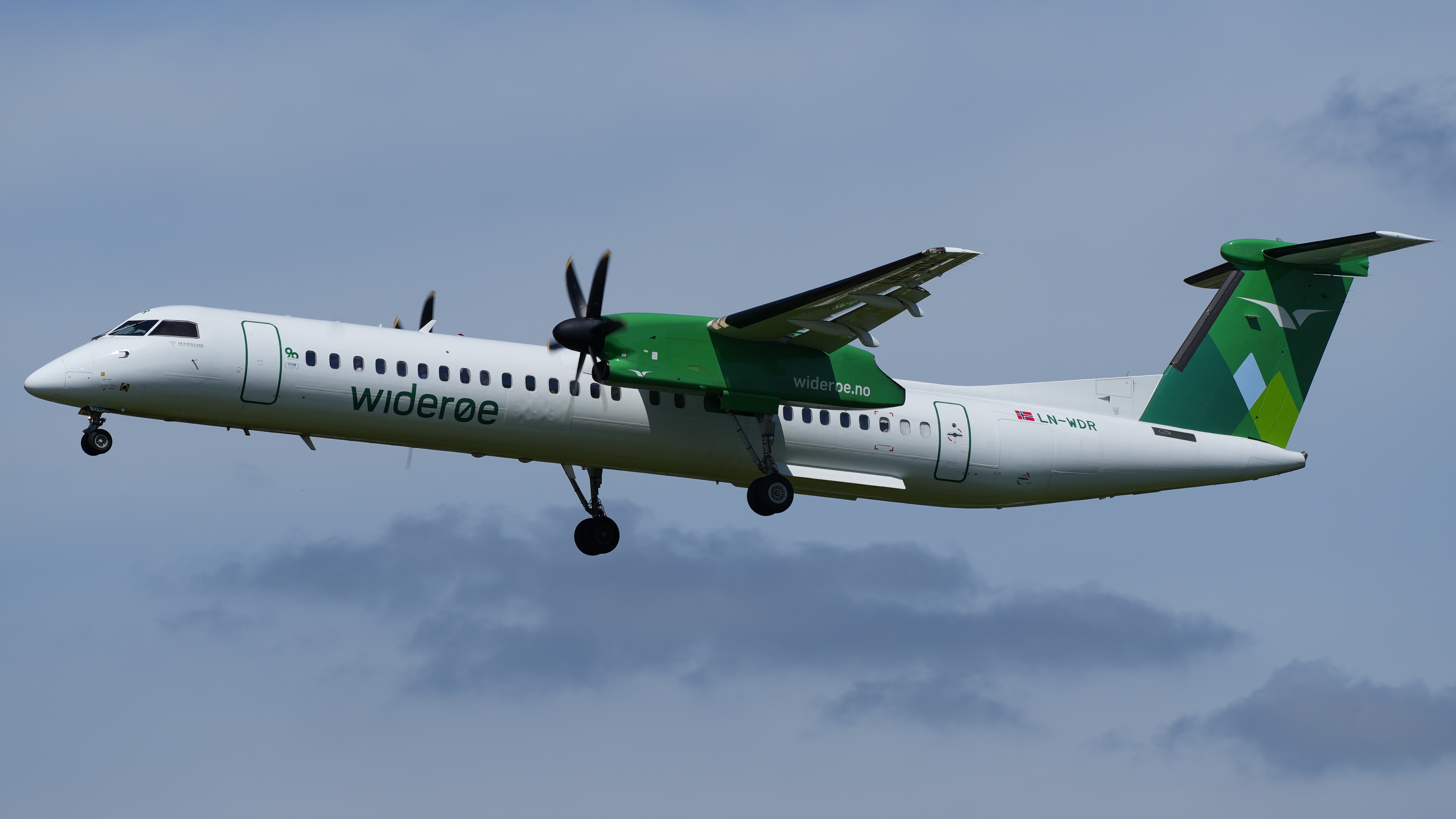
The DHC-8-100 stands out for its well-thought-out architecture, with a high-wing twin-engine turboprop configuration and an elegant T-tail. This combination not only ensured excellent flight performance, but also facilitated the loading and unloading of passengers and baggage by keeping the wing above their heads.
A revolutionary element was the introduction of the Active Noise and Vibration Suppression (ANVS) system. This advanced technology used microphones and speakers to actively cancel out cabin vibration and noise, radically transforming onboard comfort for passengers, often critical in turboprops.
The aircraft was powered by two Pratt & Whitney Canada PW120 engines, prized for their robustness, fuel efficiency and reliability. The robust landing gear design reflected Havilland Canada's tradition of operating even on less prepared runways, offering remarkable operational versatility.
Onboard Specifications
- ◆Active Noise and Vibration Suppression (ANVS): A pioneering system to drastically reduce noise and vibration in the cabin, improving passenger comfort.
- ◆Pratt & Whitney Canada PW120 Turboprop Engines: Reliable and efficient engines, known for their durability and performance in various environmental conditions.
- ◆High-Aspect Ratio Wing Design: A wing designed to maximize aerodynamic efficiency, contributing to excellent short takeoff and landing (STOL) capabilities.
Operational Career & Operators
The DHC-8-100 quickly established itself as the workhorse of global regional aviation. Its combination of efficiency, reliability and comfort made it the preferred choice for a wide range of carriers, connecting small communities with larger hubs.
Operated by airlines on every continent from North America to Oceania, the Dash 8-100 has proven its versatility in diverse environments, from warm plains to harsh Arctic climates. Its robustness has allowed continuous operations with high utilization rates, consolidating its reputation.
Legacy & Cultural Impact
The DHC-8-100 was not only a commercial success, but also laid the foundation for one of the longest-running and successful regional aircraft families in history: the Dash 8 Series, which includes the Q200, Q300 and the celebrated Q400 variants. Its "Quiet Technology" has become an industry standard.
Its impact was significant, raising comfort standards for regional flights and demonstrating that turboprops could compete in terms of passenger experience. The Dash 8-100 remains a symbol of Canadian innovation, an aircraft that redefined regional air transportation and left a lasting legacy in global aviation.
Telemetria Specs (HUD)
Hangar Trivia & Curiosità
- 💡The DHC-8-100 was designed as a successor to the DHC-7 Dash 7, offering higher cruising speed while maintaining good short take-off and landing (STOL) capabilities.
- 💡Its robust design made it popular for operations in challenging environments, including unpaved runways and regions with extreme weather conditions.
- 💡While later variants (like the Q-series) gained a 'Quiet' designation for noise reduction technology, the original Dash 8-100 still offered a relatively comfortable cabin for its time.
Archivio Avvistamenti Spotter
Immagini scattate dalla community in tutto il mondo
Vettori Rilevati (Flotta Attiva)


Asia Pacific Airlines
In Flotta: x13 u.

Air Creebec
In Flotta: x14 u.
Perimeter Aviation
In Flotta: x4 u.
Widerøe
In Flotta: x5 u.
Bighorn Airways
In Flotta: x13 u.
Jazz Air
In Flotta: x10 u.
Island Air (Hawaii)
In Flotta: x10 u.
Air Inuit
In Flotta: x4 u.
Horizon Air
In Flotta: x15 u.
748 Air Services
In Flotta: x11 u.
Central Mountain Air
In Flotta: x7 u.
PNG Air
In Flotta: x12 u.
Voyageur Airways
In Flotta: x7 u.Vettori Rilevati (Flotta Storica / Dismessa)

R1 Airlines
Stato: Dismesso

Hamburg Airlines
Stato: Dismesso
PAL Airlines
Stato: Dismesso
Tyrolean Airways
Stato: Dismesso
Air Berlin
Stato: Dismesso
Piedmont Airlines
Stato: Dismesso
Augsburg Airways
Stato: Dismesso
FlyViking
Stato: Dismesso
America West Express
Stato: Dismesso