DHC-7 (Dash 7)
de Havilland Canada
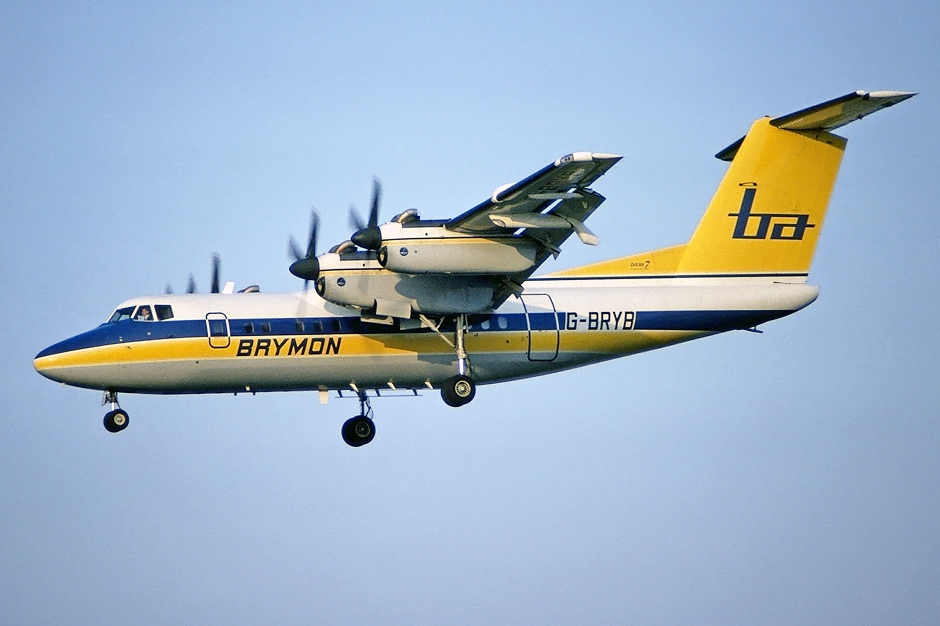
Historical Context & Origins
In the early 1970s, the need for regional aircraft capable of operating from short, quiet runways close to urban centers became pressing. De Havilland Canada, drawing on its decades of experience with STOL (Short Take-Off and Landing) aircraft, responded with a new, ambitious project.
The goal was to develop a STOL aircraft with increased passenger capacity and exceptionally quiet operation. The DHC-7, or Dash 7, was designed to revolutionize short-haul connections, operating effectively even in metropolitan airports with severe noise restrictions.
- ◆*March 27, 1975saw thefirst flight** of this innovative quad-turboprop. The “Quiet STOL Airliner” was ready to prove its worth, offering unprecedented access to remote locations and urban hubs.
Architecture & Technological Design
The design of the DHC-7 is a masterpiece of aeronautical engineering, aimed at maximizing STOL performance and drastically reducing noise. Its high-aspect ratio wing, featuring complex full-span double-slotted flaps, generated extraordinary lift even at low speeds.
Its most distinctive technical feature was the configuration with four Pratt & Whitney Canada PT6A-50 turboprop engines. These thrusters, installed on the high wing with low rotation speed propellers, not only offered enviable operational redundancy, but significantly reduced noise through the coanda effect.
This sophisticated architecture allowed the Dash 7 to land and take off on runways as short as 600 meters, even with a considerable payload. Precise directional control, aided by large tail surfaces, made it extremely maneuverable in confined airport spaces.
Onboard Specifications
- ◆Four Pratt & Whitney Canada PT6A-50 turboprop engines: Critical to distributed power, operational safety and advanced STOL capabilities.
- ◆Advanced STOL capability: Requires runways of just 600 meters for full load operations, an exceptional performance for a 50 seat aircraft.
- ◆Low noise design: With internal and external noise levels significantly lower than those heard in a normal urban environment.
Operational Career & Operators
The Dash 7 found use in a variety of roles, from scheduled regional aviation to special missions. Its ability to operate from airports with limited infrastructure made it invaluable for serving remote and difficult-to-access destinations.
European carriers such as Tyrolean Airways and Brymon Airways exploited its unique characteristics to connect airports with stringent noise restrictions. It was also used for surveillance, cartography and logistical support, even in the military sector.
Despite its undisputed qualities, the Dash 7 was produced in a relatively small number of only 113 examples. The rise of twin-engine turboprops, which were cheaper in terms of operating costs, such as the subsequent DHC-8 Dash 8, limited their diffusion, although not equaling their extreme STOL capabilities.
Legacy & Cultural Impact
The de Havilland Canada DHC-7 has left a significant legacy, not only as a pioneer of four-engine STOL aircraft but as a catalyst for innovation in regional aviation. It proved that an aircraft could be efficient, quiet and capable of operating from almost any runway.
Its emphasis on quiet operation set an important precedent in the industry, pushing for higher standards of environmental friendliness and the well-being of airport communities. The Dash 7 anticipated future needs in regional aircraft design.
Even today, many DHC-7s continue to take to the skies in niche roles, often in demanding operational scenarios where its robustness, STOL performance and payload capacity are irreplaceable. It remains an icon of Canadian aeronautical engineering and a true "workhorse" of the sky.
Telemetria Specs (HUD)
Hangar Trivia & Curiosità
- 💡The Dash 7 was one of the first airliners specifically designed for ultra-quiet operation, a key feature for its intended use at urban airports.
- 💡Its unusual four-engine configuration, while enhancing redundancy and STOL performance, also contributed to higher operating costs compared to twin-engine competitors.
- 💡The aircraft's impressive STOL capabilities allowed it to operate from runways as short as 610 meters (2,000 feet) under various conditions.
Archivio Avvistamenti Spotter
Immagini scattate dalla community in tutto il mondo