DHA-3 Drover
de Havilland Australia
Historical Context & Origins
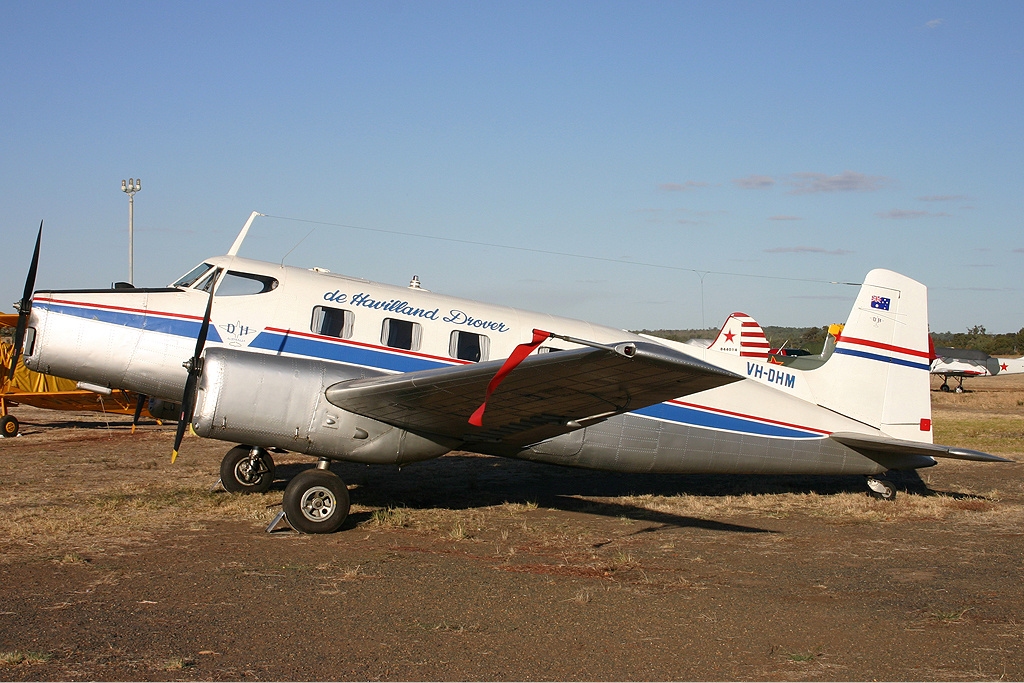
The de Havilland Australia DHA-3 Drover, first flown in 1948, was born out of the post-war Australian need for a robust and versatile aircraft. It was essential to serve the vast and often inhospitable interior regions of the continent, differentiating itself from foreign models.
De Havilland Australia (DHA) locally designed a modern "bush plane", designed for severe Australian conditions. The goal was to replace older light aircraft, offering greater safety and reliability for regional airlines and essential services.
This project embodied Australia's ambition to develop its own aviation industry. The Drover was designed for the transport of passengers, cargo and crucial support to the Royal Flying Doctor Service (RFDS), connecting the most isolated communities.
Architecture & Technological Design
The DHA-3 Drover was designed with ruggedness, simplicity and ease of maintenance in mind, essential characteristics for operating on unprepared runways and in extreme climates. Its all-metal construction was an advanced choice for its time, ensuring durability and corrosion resistance.
Its most distinctive configuration was the tri-engine arrangement, a rare solution for an aircraft of this size. With three de Havilland Gipsy Major 10 Mk.1 engines (and later Lycoming O-435), it offered critical safety in the event of failure and improved short take-off and landing (STOL) performance.
The landing gear was fixed and tricycle, a robust and simple solution that made it ideal for landings on improvised surfaces. The spacious cabin accommodated a pilot and up to 6-8 passengers, also configurable for cargo or medical equipment, underlining its exceptional versatility.
Onboard Specifications
- ◆Tri-engine configuration: Increased safety and critical redundancy for remote flights.
- ◆All-metal construction: Increased durability and simplified maintenance in harsh environments.
- ◆Fixed and robust landing gear: Ideal for operations on unprepared runways and landings on improvised surfaces.
Operational Career & Operators
The DHA-3 Drover found use with several key operators, despite facing some initial challenges. Among the main ones are Qantas Empire Airways, which used it on its routes in New Guinea, and Trans-Australia Airlines (TAA) for Australian regional connections.
The most emblematic service was with the Royal Flying Doctor Service (RFDS), where the Drover proved to be an irreplaceable tool. Its STOL capabilities allowed it to reach the most isolated areas, transporting doctors and supplies or evacuating patients from makeshift runways.
Despite some initial reliability problems with the original engines, which were resolved with their replacement, the Drover served faithfully for many years. He contributed significantly to the development of regional aviation and emergency services in Australia and the Pacific Islands.
Legacy & Cultural Impact
The de Havilland Australia DHA-3 Drover, whilst not a mass commercial success with only 20 examples produced, represents a seminal chapter in Australian aviation history. It symbolizes the boldness and ingenuity of the local industry.
His legacy is not measured in numbers, but in the impact he had on the connectivity of remote communities and his pioneering role in supporting vital services such as the RFDS. The Drover laid the foundations for future Australian aircraft design initiatives.
He is remembered as a "workhorse" of the Australian bush, a witness to the era when aviation began to weave a vital web across boundless landscapes. The Drover remains a symbol of resilience and innovation, a pride of 'made in Australia'.
Telemetria Specs (HUD)
Hangar Trivia & Curiosità
- 💡It was the first aircraft designed and built in Australia after World War II, marking a significant milestone for the local aviation industry.
- 💡Early models faced challenges with their original Gipsy Major engines, leading to engine changes and modifications to improve reliability and performance.
- 💡Despite its British lineage, the Drover was specifically tailored to the harsh conditions and long distances characteristic of Australian outback flying.
Archivio Avvistamenti Spotter
Immagini scattate dalla community in tutto il mondo