DH.66 Hercules
de Havilland
Historical Context & Origins
The de Havilland DH.66 Hercules, with its first flight in 1926, was born from the need of a rapidly expanding civil aeronautics after the First World War. The goal was to develop reliable, long-distance aircraft to connect the vast areas of the British Empire.
Its creation was directly spurred by the demands of Imperial Airways, eager to establish efficient air routes to India and Africa. These pioneering missions required a robust, safe and versatile aircraft, capable of operating in challenging logistical and environmental conditions.
De Havilland conceived the Hercules as a pioneer of intercontinental passenger transport. The project aimed to offer a multi-role "air bus", capable of ensuring regularity and safety on routes that would redefine the possibilities of air travel.
Architecture & Technological Design
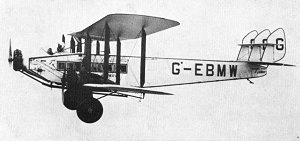
The Hercules sported a distinctive tri-engine biplane configuration, an engineering choice to maximize stability, payload capacity and redundancy. Its structure, common at the time, predominantly employed wood and canvas, offering a good balance of weight, strength and ease of maintenance in the field.
It was powered by three Bristol Jupiter VI radial engines, each producing approximately 420 hp, strategically mounted: one in the nose and two under the upper wing. This three-engine arrangement was crucial for safety, allowing the aircraft to maintain flight even in the event of an engine failure, an innovation critical to passenger confidence.
The cabin, a novelty for the time, was completely enclosed and designed to accommodate seven passengers, offering unprecedented comfort. This design marked a significant advance, making air travel a more refined and accessible experience, distinguishing itself from previous open cockpits.
Onboard Specifications
- ◆Robust and Stable Biplane Structure: Excellent lift for heavy loads and operations on unprepared runways.
- ◆Tri-Engine Configuration for Maximum Safety: Vital redundancy for long-haul flights, reducing the risk of failure.
- ◆Closed and Comfortable Passenger Cabin: Improved the travel experience, protecting from the elements and offering more privacy.
Operational Career & Operators
The DH.66 Hercules quickly became the symbol of Imperial Airways, inaugurating and consolidating key routes such as Cairo-Baghdad and extensions to India. These flights dramatically reduced travel times, establishing aviation's strategic role in connecting the British Empire.
Its remarkable reliability and ability to operate in different weather conditions and on rudimentary airfields also made it attractive to other airlines. It was employed by Qantas in Australia and South African Airways, expanding airline networks into several regions of the Commonwealth.
The aircraft earned a legendary reputation for its robustness and its ability to meet extreme logistical challenges, carrying passengers and loads of mail. The Hercules embodied the pioneering spirit of aviation, combining adventure and technological progress.
Legacy & Cultural Impact
The de Havilland DH.66 Hercules was a true trailblazer, essential for the creation of the first global air routes. Its success demonstrated the feasibility of long-range commercial air transport, paving the way for future airliners and the global expansion of civil aviation.
Its ruggedness and reliability in the field cemented de Havilland's reputation as a cutting-edge company. The Hercules helped "shrink the world," connecting cultures and economies and facilitating communication across vast imperial territories.
Although a piece of history today, the Hercules remains a testament to aeronautical ingenuity. His story is a crucial chapter in the evolution of flight, a symbol of an era in which every flight was an achievement and the sky promised a globally interconnected future.
Telemetria Specs (HUD)
Hangar Trivia & Curiosità
- 💡Often called a 'flying hotel' due to its relatively spacious cabin and significance on long-distance routes.
- 💡It was a workhorse for Imperial Airways, spearheading the expansion of airmail and passenger services across the British Empire.
- 💡Its three Bristol Jupiter radial engines were arranged with one in the nose and two mounted on the lower wings.
Archivio Avvistamenti Spotter
Immagini scattate dalla community in tutto il mondo