DH.34
de Havilland
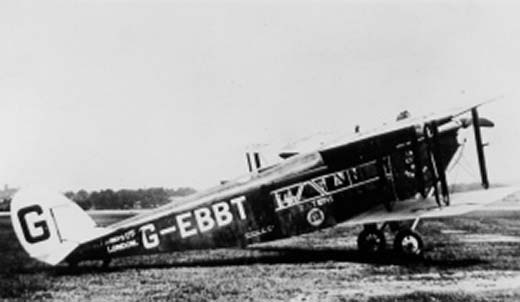
Historical Context & Origins
The period following the First World War saw a surge in interest in civil aviation, with numerous fledgling airlines seeking aircraft capable of reliably carrying passengers and cargo. In this dynamic scenario, the de Havilland Aircraft Company, already renowned for its military successes, foresightedly devoted itself to the development of commercial aircraft.
The de Havilland DH.34, which first flew in 1922, emerged as a direct response to this growing demand. Designed specifically for European air routes, it represented a significant advance over military bomber adaptations used until then, offering an inherently civilian design optimized for scheduled transport.
Architecture & Technological Design
The DH.34 was a conventional biplane, but its architecture hid a design extremely attentive to robustness and safety, fundamental qualities for pioneering commercial aviation. Its structure, mainly made of wood and canvas, was reinforced to withstand the stresses of daily flights and often unpredictable weather conditions.
At the heart of its design was a single, powerful engine, typically the Napier Lion, renowned for its reliability and performance. This engine choice guaranteed the DH.34 a cruising speed and load capacity that were notable for the time, making it a pioneer in scheduled air transport over medium distances.
The particularly spacious fuselage was designed to accommodate passengers in a relatively comfortable environment protected from the elements, an uncommon luxury in the early years of commercial aviation. This aspect contributed greatly to increasing public acceptance and confidence in air travel.
Onboard Specifications
- ◆Napier Lion Engine: A W-12 cylinder powerplant, delivering over 450 horsepower, known for its exceptional reliability and power, crucial for long hauls.
- ◆Enclosed passenger cabin: Offered weather protection and superior comfort for up to nine passengers, raising the standards of travel.
- ◆Robust landing gear: Designed to operate from unprepared airfields, with effective shock absorbers for a smoother and safer landing.
Operational Career & Operators
Although only ten examples of the DH.34 were built, their impact was decisive for the success of commercial air transport. Operated primarily by pioneering carriers such as Daimler Airway and, later, by the nascent Imperial Airways, the DH.34 became a symbol of European routes.
The aircraft regularly connected key cities such as London and Paris, demonstrating the feasibility and reliability of scheduled scheduled flights. Each flight was a feat and an anecdote, but the regularity of service offered by the DH.34 helped build the reputation and trust in commercial air transport.
Legacy & Cultural Impact
The de Havilland DH.34, although not produced in large quantities, left an indelible legacy in aviation history. It demonstrated that an aircraft designed specifically for civilian purposes could be economically viable and technologically advanced, paving the way for future developments in the sector.
His operational career, while brief, solidified de Havilland's position as a leader in civil aerospace innovation and laid the foundation for airliners of greater capacity and complexity. The DH.34 was a silent pioneer, whose robustness and reliability helped shape public perception of air travel, transforming it from an adventure for the daring few to an increasingly accessible means of transport.
Telemetria Specs (HUD)
Hangar Trivia & Curiosità
- 💡Only ten DH.34 aircraft were ever built, making it a relatively rare early airliner.
- 💡It was one of the first aircraft specifically designed from the outset as an airliner, rather than a modified military design.
- 💡The DH.34 primarily served Imperial Airways, Britain's newly formed national airline, on routes across Europe.
Archivio Avvistamenti Spotter
Immagini scattate dalla community in tutto il mondo