DH.16 (Napier Lion)
de Havilland
Historical Context & Origins
The year 1919 marked an epochal turning point for aviation, with the transition from military supremacy to the first bold steps of civil air transport. In this post-war turmoil, the de Havilland Aircraft Company, under the visionary leadership of Sir Geoffrey de Havilland, established itself as a pioneer, recognizing the latent potential of the skies as a new commercial frontier and connection between nations.
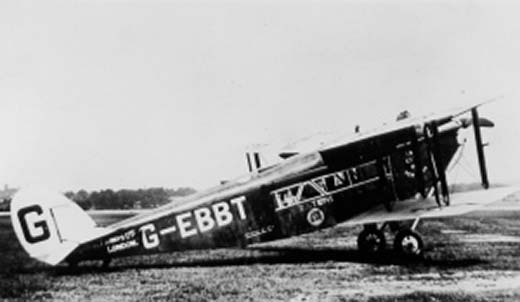
Thus was born the de Havilland DH.16, a brilliant and pragmatic civilian conversion of the famous DH.9A light bomber. Despite its wartime origins, the DH.16 was meticulously redesigned to embody the comfort and reliability required by early passenger services, representing a bastion of British ingenuity at the cutting edge of air transport. Its first flight in 1919 inaugurated an era.
Architecture & Technological Design
The DH.16, while maintaining the imposing biplane structure of the DH.9A, stood out for an innovative, completely enclosed passenger cabin, a luxury and an absolute novelty for the time. This configuration, located in what had been the bomb bay, guaranteed the four passengers shelter from the elements, raising travel standards and inaugurating a new concept of air comfort.
At the heart of this flying machine beat the mighty Napier Lion engine. This 12-cylinder W-shaped engine, capable of producing approximately 450 horsepower, was an engineering marvel of its time. Its power and reliability not only provided the performance needed for the first transnational scheduled flights, but also helped instill confidence in passengers and in the operation of the new air service.
Onboard Specifications
- ◆Enclosed and Heated Passenger Cabin: A fundamental innovation for comfort at altitude.
- ◆Napier Lion Engine (V12, 450 HP): Exceptional power and reliability for scheduled flights.
- ◆Robust and Reliable Structure: Adaptation of a proven military design for civilian needs.
Operational Career & Operators
The operational career of the DH.16 was short but intensely significant. It was the cornerstone aircraft of Air Transport & Travel (AT&T), the first British airline to operate regular international services. On August 25, 1919, an AT&T DH.16 flew from London to Paris, marking the beginning of a new era for European connections and demonstrating the feasibility of commercial air travel.
With only nine built, the DH.16 was never a mass-produced aircraft. However, its pioneering role in connecting European capitals and demonstrating the regularity and reliability of commercial air services is unsurpassed. His flights on the London-Paris route were a true epic, laying the foundations for future expansions of global airline networks.
Legacy & Cultural Impact
The de Havilland DH.16, with its iconic silhouette and cutting-edge technology for its time, was not just an airplane, but a milestone in the history of commercial aviation. It demonstrated unequivocally the potential of long-distance passenger transport, paving the way for generations of dedicated aircraft and helping to shape our perception of air travel.
The experience gained with the DH.16 was invaluable to de Havilland, cementing his reputation as an innovator and forward-thinking designer. This aircraft embodied the spirit of an era, a bridge between war technology and the dream of accessible civil aviation, leaving a lasting legacy that still resonates in aeronautical engineering and global travel culture today.
Telemetria Specs (HUD)
Hangar Trivia & Curiosità
- 💡It was one of the first aircraft designed with passenger comfort in mind, featuring a fully enclosed cabin, a notable luxury for its era.
- 💡The DH.16 played a key role in the development of British commercial aviation, with its operating companies eventually merging to form Imperial Airways.
- 💡Only four DH.16s were ever built, highlighting the experimental yet influential nature of early post-war passenger air services.
Archivio Avvistamenti Spotter
Immagini scattate dalla community in tutto il mondo