DC-8 Super 61
Douglas
Historical Context & Origins
The Roaring '60s marked a pivotal moment in commercial aviation, with the jet set era taking to the skies in a big way and demand for air travel exploding. While the original Douglas DC-8 was already a formidable rival to the Boeing 707, the growing need for high-capacity and greater efficiency flights pushed manufacturers to explore new frontiers to optimize costs and services.
Douglas Aircraft responded to this urgent market need with the Super Sixties family, a series of significantly improved and strategically designed variants to take on the competition and offer greater operational flexibility. The goal was to maximize transportation efficiency and capacity, making air travel more accessible to an increasingly larger and more diverse audience.
The Douglas DC-8 Super 61, which first flew in 1966, emerged as Douglas' solution for high-density domestic routes, particularly for busy US markets. It was specifically designed to carry massive numbers of passengers over medium distances, effectively anticipating the wide-body era and setting new volume standards in the industry.
Architecture & Technological Design
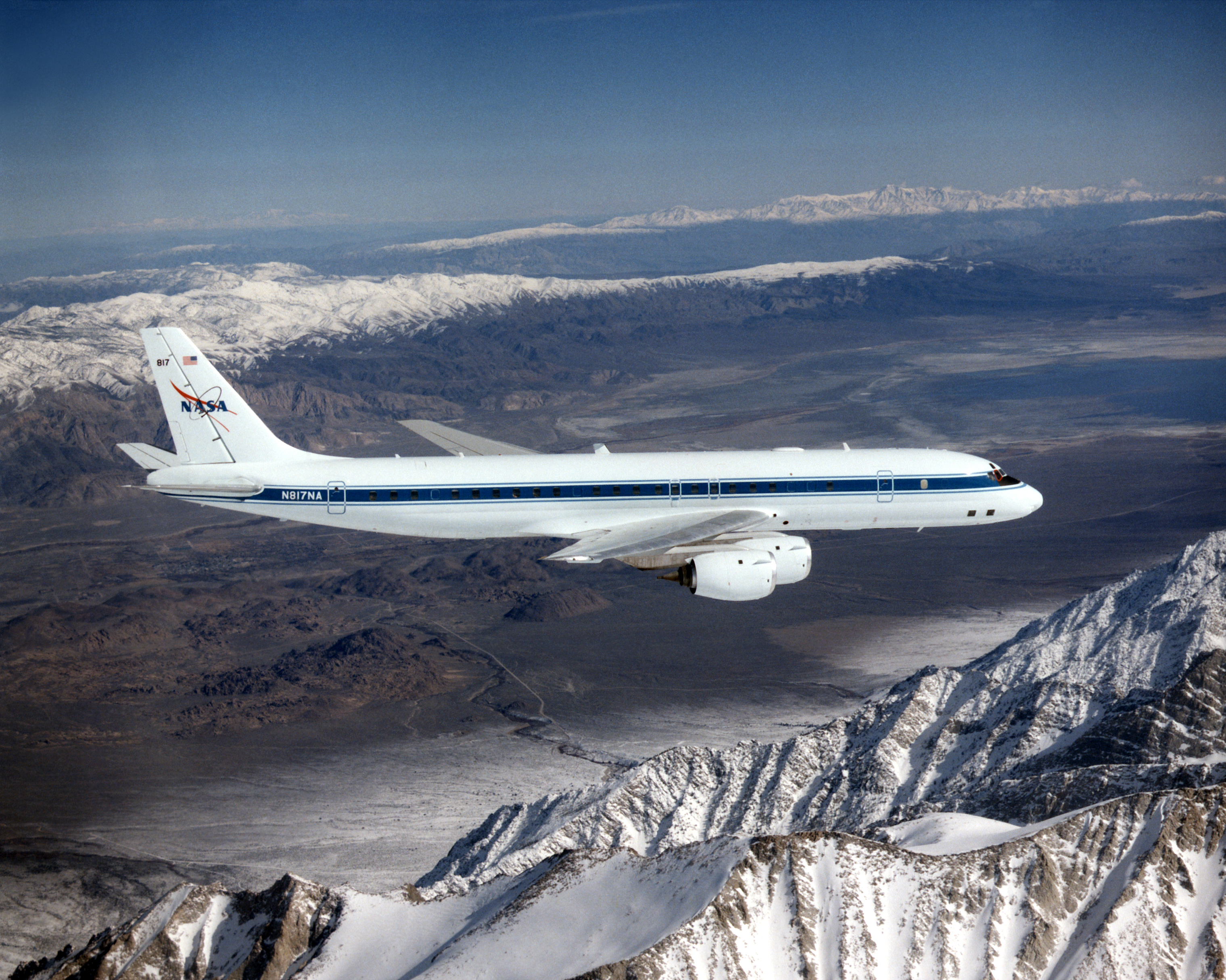
The most distinctive and revolutionary feature of the DC-8 Super 61 was its extended fuselage, a pioneering example of large-scale aeronautical "stretch". Compared to previous models, the fuselage was lengthened by an impressive 11.18 metres in two separate sections, bringing the overall length to an impressive 57.12 metres.
This substantial extension radically transformed the aircraft's capacity, allowing it to accommodate up to 259 passengers in a single-class configuration, an absolutely unprecedented number for a narrow-body jet of the time. Despite the increase in length, Douglas managed to maintain the original wing and tailplane, optimizing development costs and the structural complexity of the project.
Powered by four powerful Pratt & Whitney JT3D turbofan engines, the Super 61 offered not only robust, reliable thrust for fully loaded takeoffs, but also significantly improved fuel efficiency over previous turbojets. This made it cost-effective for operations on busy air routes, a key factor for airlines.
Onboard Specifications
- ◆Extended fuselage (11.18 meters total), with an overall length of 57.12 meters.
- ◆High passenger capacity (up to 259), a revolution for narrow-body jets.
- ◆Pratt & Whitney JT3D turbofan engines, for powerful and efficient propulsion.
Operational Career & Operators
The DC-8 Super 61 was an immediate smash hit among airlines trying to handle the exponential growth in passenger traffic of the 1960s and 1970s. Leading carriers such as United Airlines, Eastern Airlines and Delta Air Lines were among the first and largest operators, using it predominantly on crowded transcontinental and short-medium haul routes in the United States.
Its extraordinary passenger carrying capacity made it the perfect workhorse for high-frequency air links between major hubs, cementing its reputation as the tireless "workhorse" of the air. The Super 61 played a crucial role in the era of democratization of air travel, making flying more accessible to a wider audience thanks to its affordability per passenger seat.
Many examples, after decades of honored passenger service, were expertly converted into cargo versions (DC-8-61F), demonstrating the incredible robustness and intrinsic versatility of its original structure. Even today, a limited number of modified DC-8 Super 61s continue to ply the skies as cargo planes, a stunning testament to their durable engineering and reliability.
Legacy & Cultural Impact
The Douglas DC-8 Super 61 was not only a commercially successful aircraft; he was a true pioneer who profoundly influenced the design of subsequent aircraft. His innovative approach to "fuselage stretching" became a common and strategic practice in the aviation industry, laying the foundation for future aircraft variants and dramatically optimizing operating economics.
This massive jet consolidated the concept of high-capacity aircraft for dense routes, paving the way for the introduction of wide-body aircraft and the unprecedented boom in global mass travel. The Super 61 is remembered as a tangible symbol of the expansion of air travel, an elegant giant that made the world smaller and more accessible for millions of people.
His legacy lives on not only in aviation history books and pilots' memoirs, but also in the lasting impact he had on the entire industry and global culture of travel. A true American aeronautical engineering icon, the DC-8 Super 61 remains an essential milestone in the development of modern commercial aviation, admired for its audacity and longevity.
Telemetria Specs (HUD)
Hangar Trivia & Curiosità
- 💡Con i suoi 57.1 metri di lunghezza, il DC-8 Super 61 fu, per un periodo, l'aereo di linea più lungo del mondo, superato solo anni dopo dall'introduzione del Boeing 747.
- 💡Molti DC-8 della serie Super 60 ebbero una vita operativa eccezionalmente lunga, venendo convertiti in aerei cargo e rimanendo in servizio con diverse compagnie merci ben oltre il 21° secolo.
- 💡Il Super 61 presentava un allungamento della fusoliera di oltre 11 metri rispetto ai modelli precedenti di DC-8, permettendo di ospitare fino a 259 passeggeri in configurazione a classe unica.
Archivio Avvistamenti Spotter
Immagini scattate dalla community in tutto il mondo
Vettori Rilevati (Flotta Attiva)


Martinair
In Flotta: x7 u.

Lufthansa
In Flotta: x3 u.

Air France
In Flotta: x5 u.
Ethiopian Airlines
In Flotta: x13 u.
Air New Zealand
In Flotta: x16 u.

Air Inuit
In Flotta: x5 u.
SATA Air Açores
In Flotta: x7 u.
Luftwaffe
In Flotta: x14 u.
Líneas Aéreas del Estado (LADE)
In Flotta: x4 u.Vettori Rilevati (Flotta Storica / Dismessa)


Southern Airways
Stato: Dismesso
American Airlines
Stato: Dismesso
Ozark Air Lines
Stato: Dismesso

British European Airways
Stato: Dismesso
Provincetown-Boston Airlines
Stato: Dismesso
Piedmont Airlines
Stato: Dismesso
Aigle Azur (1970)
Stato: Dismesso
Olympic Airways
Stato: Dismesso